Introduction
Forensic science and population genetics are increasingly converging on rapid, cost-effective ways to read our paternal lineage. This study introduces a biochip-based method that genotypes 92 Y-chromosome haplogroups using SNP markers, designed with forensic applicability in mind. By profiling 14 core haplogroups and 78 subclades on a hydrogel biochip, researchers can infer biogeographical origins from a single, low-density SNP panel.
Why does this matter? Y-chromosome data capture patrilineal ancestry and migration patterns that shape populations over centuries. The approach provides a practical alternative to predicting haplogroups from Y-STR haplotypes, offering a direct, SNP-based route to paternal lineages that can complement autosomal analyses in both forensic and genealogical contexts. The study focuses on a Slavic population from European Russia, illuminating how migration and regional history carved the current Y-DNA landscape.
Key Discoveries
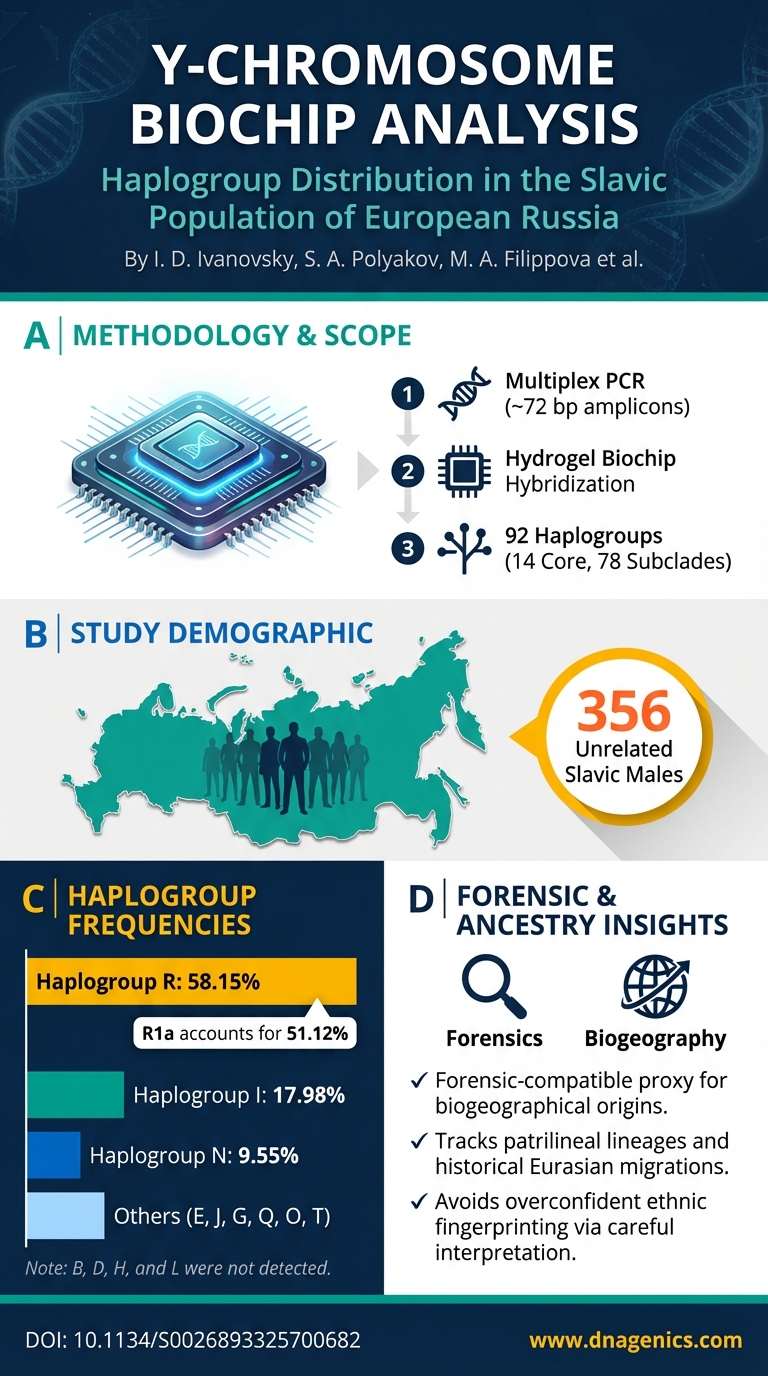
- R haplogroup dominates the dataset (about 58.15%), with R1a comprising roughly 51.12% of individuals, signaling a strong Slavic patrilineal signature in European Russia.
- Other frequent lineages include I (~18%) and N (~9.55%), while smaller representations come from E, J, G, Q, O, and T; notable is the absence of B, D, H, and L in this cohort.
- A small number of individuals (two) carried East/Southeast Asian lineages, such as O-M175, indicating low-level admixture signals beyond core European Russia ancestry.
- The study demonstrates a rapid, forensic-friendly alternative to Y-STR-based predictions via hydrogel biochip genotyping of 92 haplogroups, with an average amplicon length around 72 bp.
- Authors caution that haplogroup frequencies rely on reference data that may be biased by sampling; interpret results as probabilistic biogeographic proxies rather than definitive ethnic fingerprints.
- The authors recommend expanding the haplogroup panel to ~100 subclades per core haplogroup and integrating autosomal data to improve resolution for ancestry inferences.
What This Means for Your DNA
For individuals curious about their paternal origins, this approach shows how targeted SNP panels can illuminate major branches of the Y-DNA tree. The hydrogel biochip method offers a practical option for labs and forensic contexts to determine 92 haplogroups quickly, with short DNA segments making it feasible when DNA quality is limited. While the study focuses on a Slavic population from European Russia, the underlying principle—mapping SNP-defined haplogroups to biogeographical patterns—applies broadly to population genetics and ancestry testing.
However, it’s important to interpret results with nuance. Y-DNA reflects a single paternal lineage and is sensitive to historical events, migration, and sampling biases. When you combine Y-chromosome haplogroup information with autosomal DNA, mtDNA, and historical context, you get a richer, non-deterministic picture of your ancestry rather than a singular label.
Historical and Archaeological Context
The reported Y-DNA patterns align with broader Eurasian population history, where migrations and admixture events shaped paternal lineages across Europe and Central Asia. In European Russia, the dominance of haplogroup R (especially R1a) mirrors known migrations and expansions associated with Slavic-speaking populations and Steppe influences. The presence of I and N lineages reflects regional admixture and historic population movements that contributed to the contemporary Slavic genetic landscape. The virtually absent B, D, H, and L lineages in this cohort may reflect regional sampling, historical demography, and founder effects.
The study situates its findings within a broader timeline of Eurasian interactions, from prehistoric migrations into Europe to later demographic shifts in the medieval and post-medieval eras. The geographic focus on European Russia provides a nuanced view of how local history intersects with continental population dynamics. The inclusion of a small number of East/Southeast Asian haplogroups (e.g., O-M175) underscores the long arc of human mobility that shaped genetic diversity in this region.
The Science Behind the Study
Methodologically, the study employs multiplex PCR followed by hydrogel biochip hybridization to genotype 92 Y-chromosome haplogroups. The panel covers 14 core haplogroups and 78 subclades (for example, B-M60, C-M130 with submarkers like F1906, Z18160, and M407, and R-P224 with multiple subclades). The average amplicon length is approximately 72 bp, enabling analysis from degraded or low-quantity DNA samples—an important consideration for forensic contexts.
Population-wise, the study analyzed 356 unrelated male individuals living in European Russia. Frequencies were derived from direct haplogroup assignments based on the SNP panel, rather than inferring haplogroups from Y-STR genotypes. The authors acknowledge limitations, including sampling bias in public databases and the need to expand haplogroup coverage for finer discrimination. They advocate a two-step improvement: broaden haplogroup coverage toward ~100 subclades per core haplogroup and integrate autosomal data to sharpen ancestry interpretations.
In Simple Terms: The researchers used a tiny, chip-based DNA test to read many paternal markers at once. This lets scientists quickly determine which big paternal lineages a man belongs to, and how common those lineages are in a specific population, even when the DNA is limited or mixed.
Infographic
The study provides an infographic illustrating the distribution of Y-chromosome haplogroups in the Slavic population of European Russia, highlighting the dominance of R and presence of I and N, as well as the absence of several core haplogroups. It also visually communicates the 92-SNP panel design and the concept of forensic biogeography.
Why It Matters
This work advances practical tools for forensic genetics and population history by delivering a SNP-based, nanopanel approach tailored to a specific regional population. It demonstrates how targeted Y-DNA markers can rapidly inform biogeographical origin hypotheses while acknowledging the probabilistic nature of such inferences. The methodology provides a template for expanding, refining, and integrating Y-chromosome data with autosomal and mtDNA analyses across populations to build more robust ancestry models and to support forensics with scientifically grounded interpretation.
Future research could apply this framework to additional regions in Russia and neighboring populations, incorporate ancient DNA data to anchor haplogroup timelines, and explore how autosomal admixture correlates with Y-DNA patterns. Incorporating larger, more diverse reference datasets will also help mitigate sampling biases and improve the predictive value of Y-chromosome haplogroup panels for both research and forensic use.