Introduction
What can ancient genomes tell us about family life under the Roman Empire? A new diachronic genomic study uses a novel probabilistic framework to read Runs of Homozygosity (ROH) in ancient DNA, revealing how mating patterns shifted across Anatolia, the Balkans, and Southern Europe from the Iron Age to the Early Middle Ages. This approach lets us infer close kinship structures from long stretches of homozygosity, providing a high-resolution view of social organization that archaeology alone cannot fully resolve.
Why does this matter for our understanding of history and identity? Kinship networks influence who marries, where people live, and how communities form alliances. By showing regional divergence in mating patterns under Roman rule, the study challenges the idea of a uniform empire dissolving local social structures. It demonstrates how biological kinship can be a social strategy that coexists with empire- wide processes, shaping migrations, mortuary practices, and everyday life.
Set in Southern Europe and the Eastern Mediterranean, the work spans roughly 1200 BCE to 1000 CE, capturing a dynamic arc from late prehistory through late antiquity. The Western Mediterranean displays an exogamic shift during the Imperial period, while the East maintains endogamous, rural kinship networks. Together, these patterns illustrate a pan-Mediterranean trajectory that gradually converges only late in antiquity, a narrative more nuanced than broad Christianization accounts alone would suggest.
Key Discoveries
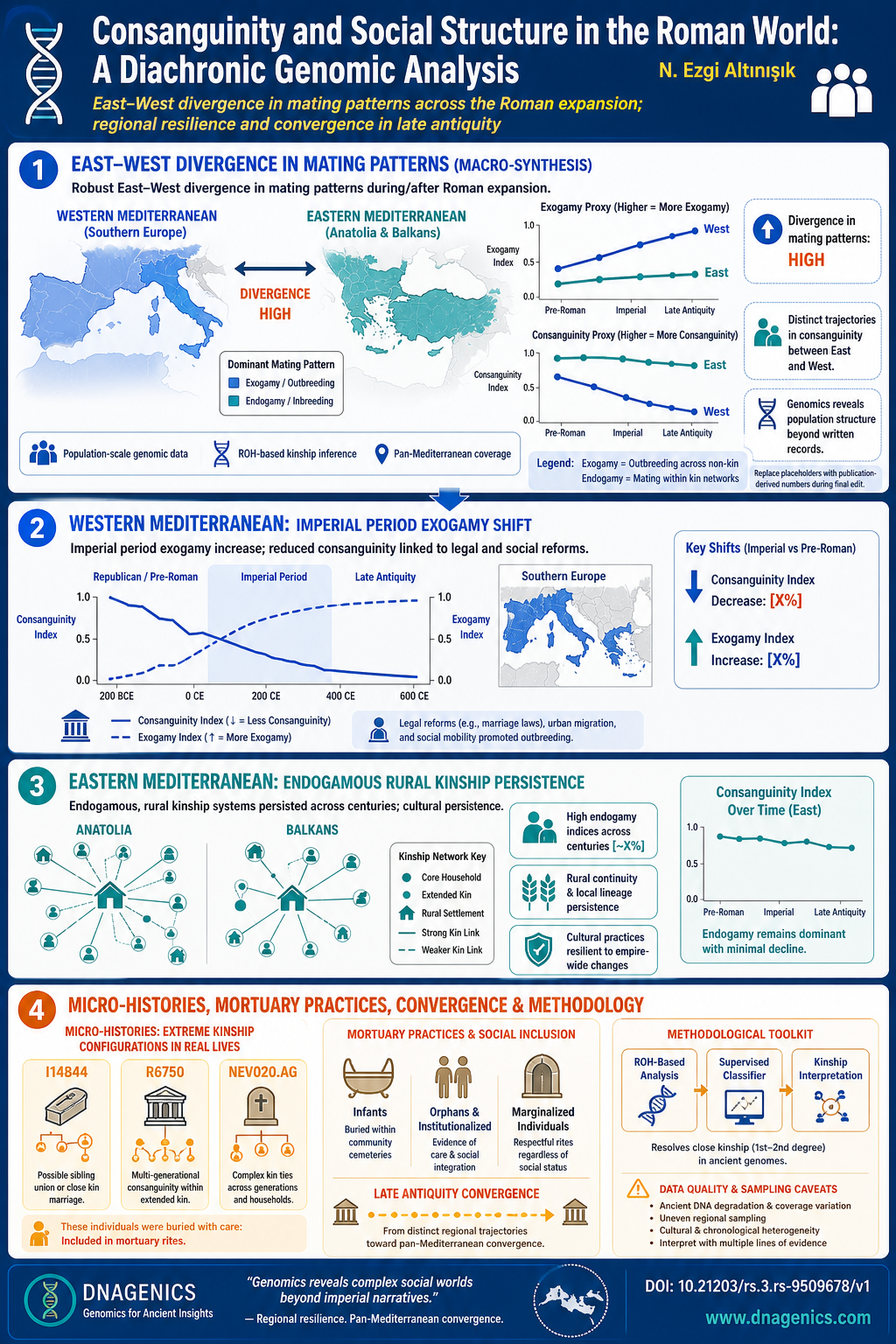
- Exogamic shift in the imperial core: Southern Europe shows a significant reduction in consanguinity (ROH burden) during the Imperial period, suggesting social and legal reforms promoting exogamy.
- Eastern resilience of endogamy: Anatolia and the Balkans maintain endogamous kinship networks anchored in rural settlements, with limited macro-scale shifts across 1200 BCE–1000 CE.
- Long-range ancestry signals in notable individuals: NEV020.AG (S. Anatolia) aligns with East Mediterranean ancestry; I14844 (Nicaea) represents an infant from a first-degree union in a foundling context; R6750 (Viminacium) indicates a first-degree union in a frontier setting.
- Micro-histories reveal social strategy and care: Cases like brephotrophia at Nicaea and deviant mortuary treatment at Viminacium reflect complex social responses to taboo unions within imperial society.
- Late Antiquity convergence and Christian-era implications: The West experiences a rebound in consanguinity, approaching eastern baselines by the end of the studied window, complicating simple narratives of Empire-wide kinship dissolution.
- Methodological innovation with caveats: ROHClassifier and ROH-based analyses enable fine-grained kinship inference from ancient DNA, but results hinge on data quality, sample distribution, and post-mortem DNA limitations.
What This Means for Your DNA
For DNA enthusiasts and genealogists, these findings translate into practical ideas about how kinship and marriage patterns leave detectable traces in the genome. In ancient contexts, long Runs of Homozygosity reflect parental relatedness and social endogamy, while shorter ROH or fewer long blocks can signal broader exogamy or more mixing of lineages. Modern ancestry testing, by contrast, often focuses on shared segments and haplotype blocks to infer recent and ancient connections; the logic—how mating networks shape genetic patterns over generations—remains the same, even as data quality and context differ.
Practically, if you explore ROH in your own DNA data, you are observing a microcosm of how families form and intermarry over generations. The Roman era case studies remind us that geography, culture, and law can produce very different kinship signals within a relatively small geographic area. Remember that ancient results depend on preservation, sampling, and analytical methods; modern interpretations must consider these caveats when translating ROH findings into family stories.
Historical and Archaeological Context
The study situates kinship dynamics within a broad sweep of history, from the Iron Age through the Early Middle Ages, across Anatolia, the Balkans, and Southern Europe. It highlights a robust East–West divergence in how populations organized mating networks under Roman expansion. In the Western Mediterranean, the Imperial period coincides with a notable exogamic shift, aligning with social and legal reforms that broaden marriage networks. By contrast, the Eastern provinces exhibit deep-seated, rural-based endogamy that persists across centuries, suggesting social structures resilient to imperial homogenization.
Key archaeological anchors include Nevalı Çori in Anatolia, a rural homestead that signals firmly rooted local kinship networks, and urban and frontier sites such as Nicaea and Viminacium, where mortuary practices illuminate how communities governed taboo unions and included marginalized individuals within Roman rites. The temporal arc reveals a late antiquity trend toward convergence across the basin, yet not a uniform, empire-wide dissolution of kinship networks. This nuanced picture reframes how we understand Roman social life, migration, and community resilience.
The Science Behind the Study
The analysis combines ROH-based methods with a supervised classifier, delivering a high-resolution reconstruction of parental kinship degrees from ancient genomes. The dataset spans multiple sites in Southern Europe and the Eastern Mediterranean, enabling diachronic comparisons of consanguinity and mating patterns. The probabilistic ROHClassifier interprets ROH length distributions to assign kinship categories, from close-relatives to more distant connections, while accounting for data quality and coverage limitations typical of ancient DNA.
The study emphasizes both strengths and caveats. Strengths include the ability to resolve close kinship in ancient genomes and to reveal regional patterns that align with historical and archaeological evidence. Limitations arise from uneven site sampling, potential post-mortem DNA damage, and variable sequencing depth, all of which can influence ROH detection and classification accuracy. Overall, the approach provides a powerful toolkit for decoding social structure from DNA, with careful interpretation required when extrapolating to broader social narratives.
In Simple Terms: Runs of Homozygosity are long stretches in a genome where the two copies you inherited from your parents are the same. Long ROH usually mean close parental relatedness or endogamy in a population. Shorter ROH reflect more genetic mixing. ROHClassifier uses the lengths and patterns of these blocks to guess how closely related the parents were in ancient individuals, helping to map kinship networks across time and space.
Infographic
(https://dgwebcontent.blob.core.windows.net/publication-infographics/pub_v1_F77zIGUuEqbl-36284789_20260507-130009.png)
The infographic visualizes the regional trajectories of kinship patterns, contrasting exogamy in the Western Roman Empire with endogamy in the Eastern provinces, and highlighting micro-histories at Nevalı Çori, Nicaea, and Viminacium. It also notes the emergence of a late antiquity convergence across the Mediterranean basin.
Why It Matters
These findings deepen our understanding of how social structure and kinship patterns persisted or shifted under large-scale political entities. They show that the Roman Empire did not homogenize all communities in the same way; instead, diverse regional strategies buffered intimate family life against empire-wide forces for centuries. This has implications for how we interpret migration, marriage practices, and social safety nets in ancient societies, and it opens new avenues for applying ROH-based analyses to other ancient populations.
Future research could extend this framework to additional regions, integrate more granular archaeological contexts, and refine the classifier with higher-coverage ancient genomes. Such work will continue to illuminate how DNA preserves the social choices that shaped communities across the ancient world.
References
Consanguinity and Social Structure in the Roman World: A Diachronic Genomic Analysis