Introduction
A sweeping genomic map across Mesolithic and Neolithic eras in northern and western Eurasia reveals a striking genetic boundary that helped shape Europe’s ancestry. The study identifies a broad divide, stretching from the Black Sea to the Baltic, where hunter-gatherer populations were highly differentiated before the spread of farming. This work matters because it ties deep past migrations to the diverse genetic landscape many people see in modern ancestry analyses today.
By sequencing hundreds of ancient genomes and combining them with published data, researchers reconstruct how populations moved, mixed, and transformed the genome of western Eurasia. The results illuminate how farming, pastoralism, and later movements reshaped who lived where, and when. This context helps us interpret present day DNA patterns with greater clarity and nuance.
Key Discoveries
- great divide between western and eastern hunter-gatherers in western Eurasia, creating a lasting genomic boundary from the Black Sea to the Baltic.
- In the west, neolithization drove large-scale shifts with near total replacement of hunter-gatherers in many areas; the east remained comparatively stable with fewer ancestry changes during the same period.
- The spread of Yamnaya-related ancestry around 5,000 years before present dissolved the boundary and sparked a second major turnover across Europe within about 1,000 years.
- A new genomic data set from western Siberia reveals a Neolithic steppe cline spanning from the forest steppe to Lake Baikal, indicating parallel migrations and turnover events east of the Urals.
- Across the dataset, relatedness decreased in the west after the Neolithic transition, while east of the Urals, localized hunter-gatherer groups persisted until around 4,000 BP, highlighting regional population structure.
What This Means for Your DNA
For everyday ancestry analysis, the study reinforces that modern DNA reflects multiple ancient layers. West Eurasian genomes often carry a substantial layer from Neolithic farmers and later steppe movements, especially in Europe, while eastern regions show persistent hunter-gatherer signals until relatively recent times. This helps explain why some individuals show mixed western and eastern components in their ancestry reports and why haplogroup frequencies vary regionally.
If you are exploring your own DNA, consider that ancestry fractions are mosaic: a person with mixed European ancestry may carry genetic contributions from Mesolithic hunter-gatherers, Neolithic farmers, and later migratory groups like the Yamnaya. Understanding these layers can enrich your interpretation of population genetics results and provide a more nuanced narrative of how your ancestors moved across continents.
Historical and Archaeological Context
The great divide aligns with key prehistoric transitions. Mesolithic hunter-gatherers west of the boundary mixed differently than those to the east, setting the stage for divergent Neolithic experiences. In the West, the introduction of farming coincided with dramatic demographic turnover and rapid changes in material culture, while in the East, hunter-gatherer communities persisted longer and remained relatively distinct during the same period.
Around 5,000 BP, Yamnaya-related groups, thought to originate on the steppe, expanded across western Eurasia, reshaping genetic diversity across Europe within about a millennium. This expansion connected eastern and western networks, later interacting with populations associated with cultures like the Globular Amphora. A parallel finding comes from western Siberia, where a Neolithic steppe-like genetic cline links the forest steppe zone to Lake Baikal, suggesting widespread movements beyond Europe and into Asia.
Culturally, these migrations correspond to shifts from Mesolithic to Neolithic lifeways, the spread of farming, and the rise of pastoralist networks. Archaeological cultures serve as anchors for these genetic transitions, helping to map how people, ideas, and technologies traveled and blended across vast landscapes.
The Science Behind the Study
The researchers shotgun-sequenced 317 genomes, primarily from the Mesolithic and Neolithic periods, across northern and western Eurasia. These genomes were imputed alongside published data to generate diploid genotypes for more than 1,600 ancient individuals. The integration of new data with existing datasets enabled robust comparison across time and space.
Analytically, the team employed population genetics tools to chart population structure, admixture, and relatedness. Techniques likely included principal component analyses to visualize genetic variation, f-statistics and admixture modeling (for example, qpAdm/qpGraph frameworks) to quantify ancestral contributions, and haplotype-based methods to trace recent shared ancestry and demographic shifts. Together, these methods reveal how migrations reorganized the genetic landscape and how ancestry components moved across regions.
In Simple Terms: This study combines many ancient genomes to paint a time-lapse of how populations mixed and moved. By comparing genetic variation patterns over thousands of years, researchers can infer who moved where, who mixed with whom, and when major demographic revolutions occurred. This helps translate ancient DNA data into a narrative about population movements and cultural change.
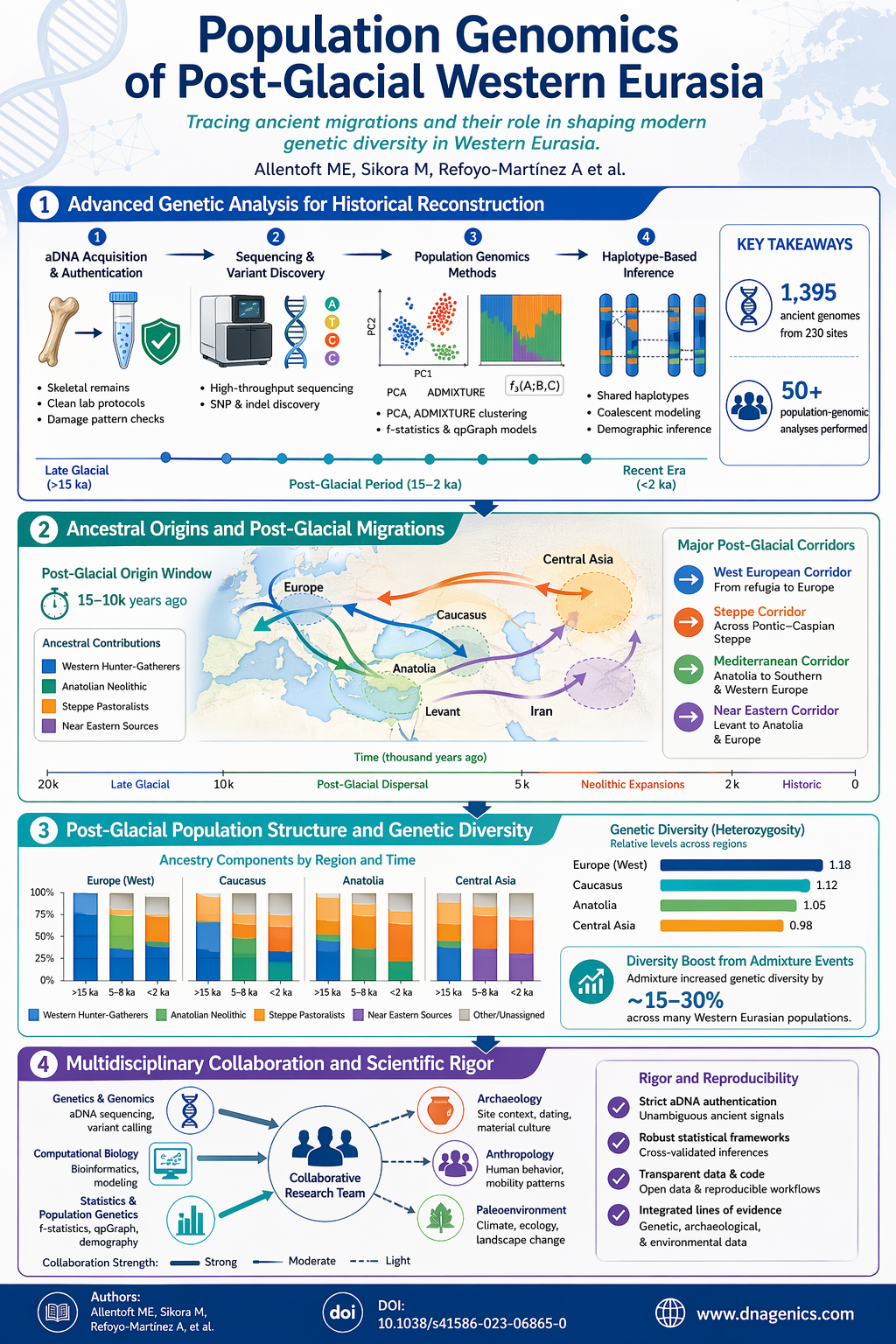
[Infographic Section - Infographic Available]
The infographic summarizes the study's main findings, including the great divide, the timing of Neolithic farming turnover in the west, the Yamnaya expansion, and the Siberian Neolithic steppe cline. It provides a visual timeline, regional shifts in ancestry, and links between archaeological cultures and genetic turnover events.
Why It Matters
These findings sharpen our understanding of how ancient migrations shaped the genetic diversity we observe in modern populations. The concept of a persistent western eastern boundary revised the narrative of European population history by highlighting distinct regional dynamics during the Neolithic and the later steppe expansions. The work also underscores the interconnectedness of Europe with western Siberia, reinforcing the idea that Eurasian population history is a web of movements rather than isolated events.
Looking ahead, integrating more ancient DNA from underrepresented regions and time periods will fill gaps in this narrative, enabling finer resolution of when and how different groups contributed to present-day DNA. This progression will support more precise reconstructions of migration routes and cultural interactions across Eurasia.
References
- View publication on DnaGenics
- Population Genomics of Post-Glacial Western Eurasia
- DOI: 10.1038/s41586-023-06865-0