Introduction
Imagine tracing your maternal line back across thousands of years to a time when Europe was a patchwork of hunter gatherer and early farming communities. A substantial prehistoric European ancestry among Ashkenazi maternal lineages reveals that the majority of Ashkenazi mtDNA comes from European sources, not the Near East or Caucasus as once thought. This finding reshapes how we understand the mother line of Ashkenazi communities and highlights the power of mitochondrial DNA to illuminate deep ancestry.
This research matters because mtDNA is inherited solely along the maternal line, making it a precise lens for genealogical history. By sequencing complete mitogenomes rather than relying on control region data alone, scientists can identify four major founder lineages and place them in a European context. The results align with broader genome studies that show strong European affinities for Ashkenazi populations while pointing to a more nuanced story of conversion and assimilation in Europe.
Set in a broader context, the study complements autosomal analyses and adds a key piece to the complex puzzle of Ashkenazi origins. It underscores how population history can be shaped by subtle, sex biased processes and how uniparental markers, when integrated with autosomal data, can yield a richer narrative of genealogical history.
Key Discoveries
European maternal ancestry dominates Ashkenazi mtDNA (~80%), with Near Eastern input ~8% and Asia ~1%; ~10% unassigned.
The four major Ashkenazi mtDNA founders belong to haplogroups K and N1b: K1a1b1a, K1a9, K2a2a1, N1b2.
K1a1b1a accounts for ~63% of Ashkenazi K lineages; K1a9 ~20%; K2a2a1 ~16%; N1b2 ~9%; all show deep European ancestry or European centered nesting.
Near Eastern mtDNA signals exist but are scattered and largely confined to a minority of lineages; North Caucasus input is not supported as a major maternal source.
Most minor Ashkenazi mtDNA lineages (H, J, T, HV0, U4/U5, I, W, M1) are predominantly European, reinforcing the European recruitment model.
The findings are consistent with autosomal studies that indicate a significant European component in Ashkenazi ancestry, while Y-chromosome data show complementary paternal signals, suggesting sex biased admixture.
The study highlights the importance of full mitogenome sequencing for genealogical reconstruction and cautions against overreliance on control region data alone.
What This Means for Your DNA
For anyone exploring an Ashkenazi or European maternal line, these results suggest that widespread European roots lie at the heart of the Ashkenazi mtDNA pool. If your maternal haplogroup aligns with the major founders or other European mtDNA lineages, your direct maternal ancestry may reflect deep European origins that were incorporated during the formation and expansion of Ashkenazi communities in Europe. In contrast, more modest Near Eastern inputs likely reflect later admixture or deeper shared ancestry that travels through multiple population layers.
These findings also underscore a practical point for DNA enthusiasts: complete mitogenome sequencing provides clearer, deeper insights than relying on control region data alone. For a fuller picture of your maternal lineage, ensure your mtDNA analysis uses full mitogenome data and reference sequences from diverse regional pools. Combine this with autosomal and Y chromosome data to capture the full tapestry of ancestry and to explore potential sex biased migration patterns in historical contexts.
Historical and Archaeological Context
The study aligns with a growing view that Ashkenazi maternal ancestry was shaped within Europe rather than predominantly imported from the Levant or the Caucasus. The presence of four major European founder lineages in K and N1b haplogroups suggests that local European women played a substantial role in forming early Ashkenazi communities, potentially through conversion or assimilation as communities formed and expanded across continental Europe.
This European recruitment would fit migration and settlement patterns observed in the archaeological record, where movement of people and cultural exchange in Europe created opportunities for lineage turnover and admixture. The timing implied by the deep European roots of these founders points to prehistoric periods, with later historical events likely reflecting ongoing gene flow and demographic shifts that shaped the modern Ashkenazi mtDNA landscape.
The Science Behind the Study
The work combines complete mitochondrial genome sequencing with robust phylogenetic analyses to trace the geographic origins of Ashkenazi maternal lineages. By analyzing a comprehensive set of Ashkenazi mtDNA samples and comparing them against global reference sequences, the authors mapped founder lineages to deep European roots. The approach relies on haplogroup assignment, phylogenetic trees, and coalescent dating to estimate when lineages diverged and diversified.
The study emphasizes the strength of full mitogenome data, which enables precise placement of lineages such as K1a1b1a, K1a9, K2a2a1, and N1b2 within the European context, and argues that relying on control region data alone can misplace origins. Sample sizes were sufficient to support robust inferences about founder lineages and their geographic origins, while analyses accounted for potential sampling biases and population structure. Overall, the research demonstrates how mitochondrial data, when integrated with autosomal and Y chromosome information, advances our understanding of Ashkenazi population history.
In Simple Terms: Mitochondrial DNA is inherited from mothers, so it traces maternal lines. Reading the entire mitochondrial genome, not just a small region, gives a much clearer picture of where those maternal lines came from and when they formed. The four major founder lineages in Ashkenazi mtDNA are mainly European, which means many Ashkenazi maternal lines originated in Europe long before modern times.
Infographic Section - Infographic Available
To visualize these findings, see the infographic below that maps the European roots of Ashkenazi maternal lineages and the relative contributions from different regions.
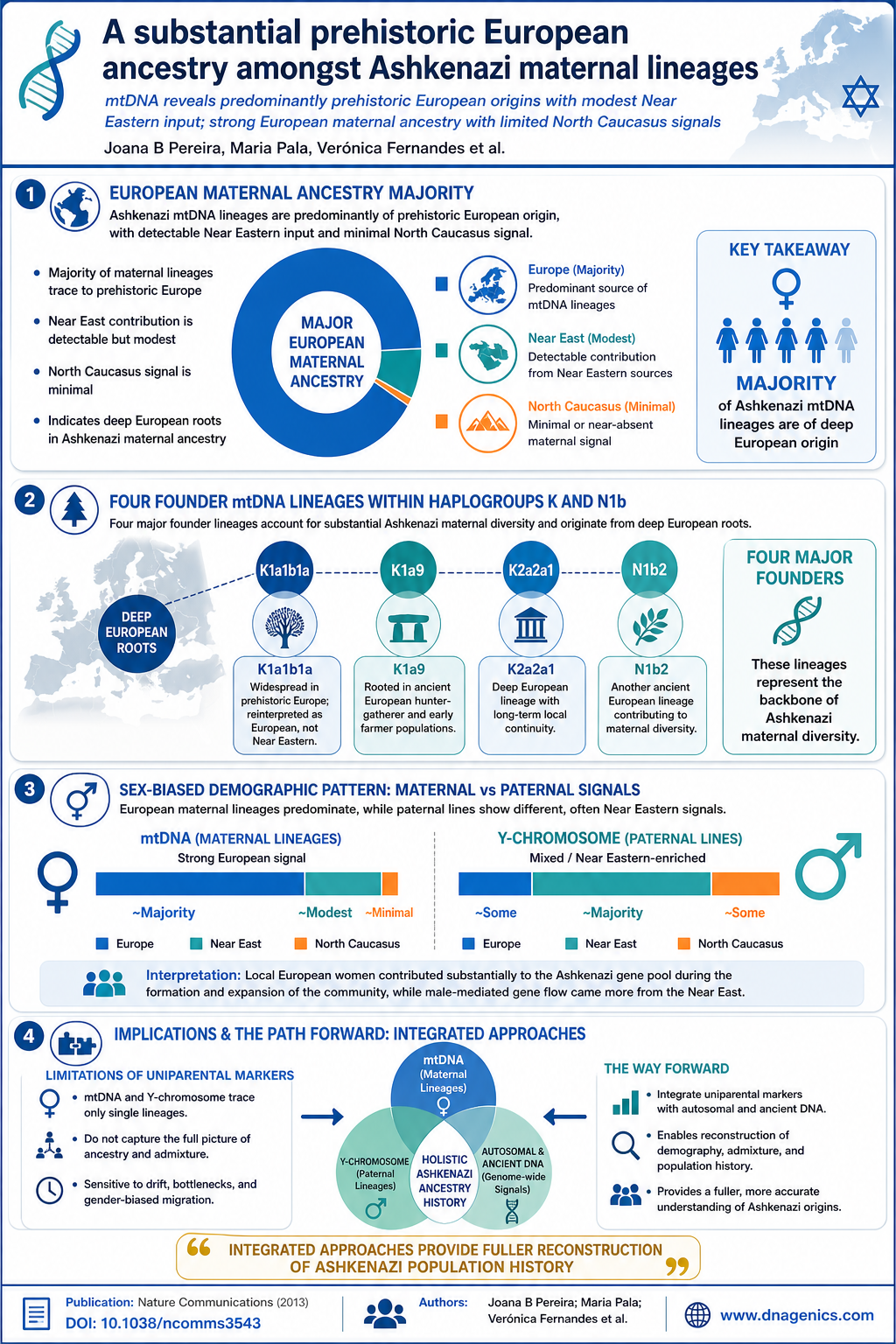
The infographic illustrates how the four major founders in haplogroups K and N1b trace back to Europe, with smaller inputs from the Near East and other regions. It also highlights the predominance of European lineages among minor Ashkenazi mtDNA haplogroups.
Why It Matters
This research provides a refined narrative of Ashkenazi maternal ancestry, highlighting a substantial European contribution and a nuanced role for Near Eastern inputs. It supports a model in which European women contributed to the formation of Ashkenazi communities during their expansion in Europe and underscores the value of integrating uniparental markers with autosomal data for a fuller reconstruction of population history. Future work combining autosomal, Y chromosome, ancient DNA, and broader reference panels will further illuminate the timing and routes of these complex migrations and admixture events.