Introduction
Imagine tracing how people moved across central Europe thousands of years ago and how their DNA mixed to shape modern ancestry. The study A genomic Neolithic time transect of hunter-farmer admixture in central Poland analyzes genome-wide data from 17 individuals spanning the Middle Neolithic to the Early Bronze Age (4300–1900 BCE) in the Kuyavia region of north-central Poland. This time transect lets researchers test how Neolithic farmers and local hunter-gatherers interacted as farming spread into northern Europe, and how later migrations from the steppe may have reshaped local populations.
Why this research matters extends beyond a single region. It shows that the Neolithic transition was not a single, uniform replacement but a mosaic of admixture events with regional variation. In Kuyavia, recurring hunter-gatherer input persisted over three millennia, while farming ancestry expanded, and steppe signals appeared only sporadically. These findings add a crucial regional piece to the broader European prehistory puzzle and illuminate how population dynamics contributed to the genetic landscape that persists in Europe today.
Key Discoveries
- Recurrent hunter-farmer admixture over roughly 3,000 years in Kuyavia, with hunter-gatherer ancestry resurging by the end of the Middle Neolithic.
- Outlier HG persistence (N22, N42) demonstrates local hunter-gatherer enclaves coexisting with Danubian farmers and highlights Mesolithic maternal lineages within Neolithic contexts.
- Steppe ancestry limited and regionally variable; Corded Ware shows some hunter-gatherer and steppe signals, whereas Globular Amphora Complex samples often lack steppe input, suggesting regional heterogeneity in migration and admixture.
- Ancestry models (qpAdm/F4) reveal a gradual increase in Western Hunter-Gatherer (WHG) ancestry toward the GAC and later introduction of Eastern Hunter-Gatherer (EHG)-related signals with the Corded Ware Complex, indicating multiple migration streams rather than a single replacement event.
- Uniparental markers align with broader European patterns, with early mitochondrial DNA haplogroups common to Neolithic farmers and later Y-chromosome haplogroups reflecting turnover and migrations into the Bronze Age.
What This Means for Your DNA
For anyone tracing ancestry, the Kuyavia results underscore how regional histories can complicate a straightforward farmer replaces hunter-gatherer narrative. You might expect to see signals of mixed ancestry in regions where farming bands interacted repeatedly with local hunter-gatherers, with admixture varying across time and place. The study also highlights that late Neolithic transitions can feature limited steppe input, meaning some populations retain stronger ties to earlier hunter-gatherer lineages even as farming expands.
When interpreting your own DNA results, consider how regional timelines and migration routes could shape the balance of hunter-gatherer and farmer ancestry. Modern populations often reflect multiple waves of migration and admixture, and haplogroup distributions (mitochondrial and Y-chromosome) can reveal layers of ancestry corresponding to distinct cultural horizons as seen in Kuyavia.
Historical and Archaeological Context
The Kuyavia study situates its samples in a rich archaeological landscape of central Europe during a pivotal period. The Early Neolithic presence aligns with Danubian farming networks spreading north into Poland, while the Middle Neolithic and Late Neolithic phases reflect interactions with local hunter-gatherers and, later, incursions associated with steppe-derived groups.
The region shows regional variation: early farmers cluster with Central European farmers, yet persistent hunter-gatherer lineages survive in certain individuals, underscoring pockets of HG refugia. The appearance of steppe ancestry is detectable in a subset of Corded Ware contexts but is largely absent in earlier GAC-derived samples from Kuyavia, indicating localized and staggered migration events rather than a uniform pan-European shift. This paints a nuanced demographic portrait for Kuyavia within the broader timeline from the Neolithic through the Early Bronze Age.
Historically, these patterns intersect with the spread of farming culture from Anatolia and the Near East, the subsequent Danubian expansions, and later steppe-associated movements that reshaped European populations. The timeline (ca 4300–1900 BCE) spans Middle Neolithic through Early Bronze Age, offering a window into how population structure evolved in a central European hub.
The Science Behind the Study
The researchers generated genome-wide data from 17 individuals, creating a genomic time transect across Kuyavia from the Middle Neolithic to the Early Bronze Age (4300–1900 BCE). They employed population genetics tools such as qpAdm and f4 statistics to model ancestry proportions, teasing apart contributions from hunter-gatherer lineages (WHG and EHG-related signals) and farmer ancestries associated with Near Eastern and Central European farmer sources. The combination of autosomal genome-wide data with mitochondrial and Y-chromosome haplogroup data allowed a multilayered view of demographic change and kinship lineages across time.
Methodologically, the study interprets admixture dynamics by comparing Middle Neolithic outlier hunter-gatherer individuals with Danubian farmer contexts, tracking the rise of WHG ancestry toward later periods, and identifying the limited but detectable steppe input in Corded Ware contexts. Sample size is modest (n = 17), but the time transect provides a valuable, region-specific view that complements larger European datasets. In Simple Terms: researchers analyze the genetic makeup of ancient people to estimate how much ancestry came from local hunter-gatherers versus incoming farmers, and how these proportions changed across time. The results reveal that population mixing happened repeatedly and in waves, not as a single event.
In Simple Terms: Ancient DNA lets us peek into how people from different backgrounds mixed over thousands of years. By comparing genetic components from hunter-gatherers and farmers, scientists can map when and where mixing occurred, and how later migrations added new genetic flavors to the local gene pool.
Infographic Section
Infographic: Neolithic Kuyavia population dynamics (4300-1900 BCE)
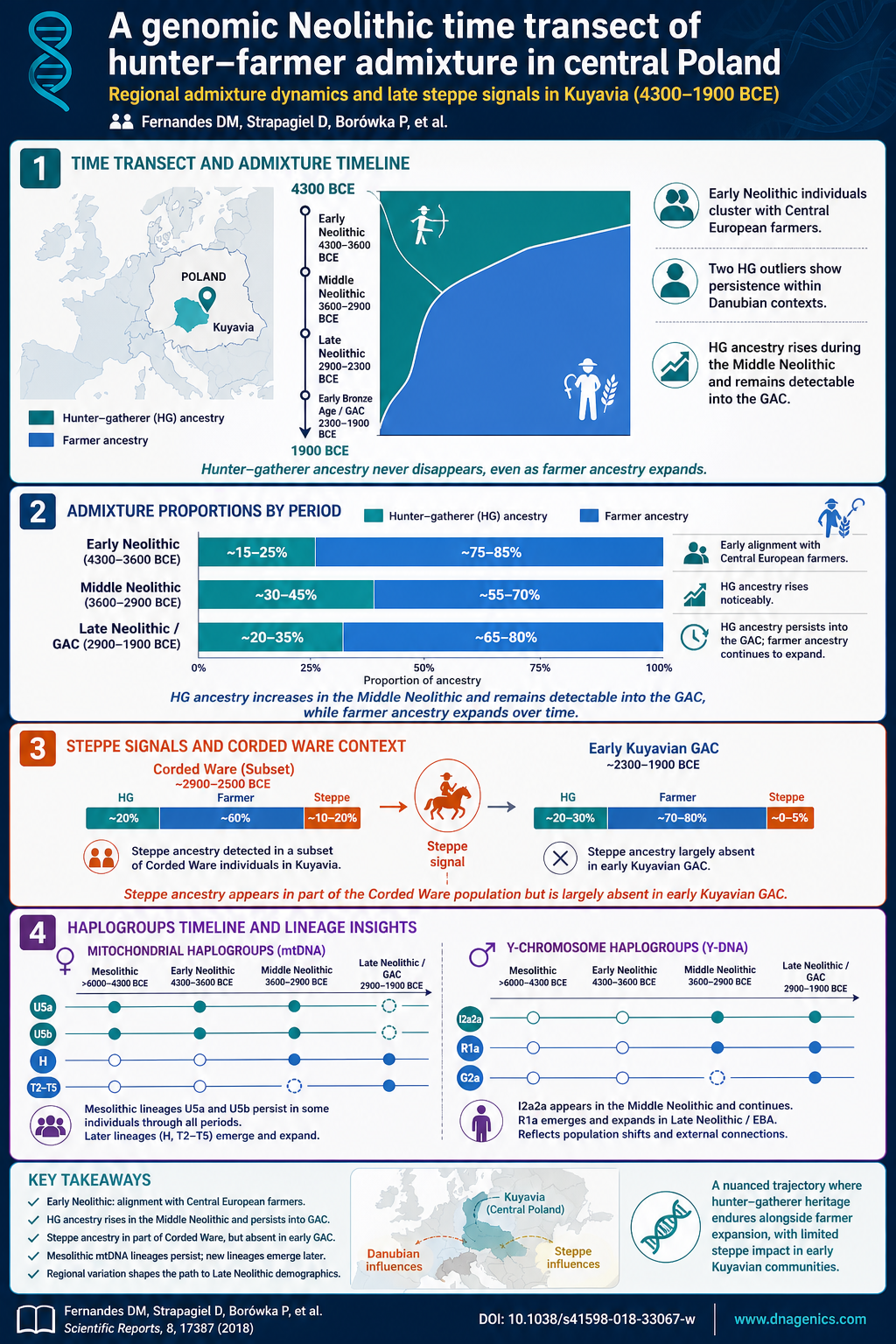
The infographic visually summarizes the Kuyavia time transect, illustrating the relative contributions of hunter-gatherer and farmer ancestry across time, the timing of steppe signals, and the appearance of different haplogroups. It helps readers quickly grasp how regional admixture varied from the Middle Neolithic through the Early Bronze Age and how a mosaic of population interactions emerged in north-central Poland.
Why It Matters
This study adds a crucial regional dimension to our understanding of Neolithic population dynamics in Europe. It demonstrates that the transition to farming involved repeated admixture with local hunter-gatherers, rather than a single uniform replacement, and that steppe-related migrations were regionally variable and often secondary to local interactions. By clarifying the Kuyavia case, researchers can better model the continuum of population processes that shaped European ancestry and refine demographic models for central Europe. Future research with larger sample sizes and broader geographic coverage will help determine how representative Kuyavia is of other northern core regions and how these regional mosaics contributed to the genetic diversity observed in modern European populations.
References
- View publication on DnaGenics
- A genomic Neolithic time transect of hunter-farmer admixture in central Poland
- DOI: 10.1038/s41598-018-33067-w