Introduction
Ashkenazi Jews form a distinctive Jewish diaspora with a deep and complex genetic history. They coalesced in the medieval Holy Roman Empire and built vibrant communities across Europe, later expanding to the Americas and Israel. Modern DNA research reveals a nuanced story: a strong signal from the Levant or Near East in paternal lines, combined with substantial European input in maternal lines, shaped by bottlenecks, migrations, and cultural exchange.
Understanding this genetic tapestry matters for anyone exploring ancestry, population history, or the broader patterns of human migration. It helps explain why Ashkenazi DNA often shows both Middle Eastern and European elements, and it sheds light on how historical events left their mark on current genetic variation. By placing genetics in a historical and cultural context, we gain a clearer view of how ancestry tests translate into personal stories while respecting the diversity within the Ashkenazi community.
Key Discoveries / Main Points
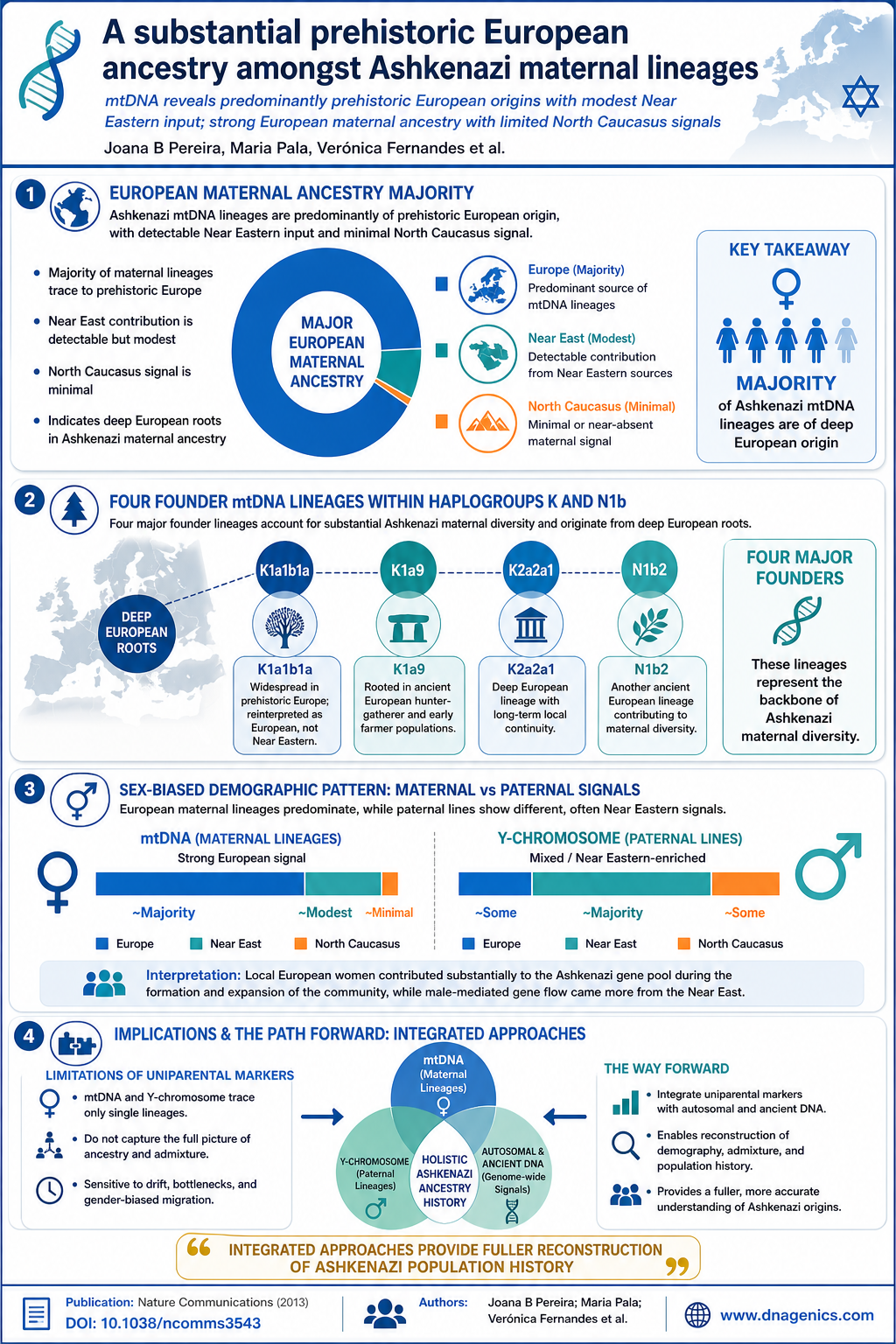
- Ashkenazi Jews exhibit a mixed ancestry that centers in the Levant with substantial European input. Paternal lineages tend to trace to the Middle East, while maternal lineages show strong European roots, reflecting complex migration and adoption patterns.
- Genetic bottlenecks and founder effects helped shape Ashkenazi diversity. A relatively small founding population, followed by rapid expansion, contributed to a homogenized genetic signal compared with other Jewish groups and with broad European populations.
- Y-DNA and mtDNA analyses reveal complementary stories. Paternal lineages (Y-DNA) point to Near Eastern origins, whereas maternal lineages (mtDNA) include several European founder lineages, with a significant portion possibly arising from women indigenous to Europe.
- European admixture varies by lineage and region. While some studies emphasize heavy Levantine influence on paternal ancestry, others highlight notable European contributions to maternal lineages, and overall Ashkenazi DNA tends to be less diverse than other Jewish populations due to historical population dynamics.
- Migration and cultural shifts have left lasting imprints. The late medieval eastward shift into areas that became the Polish–Lithuanian Commonwealth, followed by modern migrations and the Holocaust, dramatically reshaped Ashkenazi demography and language, most famously the development and use of Yiddish as a diasporic language and the later revival of Hebrew.
What This Means for Your DNA
If your ancestry includes Ashkenazi heritage, your genetic profile will often reflect a mosaic of lineages. Autosomal DNA typically blends signals from both the Near East and Europe, illustrating centuries of intermarriage, conversion, and population movement. The paternal lineage (Y-DNA) of many Ashkenazi men traces back to the Middle East, while the maternal lineage (mtDNA) can reveal European founder lineages that took root in Europe during early centuries CE.
For DNA enthusiasts, this means interpreting test results with an appreciation for founder effects and population structure. A typical Ashkenazi autosomal profile may show a composite of Levantine and European ancestry, with regional variation reflecting ancestry proportions in different individuals or families. Understanding the contrast between Y-DNA and mtDNA can illuminate how generations of men and women contributed to the genetic landscape, underscoring why genealogical narratives often intertwine local European ancestries with Middle Eastern roots.
Historical and Archaeological Context
The Ashkenazi story intersects with broad currents of European and Near Eastern history. The community is traditionally traced to rabbinical settlements along the Rhine in western Germany and northern France during the Middle Ages, where religious life and culture formed in cities such as Mainz, Worms, and Troyes. As persecution intensified in the late medieval period, many Ashkenazim migrated eastward into what later became the Polish–Lithuanian Commonwealth, shaping settlement patterns across present-day Belarus, Latvia, Lithuania, Moldova, Poland, Russia, Slovakia, and Ukraine.
This geographic shift coincided with significant cultural and intellectual ferment. The Haskalah movement, emancipation struggles, and urban intellectual life in German lands influenced a gradual reorientation toward German language and culture in some communities, even as Yiddish language and Ashkenazi liturgical traditions persisted and evolved. The diaspora's expansion into Eastern Europe and beyond created a rich tapestry of regional subpopulations, each with its own historical experiences, that genetic studies seek to illuminate.
Archaeological and historical records, alongside genetic data, point to a dynamic process of contact, conversion, and migration. The paternal traces to the Near East and the maternal traces to European populations reflect a pattern seen in many diaspora communities: a core set of founders, followed by complex mixing with local populations and subsequent demographic events that left lasting genetic signatures.
The Science Behind It
Genetic research into Ashkenazi origins relies on three main types of DNA testing: autosomal DNA (atDNA), which captures the genome-wide mix from all ancestors; Y-chromosome DNA (Y-DNA), which traces direct paternal lineages; and mitochondrial DNA (mtDNA), which traces direct maternal lineages. Researchers also use genome-wide association studies to glean broader patterns of ancestry and population structure.
Early studies focused on Y-DNA and mtDNA because these segments do not recombine, allowing clean tracing of direct paternal and maternal lineages over many generations. Across these analyses, a common theme emerged: Ashkenazi Jews show a Middle Eastern origin for many paternal lines, with varying levels of European admixture in other portions of the genome. For maternal lineages, several studies have highlighted substantial European contributions, with multiple founder lineages suggesting European roots in the maternal pool. These findings together support a model in which Ashkenazi Jewry arose from ancient Levantine populations that expanded into Europe, later undergoing bottlenecks and admixture that shaped current genetic diversity.
In Simple Terms: Ashkenazi DNA looks like a family tree with two main branches from long ago ancestors in the Middle East. One branch (the fathers) stayed closer to that origin, while the other branch (the mothers) shows strong European roots. A bottleneck means a small number of founders left a lasting mark on the genetic picture your DNA carries today.
Different studies have refined the details of these patterns. Some analyses estimate only modest European Y chromosome admixture and a stronger Near Eastern signal on the male side, while others report notable European input in maternal lineages and in autosomal DNA. Overall, Ashkenazi Jews are less genetically diverse than many other Jewish groups, a consequence often attributed to demographic bottlenecks and rapid population growth followed by geographic isolation and founder effects. The presence of shared Near Eastern ancestry across lineages, alongside European contributions, aligns with historical narratives of staged migrations, conversions, and community formation in Europe before and after the medieval period.
Why It Matters
The genetic portrait of Ashkenazi Jews is more than a curiosity about who their ancestors were. It informs our understanding of population genetics, human migration, and the processes that shape genetic diversity in diasporic communities. For anyone analyzing ancestry DNA, the Ashkenazi case illustrates how different genomic compartments (autosomal, paternal, and maternal lineages) can tell complementary stories about origin, migration, and admixture. It also highlights how historical events such as the Roman and medieval European periods, migrations eastward, and community formation can leave measurable signatures in our genomes.
This work has practical implications for interpreting test results, planning more targeted genealogical research, and recognizing the limitations and uncertainties inherent in inferring ancient population history from modern DNA. It also emphasizes the importance of considering population structure when drawing inferences about disease genetics, trait distribution, and demographic history within Ashkenazi communities and beyond.
References / Further Reading
- Behar DM, et al. (mtDNA founder lineages in Ashkenazi Jews) and related discussions on maternal ancestry.
- Hammer MF, et al. (Y-DNA paternal origins in Ashkenazi and Sephardic Jews) and Near Eastern signals.
- Nebel A, et al. (paternal and maternal ancestry in Jewish populations and European admixture).
- Behar et al. (comprehensive analyses of Ashkenazi mtDNA using high-resolution data).
- Behar, Skorecki, and others on founder lineages and European contributions to maternal ancestry.
- Atzmon G, et al. Longevity Genes Project findings on Levantine-related ancestry in Ashkenazim.
- General reviews on population genetics of Jewish populations and migration patterns across Europe and the Near East.
For those interested in primary studies and deeper methodology, a number of peer-reviewed papers synthesize these findings and discuss the nuances of haplogroups, admixture proportions, and the impact of historical events on modern Ashkenazi DNA.