Introduction
The Canary Islands have long stood at the frontier of European expansion across the Atlantic. In 1402 the settlement of San Marcial de Rubicón on Lanzarote marked the beginning of a colonial era that would reshape populations across the archipelago and beyond. By peering into the genomes of five individuals from this early city, researchers reconstruct the complex demographic tapestry that emerged during the first phase of Atlantic exploration.
This research matters because it adds a concrete, genetic dimension to the historical narrative of conquest, labor mobility, and cultural formation. By combining bioanthropology with paleogenomics, the study illuminates how European colonizers and enslaved populations from North Africa interacted with the indigenous Canarian communities, setting the stage for a multi-ethnic Canarian colonial society. In doing so, it demonstrates the power of multidisciplinary archaeology to illuminate demographic processes that written records alone cannot fully resolve.
The study focuses on five individuals excavated from San Marcial de Rubicón and uses Bayesian radiocarbon modeling alongside genome-wide data to place them in a precise historical and geographic frame. The work captures the earliest echoes of Atlantic expansion and the social dynamics that accompanied it, offering a window into the origins of Canarian population structure and identity formation.
Key Discoveries
- European ancestry is detected in two individuals (SMR-1 and SMR-2), supported by Y-chromosome markers R-M269 and J-M172, and mtDNA lineages U5b1b1e and H3o2; autosomal DNA places them near Iberian Medieval and Canarian populations.
- North African Morisco-related ancestry is found in two other individuals (SMR-3 and SMR-4), with mtDNA lineages T2c1 and U6a5a1; autosomal components align with North Africa and show Canarian Indigenous admixture signals at higher resolution.
- Radiocarbon dating constrains all four genetically analyzed individuals to the 15th century, corroborating the historical context of early Canarian occupation.
- Identity by descent (IBD) and ADMIXTURE analyses reveal distinct maternal and paternal ancestry contributions and limited kinship among the individuals.
- The findings document the historical context of gender-biased migration and Morisco integration into Canarian colonial society, signaling early admixture at the fringes of Atlantic expansion.
What This Means for Your DNA
For modern DNA enthusiasts, this study underscores how ancestry is not a single, static story but a mosaic shaped by migration, conquest, and labor networks. The San Marcial individuals reveal a male line with European heritage likely tied to Andalusian settlers and a female line with North African Morisco origins, illustrating a gender-biased pattern of migration that echoes in population genetics across colonial frontiers.
In practical terms, the research highlights how haplogroups, mtDNA lineages, and autosomal ancestry components can tell complementary stories. Y-chromosome markers (paternal lineage) and mtDNA (maternal lineage) can point to distinct geographic sources, while autosomal DNA captures the broader admixture fabric from multiple ancestral populations. For those exploring ancestry, such studies reinforce the value of looking at multiple genetic layers and contextual historical information to interpret complex admixture events.
These insights also reinforce the usefulness of ancient DNA in interpreting modern genetic variation. Even with a small sample, the work demonstrates how ancient genomes can reveal the dynamics of early colonial societies, encouraging careful interpretation of modern DNA results within a broader historical framework.
Historical and Archaeological Context
The 15th century marked a turning point in Atlantic history, with European powers establishing footholds in the Canary Islands en route to wider oceanic expansion. San Marcial de Rubicón, founded around 1402 and promoted to city status by 1404, represents a key node in this process. The site illustrates how early settlement, governance, and labor networks crystallized into a colonial society built from diverse peoples: indigenous Canarians, European settlers, and enslaved individuals drawn from North Africa.
The genetic findings align with archival and material culture evidence of a nascent, multi-ethnic community formed in a frontier zone of exchange and exploitation. The presence of Morisco-related ancestry among two of the individuals points to ongoing integration and mobility within the Atlantic labor system, while the European paternal lineages reflect the settlers who drove conquest and urban development. Chronologically, the remains are anchored in the mid-15th century, a window into the first generation of Atlantic urban life in the archipelago.
From a migration perspective, the results highlight a gender-biased pattern: European men and North African/Morisco women contributing to the early gene pool, a configuration that can influence social organization, marriage patterns, and cultural exchange in the formative stages of the Canarian colonies. Geographically, the study connects Lanzarote to broader Iberian and North African population dynamics, underscoring the Canary Islands as a crossroads of Atlantic populations.
The Science Behind the Study
This work integrates bioanthropology, paleogenomics, and radiocarbon dating to reconstruct demographic history at San Marcial de Rubicón. The researchers analyzed five individuals from a single 15th century site, generating genome-wide data from four of them for robust population inferences. Bayesian radiocarbon modeling was used to narrow the remains to the early colonial period, aligning genetic findings with historical timelines.
Key methodological elements include high-coverage sequencing for the four individuals, genotype imputation where appropriate, and population genetic analyses such as IBD (identity by descent) and ADMIXTURE to estimate ancestry components and relationships. The autosomal data were compared against reference populations spanning Iberia, North Africa, and Canarian Indigenous groups to situate the observed admixture patterns in a global context. While the small sample size and potential enrichment biases are acknowledged, the study demonstrates the value and limitations of ancient DNA in exploring colonial demographic processes.
In Simple Terms: Paleogenomics studies the DNA of ancient people to understand who they were and where they came from. By comparing ancient genomes to modern reference groups, scientists can track migrations, mixtures, and family connections that written records may miss.
Infographic
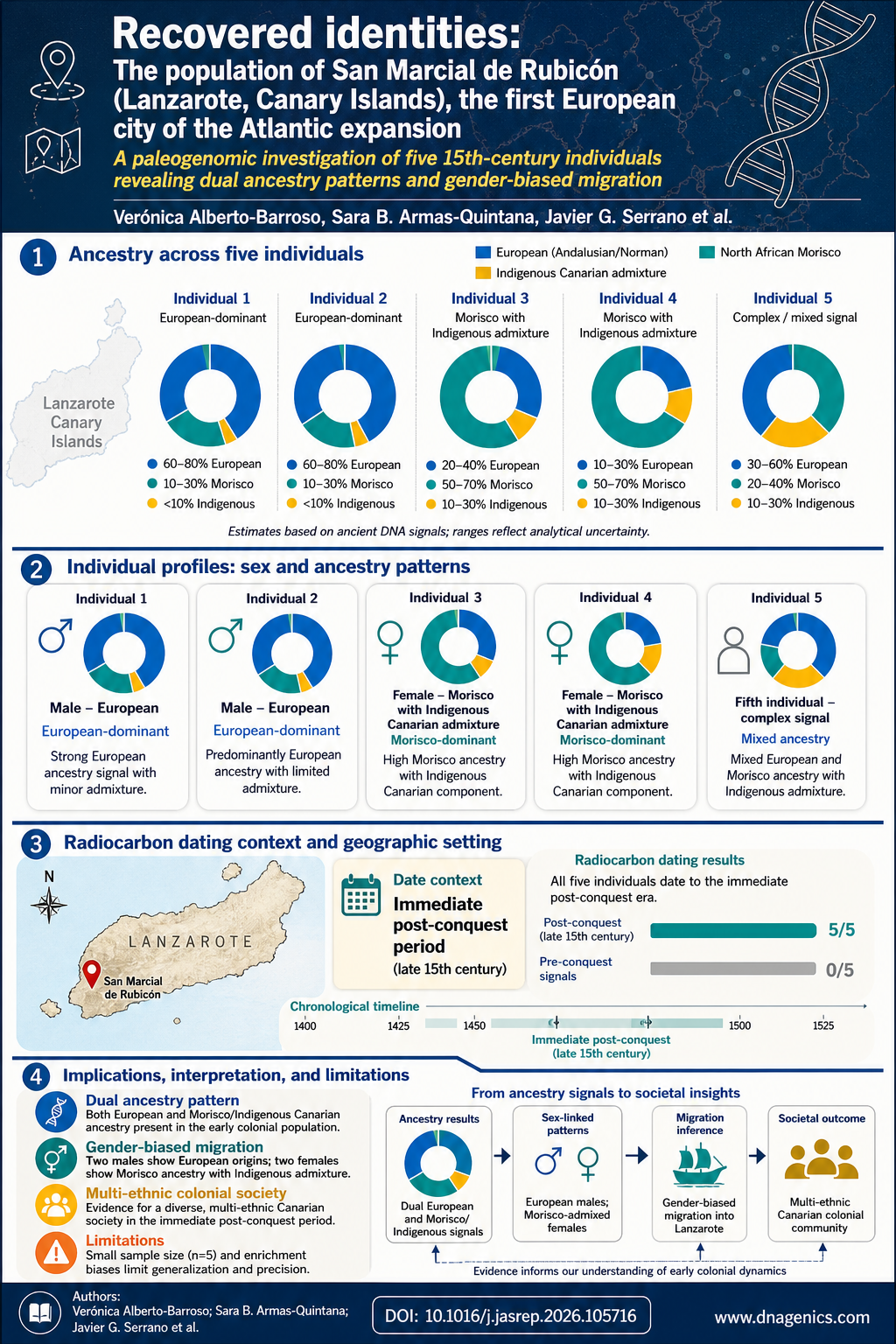
The infographic visually summarizes the dual ancestry pattern uncovered at San Marcial de Rubicón: European paternal lineages and North African Morisco maternal lineages, the radiocarbon dating window placing the individuals in the 15th century, and the overall admixture signals detected in the autosomal genome. It serves as a quick reference to the study’s core findings and their historical implications.
Why It Matters
This research provides a concrete genetic snapshot of the early Atlantic frontier, showing how European expansion intertwined with African and indigenous lineages from the Canary Islands. The identification of gender-biased migration and Morisco integration offers a nuanced view of how colonial societies formed at the cultural and biological levels. As ancient DNA methods continue to improve, similar studies can illuminate other frontier populations, refining our understanding of how migration, conquest, and labor shaped the genetic landscape of the Atlantic world.
Looking ahead, expanding sample sizes and including additional Canarian sites will help to resolve the broader patterns of admixture across the archipelago and across time. Integrating archaeological context with more extensive genetic data will enhance population-genetic models and enable sharper reconstructions of early modern migrations and social networks.
References
- View publication on DnaGenics
- Recovered identities: The population of San Marcial de Rubicón (Lanzarote, Canary Islands), the first European city of the Atlantic expansion
- DOI: 10.1016/j.jasrep.2026.105716