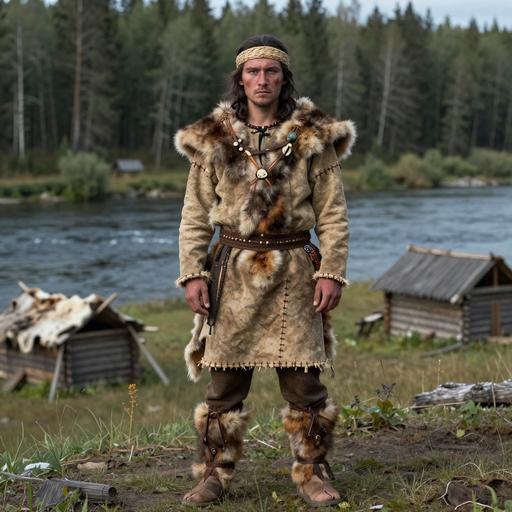
The Story
The journey of mtDNA haplogroup A10A1
Origins and Evolution
mtDNA haplogroup A10A1 is a downstream subclade of A10A, itself a branch of the wider haplogroup A10 that has deep ties to post-glacial populations of northern and central Eurasia. Based on the phylogenetic position of A10A1 beneath A10A and the archaeological contexts in which related lineages have been observed, A10A1 most likely formed in the southern Siberia / Altai region during the later Holocene (Bronze Age). Its emergence represents a more localized split from A10A maternal diversity that had been present in the region since the Early Holocene.
Phylogenetically, A10A1 is an intermediate, geographically-restricted clade: it inherits the ancestral A10A mutations while carrying additional derived changes that distinguish it from sibling lineages. Because A10A and its subclades are uncommon and often observed at low frequencies, the refined branching visible in modern and ancient mitogenomes makes A10A1 particularly useful for reconstructing fine-scale maternal continuity and movements in southern Siberia and adjacent Central Asia.
Subclades
At present, A10A1 is a relatively narrow, low-frequency clade; published datasets and ancient DNA (aDNA) surveys have not yet revealed many deeply nested, widely-sampled subclades under A10A1. As more high-coverage mitogenomes from southern Siberia and Bronze–Iron Age steppe contexts become available, additional internal structure may be recovered. Currently, A10A1 serves as an identifiable terminal or near-terminal lineage in many datasets, linking the ancestral A10A branch with localized ancient and modern maternal diversity in the Altai–Sayan corridor.
Geographical Distribution
A10A1 shows a geographically focused distribution with highest incidence in southern Siberia (Altai region) and neighboring areas of Central Asia. It occurs at low to very low frequencies in several modern indigenous Siberian and Turkic-speaking populations and appears in ancient Bronze Age remains associated with steppe and Altai-associated cultures. Occasional detections further afield in eastern Europe or eastern Asia are best interpreted as the result of later steppe-mediated population movements or rare, long-distance gene flow rather than broad geographic spread.
Key geographic patterns:
- Concentration in the Altai–Sayan and nearby southern Siberian zones (e.g., Altaian, Tubalar).
- Sporadic presence in Turkic-speaking Central Asian groups (low frequency).
- Occasional detection in indigenous northern Siberian peoples (e.g., Yakut, Evenk) and in aDNA from Bronze–Iron Age steppe contexts (Okunevo, Andronovo-related assemblages).
Historical and Cultural Significance
Although A10A1 is a minor maternal lineage by frequency, its presence in both ancient and modern samples makes it a valuable marker for studying localized maternal continuity across the Holocene in southern Siberia. Ancient DNA finds linking A10A-lineages to Okunevo- and Andronovo-associated burials indicate that descendants of A10A maternal lineages participated in Bronze Age societies of the steppe–mountain interface. Low-frequency detections of A10A1 in Central Asian Turkic-speaking groups and rare occurrences in eastern Europe reflect the complex web of Bronze Age and later movements across the steppe.
Because A10A1 is uncommon, it complements other, more frequent Siberian maternal haplogroups (for example, C4, D4, Z) when reconstructing population structure and admixture in the region. When combined with autosomal and Y-DNA evidence, occurrences of A10A1 can help identify specific maternal contributions within multi-ethnic Bronze Age and Iron Age communities of southern Siberia and adjacent Central Asia.
Conclusion
mtDNA haplogroup A10A1 is a geographically-restricted, low-frequency subclade of A10A that likely arose in the southern Siberia–Altai area during the later Holocene. Its detection in both modern indigenous Siberian peoples and in Bronze–Iron Age archaeological contexts makes it a useful marker for tracing localized maternal continuity and steppe-related female lineages. Continued sequencing of modern mitogenomes and expanded ancient DNA sampling in the Altai–Sayan and neighboring regions will improve resolution of A10A1's internal structure, timing, and population history.
Key Points
- Origins and Evolution
- Subclades
- Geographical Distribution
- Historical and Cultural Significance
- Conclusion