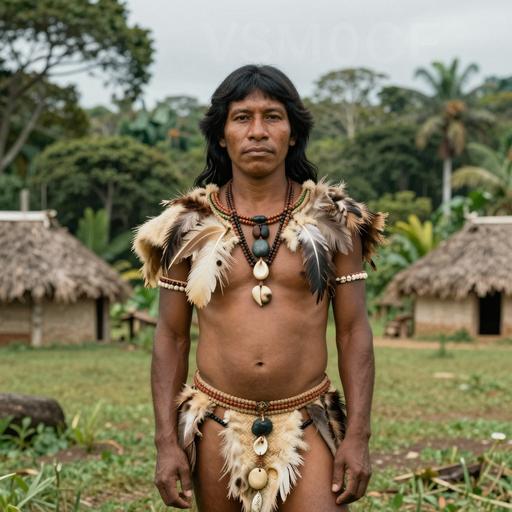
The Story
The journey of mtDNA haplogroup B2B3
Origins and Evolution
B2B3 is a downstream subclade of the Native American mtDNA lineage B2B, itself derived from haplogroup B2. The parent clade B2B likely formed in Central/South America in the early-to-mid Holocene, and B2B3 represents a further diversification that probably arose several thousand years later as local populations differentiated along ecological zones at the eastern slopes of the Andes and adjacent Amazonian foothills. The time depth for B2B3 is plausibly in the mid-Holocene (~4 kya) based on its phylogenetic position beneath B2B and on observed coalescence ages for comparable local subclades in the region.
Subclades
As an intermediate terminal subclade within the B2B branch, B2B3 may itself contain regional sublineages identifiable by private mutations in whole-mitogenome data. Published datasets and ancient DNA surveys occasionally resolve finer structure within B2-derived lineages; however, B2B3 is best understood currently as a geographically constrained derivative of B2B with limited, regional internal diversity. Continued mitogenome sequencing from modern and archaeological samples is likely to reveal additional child clades or local private variants.
Geographical Distribution
B2B3 shows a primarily South American distribution with its highest incidence on the Andean slopes and nearby Amazonian regions. Modern and ancient samples indicate the haplogroup is:
- Concentrated in some Indigenous Andean populations where it can reach moderate frequencies in localized groups.
- Present at lower, patchy frequencies among adjacent Amazonian indigenous groups, reflecting contact and gene flow across ecological zones.
- Occasional in parts of southern Central America and in coastal/Caribbean contexts where prehistoric maritime or later historic movement dispersed maternal lineages.
Ancient Holocene skeletal collections from Preceramic and Formative archaeological contexts in western South America have yielded B2-derived lineages, and targeted sampling has recovered instances attributable to the B2B/B2B3 branch, supporting an early Holocene to mid-Holocene regional presence.
Historical and Cultural Significance
Although B2B3 itself is not associated with any single large pan-regional archaeological culture, it is relevant to the demographic history of Andean preceramic and formative populations. Its distribution suggests persistence of maternal lineages across transitions such as the shift from hunter-gatherer adaptations to early horticultural and ceramic-using lifeways in highland and foothill zones. Localized high frequencies in certain groups may reflect founder effects, endogamy, or demographic continuity in isolated valleys or ecological niches.
B2B3 occurrences in coastal and Caribbean contexts are consistent with known patterns of prehistoric coastal interaction and later historic admixture that redistributed Native American maternal lineages beyond their core Andean distributions.
Conclusion
B2B3 is a regional, mid-Holocene daughter clade of B2B that helps resolve finer-scale maternal population structure in the Andean–Amazonian fringe. It provides insight into local differentiation after the initial peopling of the Americas and is best studied through whole-mitogenome sequencing and combined analyses of modern and ancient samples to clarify its substructure, chronology, and demographic significance.
Key Points
- Origins and Evolution
- Subclades
- Geographical Distribution
- Historical and Cultural Significance
- Conclusion