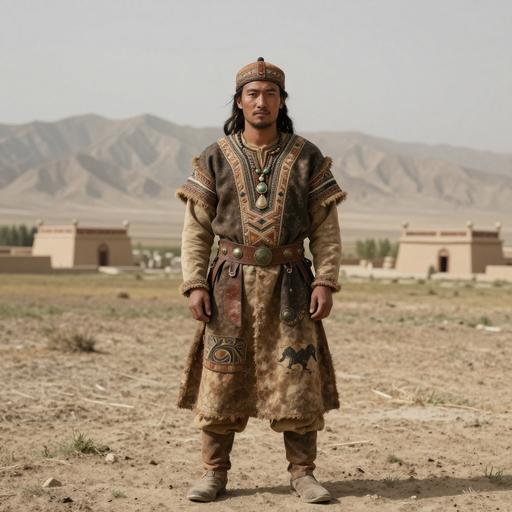
The Story
The journey of mtDNA haplogroup C7B
Origins and Evolution
mtDNA haplogroup C7B is a subclade of C7, itself a branch of macro-haplogroup C. Based on phylogenetic position and coalescent estimates for C7 lineages, C7B most likely arose in Northeast Asia/Siberia during the Late Pleistocene to Early Holocene (roughly ~12 kya). Its emergence is consistent with post‑Last Glacial Maximum (LGM) population structure and localized maternal diversification as human groups recolonized high‑latitude East Asia and adjacent Siberian regions.
C7B carries the defining mutations that place it within the C7 clade and shows limited internal diversity in currently published datasets, which suggests either a relatively recent diversification within the subclade or undersampling of extant populations. The single ancient DNA hit reported in the user's database indicates at least one archaeological occurrence, supporting continuity of this lineage through the Holocene in northern East Asia.
Subclades (if applicable)
At present, C7B is recognized as a distinct branch under C7; publicly available phylogenies report few fully resolved downstream subclades of C7B in broad surveys. This limited resolution is likely a consequence of sparse whole-mtDNA sequencing in many northern Asian populations. As more complete mitochondrial genomes from Northeast Asia and Siberia are sequenced, C7B may resolve into named subbranches reflecting local expansions (for example, geographically restricted lineages in Hokkaido, the Russian Far East, or Amur basin populations).
Geographical Distribution
C7B is principally a northern East Asian and southern Siberian lineage. Modern occurrences are concentrated among:
- Northern and northeastern Han Chinese (higher frequency in northern China than southern),
- Korean populations,
- Japanese samples (documented in Honshu and Hokkaido),
- Mongolic and Tungusic‑language groups (e.g., Buryats, Evens),
- Indigenous Siberian peoples (e.g., Evenk, Yakut in some surveys),
- Low-frequency occurrences in parts of Southeast Asia (Vietnam, Thailand) and selected Central Asian groups (Altaians, Tuvans).
These distributions are consistent with a northern origin followed by both inland and coastal expansions during the early Holocene, as well as later gene flow related to historic movements of Tungusic and Mongolic speakers.
Historical and Cultural Significance
While not one of the highest-frequency maternal lineages in East Asia, C7B is informative about northern East Asian population history. Its presence among Jōmon-associated Japanese samples and among Tungusic/Mongolic groups can signal maternal continuity from early Holocene hunter‑gatherer populations in the region and subsequent incorporation into later cultural complexes. In Siberia and the Amur basin, C7B fits the pattern of postglacial local lineages that contributed to the maternal gene pool of prehistoric and historic northern Asian communities.
Because C7B appears at low-to-moderate frequencies across multiple ethnolinguistic groups, it is useful for reconstructing regional demographic processes—for example, differentiating northern coastal versus inland maternal ancestries in northeastern Asia and tracing localized Holocene expansions rather than large continent‑wide dispersals.
Conclusion
mtDNA haplogroup C7B is a regionally focused maternal lineage that reflects the deep but localized post‑LGM diversification of mitochondrial lineages in Northeast Asia and southern Siberia. Although presently documented at low-to-moderate frequencies and with limited ancient DNA representation, C7B contributes to the genetic signature of northern East Asian and Siberian populations and will likely become better resolved as more complete mitochondrial genomes from those regions are analyzed.
Key Points
- Origins and Evolution
- Subclades (if applicable)
- Geographical Distribution
- Historical and Cultural Significance
- Conclusion