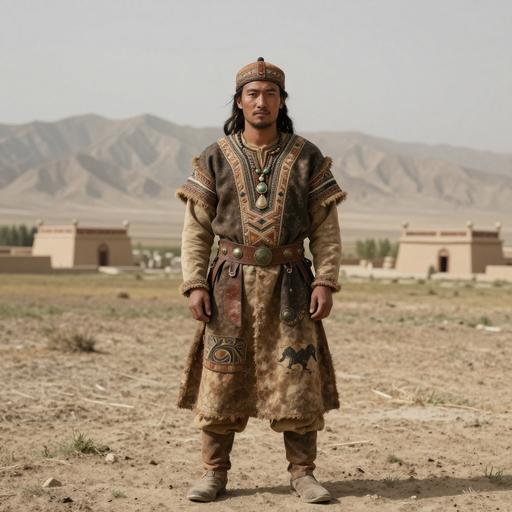
The Story
The journey of mtDNA haplogroup C7
Origins and Evolution
mtDNA haplogroup C7 is a derived branch of haplogroup C (itself part of macro-haplogroup M, within the M8'CZ grouping). Based on phylogenetic position and comparative coalescence estimates for sibling C subclades, C7 most plausibly arose in northeastern Asia near the transition from the Late Pleistocene to the Early Holocene (roughly ~12 kya in this summary). Its emergence fits a pattern seen across many maternal lineages in northern and eastern Asia: diversification during or shortly after the Last Glacial Maximum followed by regional differentiation during the Holocene.
The clade shows the hallmarks of a regional lineage rather than a pan-Asian founding lineage: moderate internal diversity with several named sublineages (commonly reported as C7a, C7b in the literature) and geographically localized distributions consistent with population structure and local expansions.
Subclades
Within C7, published phylogenies and population surveys identify at least a few sublineages (often annotated in mtDNA databases as C7a, C7b, etc.). These subclades are typically defined by private coding- or control-region mutations and tend to show geographically structured frequencies, with some sublineages more frequent in Japan and Korea and others observed among Mongolic/Tungusic-speaking groups or in parts of Southeast Asia at low frequency. Ancient DNA recovery of C7 sublineages is limited compared with some other mtDNA types, so much of the subclade resolution comes from modern population sequencing.
Geographical Distribution
C7 is concentrated in East Asia (particularly among some Japanese, Korean, and northern Chinese samples) and occurs at lower frequencies among Mongolic and Tungusic-speaking groups and several indigenous Siberian populations (e.g., Evenk, Buryat, Yakut in some studies). Low-frequency occurrences are reported in parts of Southeast Asia and Central Asia, consistent with Holocene gene flow and historic movements across Eurasia. Unlike C1 (a major founder lineage of the Americas) or C4 (common in Siberia and also present in some Native American contexts), C7 is not considered a principal founding lineage of the Americas.
Genetic surveys show C7 often occurs alongside other East Asian maternal lineages such as D4, G, and M7, reflecting shared regional ancestry and demographic events. Frequencies are typically moderate in core East Asian regions and low-to-rare in peripheral zones.
Historical and Cultural Significance
While mtDNA haplogroups do not map cleanly onto archaeological cultures, the distribution and timing of C7 make it relevant to several regional population processes: postglacial recolonization of northeastern Asia, Holocene coastal and inland demographic changes, and later population movements in the historical period. In Japan, sublineages of C7 are detected among modern populations and may be part of the genetic mix resulting from interactions between Jomon-era hunter-gatherers and later Yayoi agricultural migrants. In northeastern Asia, C7's presence among Tungusic and Mongolic groups is consistent with deep local continuity combined with gene flow during the Bronze–Iron Age and later historic contacts.
Because dated ancient DNA evidence for C7 remains sparse, caution is warranted in assigning C7 to specific prehistoric cultures; the most robust conclusions come from combining modern phylogeography with broader regional ancient DNA patterns showing continuity and turnover across the Holocene.
Conclusion
mtDNA haplogroup C7 represents a regional East/Northeast Asian maternal lineage that diversified after the Last Glacial Maximum and persisted through the Holocene with geographically structured subclades. It is informative for studies of East Asian maternal population structure, local demographic expansions, and the genetic composition of modern Northeast Asian and some Southeast/Central Asian groups, but it is not a primary founding lineage of the Americas. Future ancient DNA sampling across East Asia and Siberia will refine the precise timing and archaeological correlates of C7's subclade expansions.
Key Points
- Origins and Evolution
- Subclades
- Geographical Distribution
- Historical and Cultural Significance
- Conclusion