Menu
mtDNA Haplogroup • Maternal Lineage

D4E4

mtDNA Haplogroup D4E4

~12,000 years ago
Northeast/East Asia
1 subclades
Scroll to explore
Chapter I

The Story

The journey of mtDNA haplogroup D4E4

Origins and Evolution

mtDNA haplogroup D4E4 falls within the D4 clade, a deeply rooted East/Northeast Asian maternal lineage. The parental clade D4E likely diversified soon after the Last Glacial Maximum (post-LGM), and D4E4 is best interpreted as a downstream branch that formed during the Late Upper Paleolithic to early Holocene period in Northeast/East Asia. Based on the phylogenetic position of D4E4 under D4E and the documented ages of closely related D4 subclades, a plausible time to most recent common ancestor (TMRCA) for D4E4 is in the order of ~12 kya, reflecting post-LGM expansions and localized differentiation.

Subclades (if applicable)

At present, D4E4 appears to be a relatively low-frequency branch with limited deep substructure described in public databases and the literature. A small number of internal variants have been reported in modern and ancient samples, but the scarcity of well-sampled complete mitogenomes means that formal naming of multiple robust subclades under D4E4 is still incomplete. Increased whole-mitochondrial sequencing and ancient DNA sampling from Northeast Asia and the Russian Far East will be necessary to resolve finer-scale subclades and demographic events within D4E4.

Geographical Distribution

D4E4 shows its highest concentrations in Northeast Asia and the Russian Far East, with occurrences in Japan (including populations with Jomon ancestry), Korea, and Han Chinese groups. It is also present among Indigenous Siberian populations (for example, Yakut, Evenk, and Nivkh) and at lower frequencies in some Mongolic and Turkic-speaking groups of Central Asia. Sporadic low-frequency occurrences appear in parts of coastal Southeast Asia and in maritime contact zones where historic admixture has introduced Northeast Asian maternal lineages. Ancient DNA recovered from archaeological contexts has identified D4E4 in a small number (four) of ancient samples, supporting its antiquity in the region.

Historical and Cultural Significance

The distribution of D4E4 is consistent with female-line continuity among northeastern Eurasian hunter-gatherer and early Holocene populations. Its presence in Jomon-associated remains and modern populations of northeastern Japan suggests participation in the maternal ancestry of island and continental forager populations that persisted through the Holocene. In Siberia and the Russian Far East, D4E4 likely represents part of the maternal genetic substrate that later interacted with expansions of pastoralist and agrarian groups, but it remained more regionally concentrated than some pan-Eurasian mtDNA lineages. The haplogroup's low-to-moderate frequency and spotty geographic presence indicate that D4E4 was never a sweeping pan-regional maternal lineage but rather a marker of northeast Eurasian population structure and local continuity.

Conclusion

mtDNA D4E4 is a diagnostically Northeast/East Asian maternal lineage that diversified after the LGM and today marks a thread of maternal continuity across Jomon-related groups, modern Japanese/Korean/Chinese populations, and several Indigenous Siberian groups. Current evidence points to a postglacial origin in Northeast Asia, limited downstream diversification visible in modern and ancient samples, and a geographic footprint concentrated in the Russian Far East, northeastern Japan, Korea, and adjacent parts of China and Siberia. Further complete mitogenome sequencing and targeted ancient DNA sampling will clarify the internal structure and precise demographic history of D4E4.

Key Points

  • Origins and Evolution
  • Subclades (if applicable)
  • Geographical Distribution
  • Historical and Cultural Significance
  • Conclusion
Chapter II

Tree & Relationships

Phylogenetic context and subclades

Evolution Path

This haplogroup's evolutionary journey from its earliest ancestor to the present.

Steps Haplogroup Age Estimate Archaeology Era Time Passed Immediate Descendants Tested Modern Descendants Ancient Connections
1 D4E4 Current ~12,000 years ago 🌾 Neolithic 12,000 years 1 0 0
2 D4E ~15,000 years ago 🏹 Mesolithic 15,000 years 4 6 18
3 D4 ~25,000 years ago 🦴 Paleolithic 25,000 years 12 276 19
4 D ~45,000 years ago 🦴 Paleolithic 45,000 years 7 398 137
5 M ~60,000 years ago 🦴 Paleolithic 60,000 years 11 1,200 41
6 L3 ~70,000 years ago 🦴 Paleolithic 70,000 years 11 17,621 6
7 L ~160,000 years ago 🦴 Paleolithic 160,000 years 7 18,987 5

Siblings (3)

Other branches from the same parent haplogroup

Chapter III

Where in the World

Geographic distribution and modern presence

Place of Origin

Northeast/East Asia

Modern Distribution

The populations where MTDNA haplogroup D4E4 is found include:

  1. Han Chinese, Japanese, and Korean populations (East Asia)
  2. Indigenous Siberian groups (e.g., Yakut, Evenk, Nivkh, other Russian Far East populations)
  3. Jomon-era and other ancient Northeast Asian archaeological samples
  4. Mongolic and some Turkic-speaking Central Asian groups (low frequency)
  5. Selected Southeast Asian populations at low frequency (coastal and northern groups)
  6. Modern populations of the Russian Far East and northeastern Japan (local enrichments)
  7. Isolated occurrences in populations affected by historic admixture (e.g., maritime contact zones)
CHAPTER IV

When in Time

Your haplogroup in the context of human history

~12k years ago

Haplogroup D4E4

Your mtDNA haplogroup emerged in Northeast/East Asia

Northeast/East Asia
~10k years ago

Neolithic Revolution

Agriculture begins, settled communities form

~5k years ago

Bronze Age

Metalworking, writing, and early civilizations

~3k years ago

Iron Age

Iron tools, expanded trade networks

~2k years ago

Classical Antiquity

Greek and Roman civilizations flourish

Present

Present Day

Modern era

Your Haplogroup
Historical Era
Chapter IV-B

Linked Cultures

Ancient cultures associated with mtDNA haplogroup D4E4

Cultural Heritage

These ancient cultures have been linked to haplogroup D4E4 based on matching ancient DNA samples from archaeological excavations. The presence of this haplogroup in these cultures provides insights into the migrations and population movements of populations carrying this haplogroup.

Blagoveshchensk Culture Bolshoy Oleni Ostrov Devil's Cave Culture Kazakh Medieval Magyar Elite Culture Shamanka Culture Tangbalesayi Culture Tasmola Culture
Culture assignments are based on archaeological context of ancient DNA samples and may represent regional associations during specific time periods.
Chapter V

Sample Catalog

4 direct carriers and 2 subclade carriers of haplogroup D4E4

6 / 6 samples
Portrait Sample Country Era Date Culture mtDNA Match
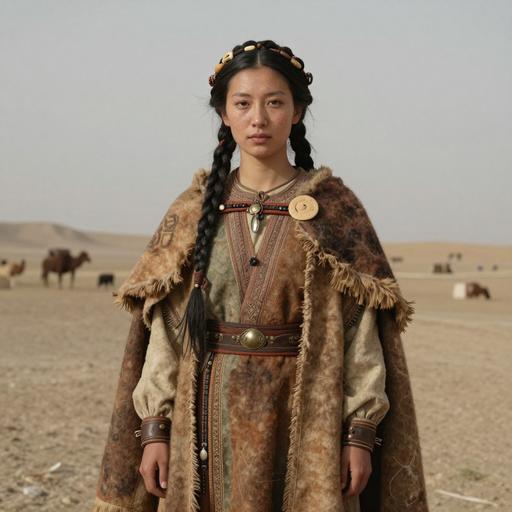
Portrait of ancient individual C1709 from China, dated 358 BCE - 170 BCE
C1709
China Iron Age Tangbalesayi, Xinjiang, China 358 BCE - 170 BCE Tangbalesayi Culture D4e4 Direct
Portrait of ancient individual NEO901 from Kazakhstan, dated 685 CE - 878 CE
NEO901
Kazakhstan Medieval Kazakh 685 CE - 878 CE Kazakh Medieval D4e4 Direct
Portrait of ancient individual VPB-310 from Hungary, dated 892 CE - 993 CE
VPB-310
Hungary Conqueror Elite Hungary 892 CE - 993 CE Magyar Elite Culture D4e4 Direct
Portrait of ancient individual BOO006 from Russia, dated 2050 BCE - 1500 BCE
BOO006
Russia Bolshoy Oleni Ostrov Site, Russia 2050 BCE - 1500 BCE Bolshoy Oleni Ostrov D4e4 Direct
Portrait of ancient individual bla001 from Russia, dated 601 CE - 758 CE
bla001
Russia Iron Age Blagoveshchensk, Russia 601 CE - 758 CE Blagoveshchensk Culture D4e4a* Downstream
Portrait of ancient individual bla001 from Russia, dated 601 CE - 758 CE
bla001
Russia Iron Age East Asia 601 CE - 758 CE D4e4a* Downstream
Chapter VI

Carrier Distribution Map

Geographic distribution of 6 ancient DNA samples (direct and subclade carriers of D4E4)

Direct carrier Subclade carrier
Time Period Filter
All Time Periods
Showing all samples
Chapter VII

Temporal Distribution

Distribution of carriers across archaeological periods

Chapter VIII

Geographic Distribution

Distribution by country of origin (direct and subclade carriers shown by default)

Chapter IX

Country × Era Distribution

Cross-tabulation of carrier countries and archaeological periods (direct and subclade carriers shown by default)

Data

Data & Provenance

Source information and data quality

Last Updated 2026-02-16
Confidence Score 50/100
Coverage Low
Data Source

We use the latest phylotree for MTDNA haplogroup classification and data.