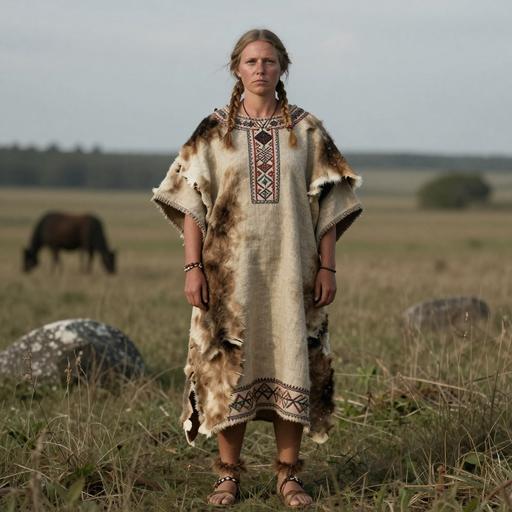
The Story
The journey of mtDNA haplogroup K1A1A2
Origins and Evolution
mtDNA haplogroup K1A1A2 sits downstream of K1A1A within macro-haplogroup K (derived from U8b). The parent clade K1A1A is generally dated to the Early Holocene (~9 kya) in the Near East / Anatolia, and K1A1A2 represents a more recent split within that lineage, plausibly arising in the same broad region during the Early to Mid-Neolithic (estimated ~8 kya). Its emergence is consistent with the pattern of maternal lineages that diversified among early farming populations in Anatolia, the Levant and adjacent coastal regions before dispersing into Europe with agricultural expansions.
Because mtDNA accumulates mutations at a measurable rate, phylogenetic placement and available ancient DNA hits indicate K1A1A2 is not one of the most deeply branching K subclades but rather a derived lineage that achieved geographic spread through demographic processes associated with the Neolithic and later regional founder events.
Subclades
At present K1A1A2 is a relatively specific terminal subclade; published sequence surveys and public phylogenies report only a small number of downstream private branches in modern and ancient samples. Where present, K1A1A2 often appears as a single defined branch or with short, population-specific derivatives rather than a large, deeply subdivided clade. This pattern matches a history of early expansion followed by local founder effects and drift in isolated or endogamous communities (for example, island populations and some Jewish communities).
Geographical Distribution
K1A1A2 is most frequent and best supported in regions connected to Anatolian and Mediterranean Neolithic expansions. Modern and ancient DNA results place the haplogroup in:
- Anatolia and the Near East (moderate frequency, high confidence), reflecting its likely origin area.
- Southern Europe (Italy, Greece, Iberia and Mediterranean islands) where it appears at low-to-moderate frequencies, often concentrated in coastal and insular populations.
- The Caucasus and adjoining parts of Iran and the Levant where Near Eastern maternal lineages are common.
- Ashkenazi Jewish communities, where K subclades including K1A1A derivatives contribute to documented maternal founder effects; in those contexts K1A1A2 may appear as one of several founder mtDNA lineages at low but notable frequency.
- Low-level presence in northern and western Europe, and traces in North African coastal groups and parts of Central Asia, consistent with historical mobility and gene flow along Mediterranean and steppe-trade/transit routes.
Frequency patterns show higher relative proportions in populations with substantial Near Eastern/Anatolian Neolithic ancestry and lower proportions where hunter-gatherer-derived maternal lineages dominate.
Historical and Cultural Significance
The distribution and age of K1A1A2 tie it to major demographic events in prehistory and history:
- Neolithic expansion: Its origin in the Near East / Anatolia and downstream presence in early European farmer-associated contexts link K1A1A2 to the spread of agriculture into Europe (LBK, Cardial/Impressed Ware and related maritime Neolithic expansions).
- Founder effects: In some insular Mediterranean populations and in parts of the Jewish diaspora (notably Ashkenazi communities), K1A1A2—or closely related K lineages—contribute to maternal founder signatures produced by bottlenecks, endogamy and subsequent population growth.
- Long-range contacts: Low-frequency occurrences in North Africa, the Caucasus and Central Asia likely reflect the long history of trade, migration and admixture connecting the Near East and the Mediterranean with adjacent regions across the Bronze Age, Iron Age and historic periods.
Conclusion
K1A1A2 is a derived, regionally informative maternal lineage that documents the demographic imprint of Near Eastern / Anatolian Neolithic populations and subsequent founder events in the Mediterranean and Jewish diasporas. It is relatively rare compared with major European mtDNA haplogroups but valuable for reconstructing Neolithic dispersals, local founder histories and post-Neolithic mobility in coastal and Near Eastern-influenced populations.
Key Points
- Origins and Evolution
- Subclades
- Geographical Distribution
- Historical and Cultural Significance
- Conclusion