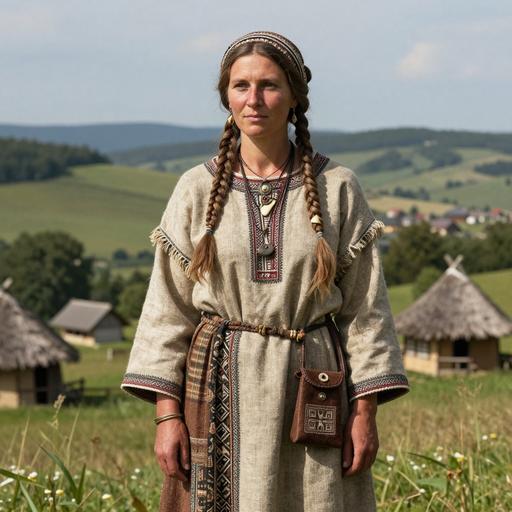
The Story
The journey of mtDNA haplogroup K1A1B2B
Origins and Evolution
K1A1B2B is a nested maternal lineage within mtDNA haplogroup K, specifically branching from K1A1B2. Haplogroup K itself derives from the broader U8/K clade and has a long history tied to post-glacial and Neolithic demographic processes in Eurasia. K1A1B2 appears to have an origin associated with Near Eastern/Anatolian populations during or after the early Neolithic; K1A1B2B represents a later, more geographically restricted sub-branch that most likely differentiated during the late Chalcolithic to Bronze Age (roughly 3.5 kya, with uncertainty on either side). As with many downstream K lineages, K1A1B2B is defined by a small set of coding-region and control-region polymorphisms that distinguish it from sister clades within K1A1B2.
Subclades
At present, K1A1B2B is recognized as a specific terminal or near-terminal subclade of K1A1B2. Published phylogenies and community haplogroup trees show relatively few deep downstream branches under K1A1B2B, indicating it is either a young lineage or one that has experienced limited diversification and demographic expansion. Because resolution depends on sampling density, additional sequencing (especially full mitogenomes from Anatolia, the Levant and Ashkenazi communities) could reveal further internal structure.
Geographical Distribution
K1A1B2B is best documented in populations with historical or prehistoric ties to the Near East and the Mediterranean. Modern surveys and targeted studies find the lineage at low-to-moderate frequencies in Anatolia and southern Europe, with sporadic occurrences in the Levant, the Caucasus and North African coastal groups that have historic Near Eastern contact. The clade is also recorded in some Ashkenazi Jewish mitochondrial datasets where founder effects or drift have increased the visibility of particular K subclades. Ancient DNA records (currently limited; five archaeological samples in the user's database) indicate K1A1B2B has been recovered from archaeological contexts consistent with late Neolithic to Bronze Age and later horizons in the Mediterranean–Near Eastern corridor.
Historical and Cultural Significance
The inferred timing and location of origin place K1A1B2B in a context shaped by post-Neolithic population interactions — the movements of Anatolian-derived farming communities, subsequent Bronze Age population shifts, and later historical migrations across the Mediterranean. In coastal and island contexts (for example parts of southern Italy, Greece and Mediterranean islands), the lineage's presence may reflect both early farmer ancestry and later maritime connectivity. In Ashkenazi communities, the appearance of K1A1B2B in multiple individuals can reflect historical founder events, population bottlenecks and endogamy rather than large-scale demographic replacement.
K1-derived lineages frequently appear in studies of Neolithic diffusion and later Mediterranean demographic processes. While K1A1B2B is not typically associated with steppe-related Bronze Age expansions (those are more often reflected in Y-DNA and in mtDNA lineages with a different geographic signature), it nevertheless provides a marker for female-line continuity and migration within the Near East–Mediterranean sphere.
Conclusion
K1A1B2B is a relatively localized mtDNA subclade whose phylogenetic position and geographic distribution point to a Near Eastern/Anatolian origin in the later Chalcolithic–Bronze Age and to subsequent dispersal into the Mediterranean and into some Jewish maternal lineages. Its low to moderate frequency and limited known diversity indicate the clade has either a recent origin or has undergone drift and founder effects in particular populations; increased mitogenome sampling, especially from Anatolia, the Levant and historical Jewish communities, will refine its age estimate and internal structure.
Key Points
- Origins and Evolution
- Subclades
- Geographical Distribution
- Historical and Cultural Significance
- Conclusion