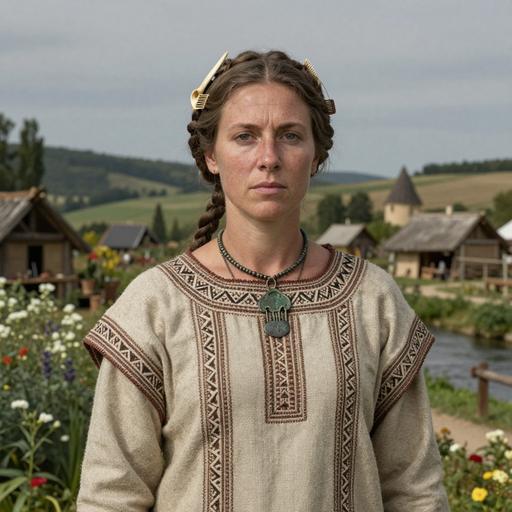
The Story
The journey of mtDNA haplogroup K1A26
Origins and Evolution
mtDNA haplogroup K1A26 is a derived subclade nested within K1A2, itself a branch of haplogroup K which traces back to Near Eastern/Eastern Mediterranean maternal lineages that diversified around the Late Glacial to Early Holocene. Based on its phylogenetic position under K1A2 and the archaeological record of maternal K lineages, K1A26 most plausibly arose in the Near East or Anatolia during the Early Neolithic (roughly ~8 kya), a period of rapid demographic expansion tied to the spread of farming.
Genetically, K1A26 is defined by one or more private (downstream) mutations relative to K1A2; these downstream mutations mark it as a recognisable maternal lineage with limited internal diversity, suggesting a moderate-time depth and several localized founder events during its dispersal.
Subclades
As a relatively recent subclade of K1A2, K1A26 shows limited diversification in published datasets. Where finer-scale sequencing has been performed, small sub-branches (e.g., K1A26a/K1A26b in some nomenclatures) have been reported in localised contexts, indicating that the haplogroup has experienced restricted regional expansions and some founder-enriched lineages, particularly in isolated island and diaspora communities.
Geographical Distribution
K1A26 is principally associated with the Near East / Anatolia and the Mediterranean space through patterns expected for a Neolithic-associated maternal lineage. Modern occurrences are concentrated in:
- Anatolia and the Levant (modern Turkey, Syria, Lebanon, Israel) where K1A2 and subclades persist at low–moderate frequencies.
- Southern Europe (Italy, Greece, Iberia and Mediterranean islands) where Neolithic farmer maternal signatures are common and local founder effects can raise frequencies on islands and isolated inland communities.
- Jewish populations, notably some Ashkenazi lineages, where K1-derived subclades—occasionally including K1A26—appear as enriched founder lineages in certain maternal genealogies.
Lower-frequency occurrences are reported in Western and Northern Europe, the Caucasus, North Africa (coastal groups with Near Eastern admixture) and, through historical migration, in the Americas. Ancient DNA (aDNA) studies have identified related K1A lineages in Early Neolithic contexts in Anatolia and Europe, supporting a Neolithic dispersal model for this lineage.
Historical and Cultural Significance
Because of its timing and geographic placement, K1A26 is best understood in the context of agricultural expansion. The haplogroup likely spread as part of the demographic and cultural processes that moved people, livestock and crops from Anatolia into the Aegean and continental Europe during the Early to Middle Neolithic. In later periods, K1A26 may appear in contexts influenced by maritime connectivity (Aegean, Mediterranean islands) and in populations shaped by historical movements (trade, colonization, and diasporas).
In some communities—particularly isolated islands and specific Jewish maternal lines—K1A26 or its local derivatives can show evidence of founder effects, where a relatively small number of female ancestors contributed disproportionately to the present-day maternal pool. Consequently, the haplogroup can be useful in reconstructing maternal genealogies, founder events, and localized demographic histories.
Conclusion
mtDNA K1A26 represents a geographically Mediterranean/West-Asian maternal lineage that likely originated in the Near East/Anatolia during the Early Neolithic and spread with farming populations into Southern Europe. Its present-day distribution—characterized by low to moderate frequencies with occasional local enrichment—reflects a combination of Neolithic dispersal, later regional migrations, and founder effects in isolated or diasporic communities. Continued high-resolution mitogenome sequencing and ancient DNA sampling will refine the internal structure and precise migration history of K1A26.
Key Points
- Origins and Evolution
- Subclades
- Geographical Distribution
- Historical and Cultural Significance
- Conclusion