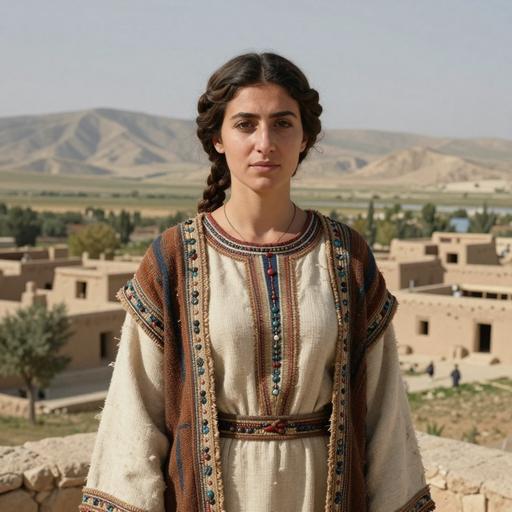
The Story
The journey of mtDNA haplogroup K1A8B
Origins and Evolution
K1A8B is a daughter lineage of K1A8, itself nested within mtDNA haplogroup K1A. Haplogroup K1A8 most likely arose in the Near East/Anatolia during the Neolithic and spread into Europe with farmer-associated migrations; K1A8B represents a later branching event within that Near Eastern-derived maternal lineage. Based on its phylogenetic position beneath K1A8 and on the geographic pattern of related lineages, a reasonable estimate places K1A8B's coalescence in the mid- to late-Holocene (roughly 4–7 kya), consistent with demographic events associated with post-Neolithic regional differentiation and localized founder events.
Subclades
At present, K1A8B is described as a relatively specific subclade under K1A8. Published surveys and public sequence databases show limited internal diversity for K1A8B compared with older K subclades, suggesting a more recent origin or a history of bottlenecks and founder effects in populations where it reached appreciable frequency. Further full mitogenome sequencing of individuals assigned to K1A8B (and screening of ancient DNA) is required to resolve internal substructure and identify any named downstream subclades.
Geographical Distribution
K1A8B is concentrated where Near Eastern Neolithic maternal lineages and later population movements left a genetic signature. It appears most often at low-to-moderate frequency in:
- Ashkenazi Jewish communities, where several K sublineages are historically amplified by founder effects and diaspora‑era population structure.
- Anatolia and the Levant, reflecting the putative Near Eastern origin of the parent K1A8 lineage.
- Southern Europe and Mediterranean islands (Italy, Greece, Sardinia, parts of Iberia), where Neolithic farmer ancestry and later maritime contacts have introduced and maintained Near Eastern mtDNA variants.
- Parts of the Caucasus and North Africa, generally at low frequencies linked to historical gene flow.
The distribution is consistent with diffusion from an Anatolian/Near Eastern source followed by local founder events, maritime dispersal, and later historical movements (including Jewish diaspora migrations and Mediterranean trade routes). Ancient DNA records for K1A8B are still sparse but its presence in at least one archaeological sample supports antiquity in the region.
Historical and Cultural Significance
Because K1A8B derives from a K1A8 background associated with Neolithic farmers, its presence in modern populations is tied to the major cultural transition in southwest Asia and Europe during the Neolithic. The lineage likely spread initially with Anatolian/Levantine agriculturalists and later persisted and diffused through Mediterranean coastal networks and island colonizations. In Ashkenazi Jewish populations, K subclades (including K1 derivatives) have been amplified by founder effects over the last two millennia; detection of K1A8B within Jewish maternal lines may therefore reflect both older Near Eastern ancestry and more recent population history (bottlenecks, endogamy).
K1A8B's occurrence on islands or in isolated communities (e.g., Sardinia, some Aegean islands) points to founder/founder‑effect dynamics where a small number of maternal ancestors can raise the observable frequency of a lineage over generations.
Conclusion
K1A8B is best interpreted as a geographically and temporally intermediate mtDNA subclade that emerged from the Near Eastern K1A8 stock in the mid- to late-Holocene, carried into Europe by early farmers and subsequently maintained or amplified by local founder effects and historical migrations. Its low overall frequency and limited published ancient DNA representation mean that expanded mitogenome sampling (modern and ancient) is the best path forward to refine its age, phylogeography, and any internal substructure.
Key Points
- Origins and Evolution
- Subclades
- Geographical Distribution
- Historical and Cultural Significance
- Conclusion