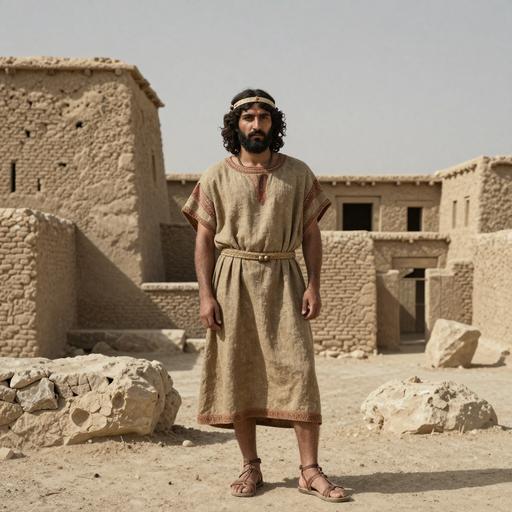
The Story
The journey of Y-DNA haplogroup J2A1A1A2
Origins and Evolution
Y-DNA haplogroup J2A1A1A2 is a downstream subclade of J2a1a1a, itself part of the broader J2 branch of the human Y-chromosome tree. J2 lineages are widely interpreted as having diversified in or near the Near East, where they became associated with early Holocene population expansions and later regional interactions across western Asia and the eastern Mediterranean.
Because J2A1A1A2 is an intermediate-to-terminal branch within this lineage, its precise age is expected to be younger than its parent clade, likely emerging during the mid-Holocene. A reasonable estimate places its origin around 5.5 kya, though the exact age depends on sampling density and phylogenetic resolution. Like many J2 subclades, it probably reflects the genetic legacy of Neolithic farming communities, followed by further spread during Bronze Age mobility, trade, and urbanization.
Subclades
J2A1A1A2 is a subclade of J2A1A1A, and its internal structure may still be incompletely resolved in public datasets. In practical population-genetic terms, such branches often represent localized founder effects or regional continuity within broader J2 dispersals. As more high-resolution Y-chromosome sequencing becomes available, additional downstream splits may be identified.
Geographical Distribution
This haplogroup is expected to be rare but geographically concentrated in regions where J2 lineages are common. The strongest presence is likely in the Levant, Anatolia, Mesopotamia, the Caucasus, and parts of southeastern Europe, with secondary occurrences in the Arabian Peninsula, North Africa, and among Jewish and some South Asian populations.
Its distribution pattern is consistent with long-term movement corridors linking the Fertile Crescent, Anatolia, and the eastern Mediterranean, where repeated episodes of migration, commerce, conquest, and intermarriage carried Near Eastern paternal lineages into surrounding areas.
Historical and Cultural Significance
J2 subclades are often discussed in relation to the spread of early farming, urbanism, and later bronze-age connectivity across the Near East and Mediterranean. While no single archaeological culture can be assigned uniquely to J2A1A1A2, its ancestry is compatible with populations involved in Neolithic and Chalcolithic expansion zones, and later with societies of the Bronze Age Levant, Anatolia, and Aegean.
In historical times, J2-derived lineages continued to move through the eastern Mediterranean world, including Greek, Anatolian, Levantine, and Near Eastern populations. The presence of related branches among Jewish communities and in parts of South Asia likely reflects a combination of ancient regional ancestry and later historical dispersals.
Conclusion
Y-DNA haplogroup J2A1A1A2 is a relatively specific paternal lineage within the broader J2 family, and it likely arose in the Near East during the mid-Holocene. Its distribution fits a pattern of continuity from early western Asian population structure, followed by spread through Neolithic and Bronze Age networks into the Mediterranean, Caucasus, and adjacent regions.
Key Points
- Origins and Evolution
- Subclades
- Geographical Distribution
- Historical and Cultural Significance
- Conclusion