انتقل إلى المحتوى الرئيسي
ملفات الحمض النووي

Alkhantepe: Late Chalcolithic Azerbaijan

A lone burial in Jalilabad hints at early Caucasus lineages and copper‑age lifeways

3776 CE - 3651 BCE
Jalilabad, Azerbaijan (Alkhantepe)

القصة

Archaeological and genetic data from a single Late Chalcolithic burial at Alkhantepe (Jalilabad district, Azerbaijan, 3776–3651 BCE) reveal a G1 Y‑chromosome and mtDNA K. Limited evidence suggests local Caucasus continuity with broader Chalcolithic social complexity.

Time Period

3776–3651 BCE

Region

Jalilabad, Azerbaijan (Alkhantepe)

Common Y-DNA

G1

Common mtDNA

K

الخط الزمني

3713 BCE

Alkhantepe burial (Jalilabad) dated

Radiocarbon-dated burial at Alkhantepe falls between 3776–3651 BCE, providing a Late Chalcolithic genetic datapoint from the Azerbaijan lowlands.

Origins & Emergence

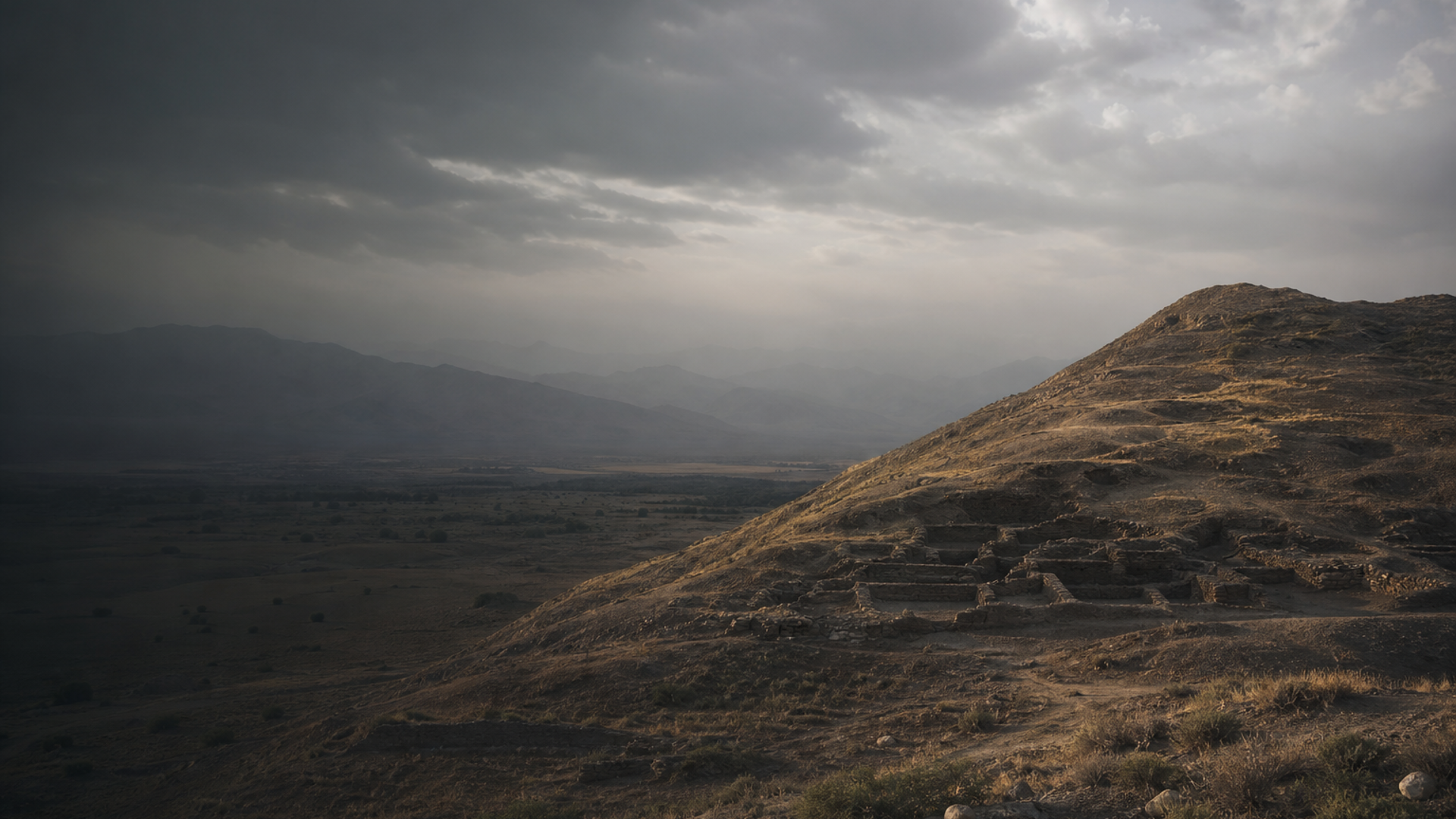
In the soft light of the Late Chalcolithic, the lowlands of the Kura–Araxes horizon were landscapes of shifting herds, nascent metallurgy and tightly woven social ties. At Alkhantepe, a single securely dated burial (radiocarbon range 3776–3651 BCE) anchors a fleeting glimpse into these emergent societies. Archaeological data indicate settlement continuity across the southern Caucasus, with local adaptations to floodplain environments and growing exchange networks that carried raw materials and ideas across valleys.

Limited evidence suggests the people interred at Alkhantepe participated in regional patterns of craft specialization—early copper working, pottery innovation, and long‑distance exchange of obsidian and other sought materials. The site sits within the broader tapestry of Late Chalcolithic Azerbaijan, where mounded tells and riverine settlements formed nodes of connectivity between the Caucasus highlands and the Iranian Plateau.

Because the dataset here is a single individual, any reconstruction of origins is provisional. Archaeological context provides the stage—settlement traces, burial practice, and material culture—but genetic data (see below) are required to test hypotheses about mobility, kinship, and ancestry.

Overall, Alkhantepe evokes a world on the cusp of metallurgical horizons: local lifeways shaped by ecological opportunity, craft innovation, and the slow choreography of human movement across the Caucasus.

  • Single, securely dated burial at Alkhantepe (3776–3651 BCE)
  • Located in Jalilabad district, southern Azerbaijan lowlands
  • Context fits broader Late Chalcolithic regional patterns

Daily Life & Society

Life in the southern Caucasus lowlands during the Late Chalcolithic would have unfolded between river channels, cultivated plots and seasonal pastures. Archaeological remains from contemporaneous sites in Azerbaijan show communities balancing farming, herding and emerging craft production. Pottery shapes and toolkits hint at household economies where women and men likely shared labor across ceramic manufacture, textile production, and food processing.

Material culture from nearby Chalcolithic sites suggests a palette of fired-clay vessels, stone and bone tools, and early copper artifacts—each object a tangible trace of daily choices and social identities. Burial practice at Alkhantepe, though represented by a single interment, contributes to this picture: funerary placement and associated grave goods (if present) can reflect kinship ties, status distinctions, and community values.

Seasonal mobility for pastoralists, exchange relationships for obsidian and copper, and local agricultural intensification would have structured rhythms of life. Yet without more extensive excavation and a larger sample of burials, social reconstructions remain cautious and richly provisional.

The cinematic contours of everyday existence—smoke from hearths, the ring of a copper awl, children trailing along irrigation banks—are inferred from scattered finds and regional parallels rather than direct evidence at Alkhantepe alone.

  • Mixed farming and herding economy likely
  • Emerging craft production (pottery, early copper) evident regionally

Genetic Profile

Ancient DNA from the Alkhantepe burial provides a rare molecular voice from the Late Chalcolithic lowlands. This single individual carries a Y-chromosome haplogroup G1 and mitochondrial haplogroup K. Haplogroup G1 is often associated with the broader Caucasus region in modern and ancient datasets, while mtDNA K appears in various Neolithic and later European and Near Eastern populations.

These genetic markers suggest affinities consistent with local Caucasus ancestry, but strong caveats apply: the sample count is one, and therefore population-level inferences are highly preliminary. Archaeological data indicate regional continuity in the southern Caucasus; the genetic signal from this burial is compatible with that continuity but cannot on its own resolve questions about migration, sex‑biased mobility, or admixture with neighboring groups.

Where comparative ancient DNA is available from the Caucasus and adjacent regions, patterns frequently show a mosaic of local hunter‑gatherer ancestry, incoming Neolithic farmer components, and later contributions. The Alkhantepe individual's G1 and mtDNA K fit within that diverse genetic landscape, suggesting connections across the highland–lowland ecotone.

Future sampling from Jalilabad district and contemporaneous sites is essential to test hypotheses about kin networks, demographic change, and the role of the Caucasus as a conduit or barrier for gene flow during the Chalcolithic.

  • Y-DNA: G1 — consistent with Caucasus-associated lineages
  • mtDNA: K — found in Neolithic and later Near Eastern/European contexts

Legacy & Modern Connections

The genetic echoes from Alkhantepe are threads that tie deep past populations to the living tapestry of the Caucasus. Haplogroup G1 still appears at low frequencies in the region today, hinting at long‑term genetic continuity in parts of Azerbaijan and neighboring areas. Mitochondrial K likewise contributes to maternal lineage diversity across West Eurasia.

Archaeologically, the Late Chalcolithic set the stage for the transformations that would follow in the Bronze Age: intensified metallurgy, more complex settlement hierarchies, and expanding exchange networks. While one burial cannot map these trajectories, it gestures toward ancestral roots for later populations and underscores the Caucasus's role as both cradle and corridor.

Given the single sample, all modern connections remain suggestive rather than definitive. Expanded ancient DNA sampling and continued excavation in Jalilabad and surrounding districts will clarify how these early lowland communities contributed to the genetic and cultural landscapes of the Caucasus.

  • G1 presence suggests potential long-term regional continuity
  • Find underscores need for broader aDNA sampling in Azerbaijan

مساعد الذكاء الاصطناعي

مساعد الذكاء الاصطناعي من DNA Genics

فتح هذه الميزة
اطرح أسئلة عن ثقافة Alkhantepe: Late Chalcolithic Azerbaijan. يمكن للمساعد شرح النتائج الجينية والسياق التاريخي والأدلة الأثرية والصلات بالعصر الحديث.
مثال على تحليل بالذكاء الاصطناعي

لمحة عن ثقافة Alkhantepe: Late Chalcolithic Azerbaijan

تساعد عينات الحمض النووي القديم الباحثين على دراسة أنماط الهجرة والعلاقات الجينية بين المجموعات السكانية القديمة.

هذه معاينة للتحليل. يتيح المساعد الكامل استكشاف الموضوعات التالية:

  • التركيب الجيني والأصول
  • أنماط الهجرة والأصول
  • الحياة اليومية والممارسات الثقافية
  • الإرث الجيني المعاصر