Introduction
What if the story of our bodies could be read in ancient genomes? Ancient DNA (aDNA) lets us reconstruct chronologically sampled genomes from people, animals, plants, and even microbes. Recent advances in extracting short, degraded DNA and sequencing at low cost mean we can build broad, cross-regional datasets. These datasets move us from broad population history toward revealing the biological mechanisms that shaped physiology across time. By tracking how allele frequencies shifted through eras and by linking genetic changes to functional data like gene expression and chromatin structure, researchers can begin to connect sequence variation with physiological function in its environmental and cultural context.
Why does this matter for modern humans? Because our bodies are the product of countless trade‑offs driven by subsistence shifts (dairying, farming, starch-rich diets), climate fluctuations, and disease exposure. aDNA helps us disentangle how much of present-day variation in traits such as digestion, pigmentation, immune responses, and adaptation to altitude is inherited from ancient populations, and how much arises from more recent mixtures. This synthesis highlights where our understanding is strongest, where biases remain, and where ethical governance is essential as we expand the reach of ancient genomics.
Key Discoveries
- Archaic introgression is a lasting component of modern human genetic diversity: Neanderthal DNA is widespread in non-Africans; Denisovan DNA is enriched in Oceanians and some Asians and contributes to adaptive variation in high-altitude, immune, and metabolic traits.
- Three major ancestral streams explain European ancestry: Western hunter-gatherers, Near Eastern farmers, and Steppe pastoralists collectively shaped present-day European genomes through successive admixture events.
- Lactase persistence is a quintessential example of gene-culture co-evolution**: The LCT regulatory variant increased with dairying, though some regions (e.g., parts of South Asia) show ancestry‑driven rather than selection‑driven patterns.
- Starch digestion and lipid metabolism reflect agricultural transitions: AMY1 copy number and FADS1/2 variants shifted with diet, with regional differences tied to geography and subsistence strategy.
- High-altitude adaptation in Tibetans is a clear case of adaptive introgression: Denisovan-like DNA at EPAS1 modulates hemoglobin response to hypoxia, enabling better tolerance at high altitude.
What This Means for Your DNA
For anyone exploring their ancestry, the study of ancient physiology offers practical takeaways and caveats. First, present-day traits are often shaped by multiple ancestral streams rather than a single source. Knowing that European ancestry, for example, is a mosaic of Western hunter-gatherers, Near Eastern farmers, and Steppe peoples helps explain regional variation in traits like lactase persistence, pigmentation, and metabolism. Second, some traits reflect gene‑culture co-evolution—where cultural practices (such as dairying) created selection pressures that shaped genetic variation over time. This means that your own DNA can carry signals of past diets and environments that are not obvious from present geography alone.
For beginners, think of ancient DNA as a time‑stamped dataset that complements modern DNA analysis. Rather than predicting a guaranteed trait, ancient data provide probabilities and historical context for how certain variants rose to prominence or faded, depending on lifestyle and climate. Advanced readers will appreciate how researchers use temporal sampling, functional genomics, and demography models to separate the effects of natural selection from genetic drift, improving how we interpret current genetic diversity in the context of history.
Historical and Archaeological Context
The narrative of ancient physiology sits at the intersection of genetics, archaeology, and climatology. Population movements—such as the initial Out‑of‑Africa dispersals of Homo sapiens, followed by encounters with Neanderthals and Denisovans—created layers of ancestry that later migrations built upon. In Europe, the formation of present-day gene pools reflects admixture among Western hunter-gatherers, Near Eastern farmers who spread farming practices, and Steppe pastoralists who arrived with new cultural technologies and animal husbandry. These events align with archaeological records of dairying, grain agriculture, and long-distance trade, and they help explain regional patterns in traits tied to diet and metabolism.
Geographically, archaic introgression is not uniform: Neanderthal DNA is widespread in non-Africans, while Denisovan ancestry is notably enriched in Oceania and parts of Asia, contributing to adaptive responses in immune function and high‑altitude physiology. The timing of these admixture events—tens of thousands of years ago—provides a backdrop for interpreting later changes in pigmentation, digestion, and immune genes observed in ancient genomes and modern populations.
The Science Behind the Study
This review synthesizes case studies that track allelic shifts across time, integrate functional genomics resources, and model population demography to parse selection from drift. Researchers use chronologically sampled genomes from diverse regions, alongside environmental and archaeological data, to link genetic changes with real-world contexts such as dairying, farming, and climate shifts. By combining short‑read sequencing, targeted enrichment, and careful authentication of ancient samples, studies can recover informative variants even from highly degraded DNA. Functional interpretation draws on expression data, chromatin accessibility, and protein function to connect variants with physiological pathways.
In Simple Terms:
In Simple Terms: Ancient DNA gives us time-stamped genetic data. By watching how allele frequencies rise or fall over millennia, scientists can tell when natural selection likely acted—versus random genetic drift—and then connect those changes to body functions like digestion, pigmentation, or oxygen use. This approach layers biology on top of history, showing how environment and culture shaped who we are today.
These methods face challenges, including uneven geographic and temporal sampling, DNA degradation, and the difficulty of predicting phenotypes from genotype alone. Nevertheless, rapid methodological progress and ethical frameworks are expanding what we can learn about physiology’s evolution.
Infographic Section – Available Insight
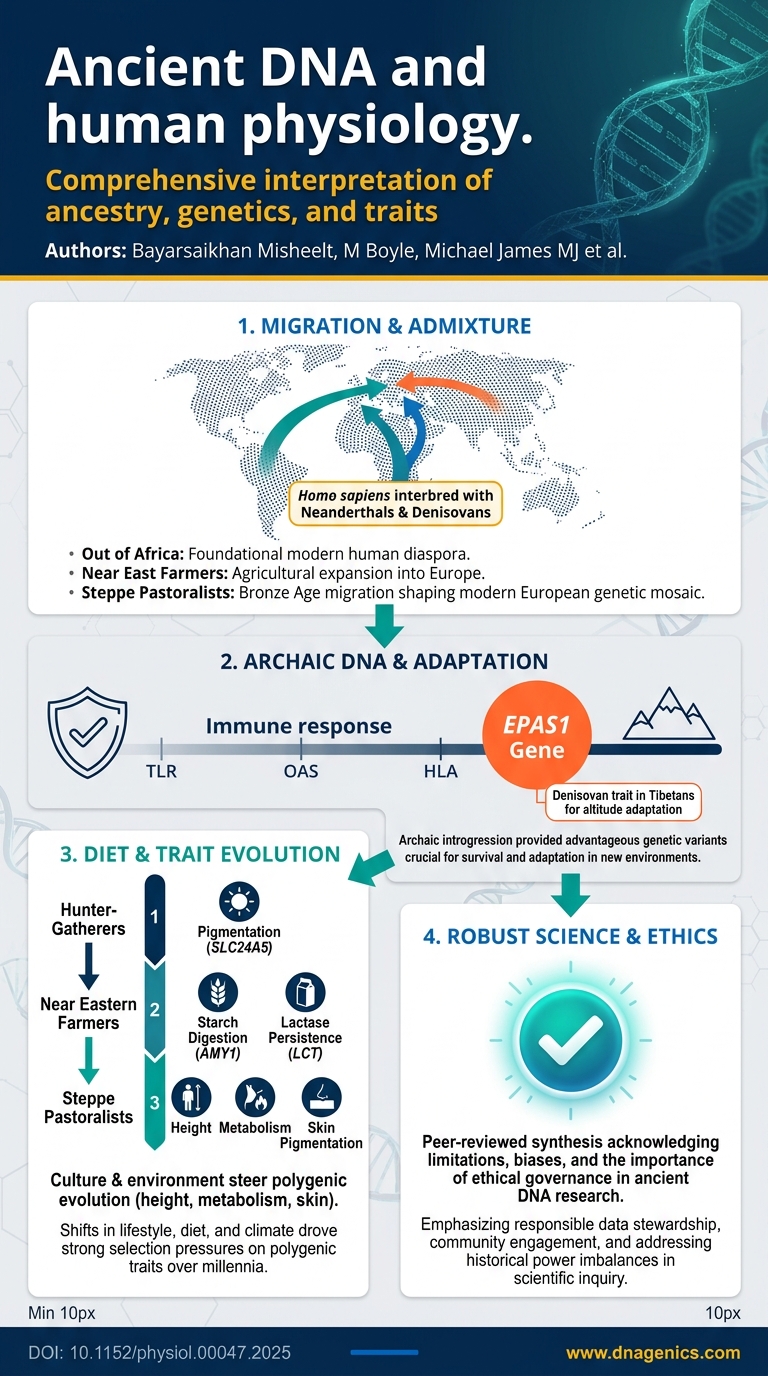
The infographic summarizes core themes: how archaic introgression and admixture shaped modern genomes, major dietary and environmental adaptations, and the geographic and temporal patterns underpinning physiological traits. Use it as a visual guide to the timelines and pathways discussed in the sections above.
Why It Matters
Understanding ancient DNA and physiology sharpens our view of how humans adapted to changing environments and cultures. It helps explain why certain populations carry legacy adaptations to dairying, starch-rich diets, or high-altitude living, and why immune pathways show both protective benefits and trade-offs. Looking ahead, expanding sampling across underrepresented regions and times will refine our pictures of selection pressures and demographic history. These insights inform modern health research, improve ancestry storytelling, and guide ethical considerations as the field continues to reconstruct human biology through time.
References
Ancient DNA and human physiology
DOI: 10.1152/physiol.00047.2025