Introduction
Your matrilineal story stretches back to a single African woman who lived roughly 145 thousand years ago. This lineage is carried in your mitochondria, the tiny energy factories within our cells, passed exclusively from mother to child. The study of mitochondrial DNA, or mtDNA, provides a time-stamped record of human ancestry and population movements across deep time. In recent years, the amount of mtDNA data has exploded, but the reference trees used to organize and interpret that data lagged behind.
Mitotree presents a major leap forward: the largest de novo human mtDNA phylogeny described to date, built from roughly 330,000 complete sequences and encompassing about 54,000 branches. This living resource integrates ancient DNA, relaxed clock age estimates, and public databases to deliver a high-resolution map of matrilineal history that is continually updated and widely accessible through HAPLOGREP v3. This matters for researchers, genealogists, and medical scholars who rely on precise haplogroup placement to understand migrations, founder events, and population structure.
Key Discoveries
- L2e is split ~83 kya, forming a very old African lineage with living descendants, highlighting deep African mtDNA diversity.
- Ötzi’s K1f is placed within a broader Balkan/K Near Eastern sublineage with a living Berber match, reframing an apparent extinct terminal branch.
- Jewish founder haplogroups and Sardinian founder haplogroups are refined into large subclades, illustrating strong founder effects and regional continuity.
- L0–L7 African superclades are resolved with substantial internal diversity, including multiple deep-rooted subclades.
- M, N, R radiations are expanded with dozens of new primary haplogroups and many subclades, illuminating regional expansions in India, Southeast Asia, Oceania, Europe, and Africa.
- Austronesian and Malagasy lineages gain new structure, refining the understanding of the Lapita-focused dispersal and Madagascar’s mtDNA history.
- Ainu/Jomon and Paleo-Eskimo connections are elaborated, contributing to the broader picture of Paleolithic mtDNA lineages across Eurasia and the Americas.
- Mitotree is designed as a living reference for mtDNA, intended to be updated yearly with de novo reconstructions, and is integrated with HAPLOGREP v3 for broad accessibility.
What This Means for Your DNA
For people curious about their ancestry, Mitotree means more precise placements of your maternal line. The expanded haplogroup resolution helps distinguish closely related matrilines and clarifies historical founder events that shaped regional populations. The integration with HAPLOGREP v3 makes these insights broadly available for consumer and research analyses alike, enabling clearer connections between your DNA and the deeper branches of humanity.
As a practical takeaway, expect finer-grained subclade assignments in regions with rich mtDNA histories, such as Africa, the Mediterranean, and parts of Asia and Oceania. While this enhances resolution, it also comes with caveats about sampling bias and the ongoing need for data from underrepresented populations. Mitotree is a living resource, designed to improve as more complete sequences and ancient DNA are added over time.
Historical and Archaeological Context
The Mitotree framework places deep African lineages (L0–L7) at the root of the matrilineal tree, underscoring a long, diverse prehistory within Africa before major out-of-Africa migrations. The expanded radiations of the M, N, and R haplogroups illuminate how populations spread across continents in waves, with notable signals in India, Southeast Asia, Oceania, Europe, and Africa. Such structure aligns with archaeological records of modern human dispersals and maritime networks that connected distant regions.
The refined placement of Ötzi the Iceman’s K1f lineage into a broader regional subclade is a striking example of how ancient individuals can be recontextualized within living populations. Likewise, newly resolved founder haplogroups among Jewish communities and Sardinian populations reflect demographic events in which small founder groups left enduring genetic signatures in mtDNA. The Austronesian and Malagasy lineages refine our understanding of the Lapita dispersal and Madagascar’s mtDNA history, while Ainu/Jomon and Paleo-Eskimo connections broaden the Eurasian paleogenetic landscape.
The Science Behind the Study
Mitotree relies on a novel recursive weighted maximum parsimony pipeline to reconstruct a large, highly resolved mtDNA phylogeny. This divide-and-conquer approach breaks the enormous search space into tractable pieces, builds local trees, and then joins them to form a comprehensive global phylogeny. The pipeline accommodates rampant homoplasy in mtDNA—instances where the same mutation arises independently in separate lineages—while maintaining tight accuracy standards.
The study integrates thousands of publicly available sequences, Including ancient DNA, GenBank entries, and panels from 1000 Genomes, HGDP, and SGDP, to calibrate ages through relaxed clock estimates ( TMRCAs ). The researchers report a false negative rate of 3.5% and a false positive rate of 1.0%, underscoring both the power and the limits of the current data landscape. A key feature is the living nature of the resource, designed for annual updates and deep integration with HAPLOGREP v3, making Mitotree a practical tool for both research and genealogical work.
In Simple Terms: Mitotree builds an enormous family tree of matrilineal ancestors by comparing mtDNA mutations, using smart shortcuts to manage a huge number of sequences. It checks ages with ancient DNA, and it keeps the tree up to date so analyses stay current, even as new data arrive.
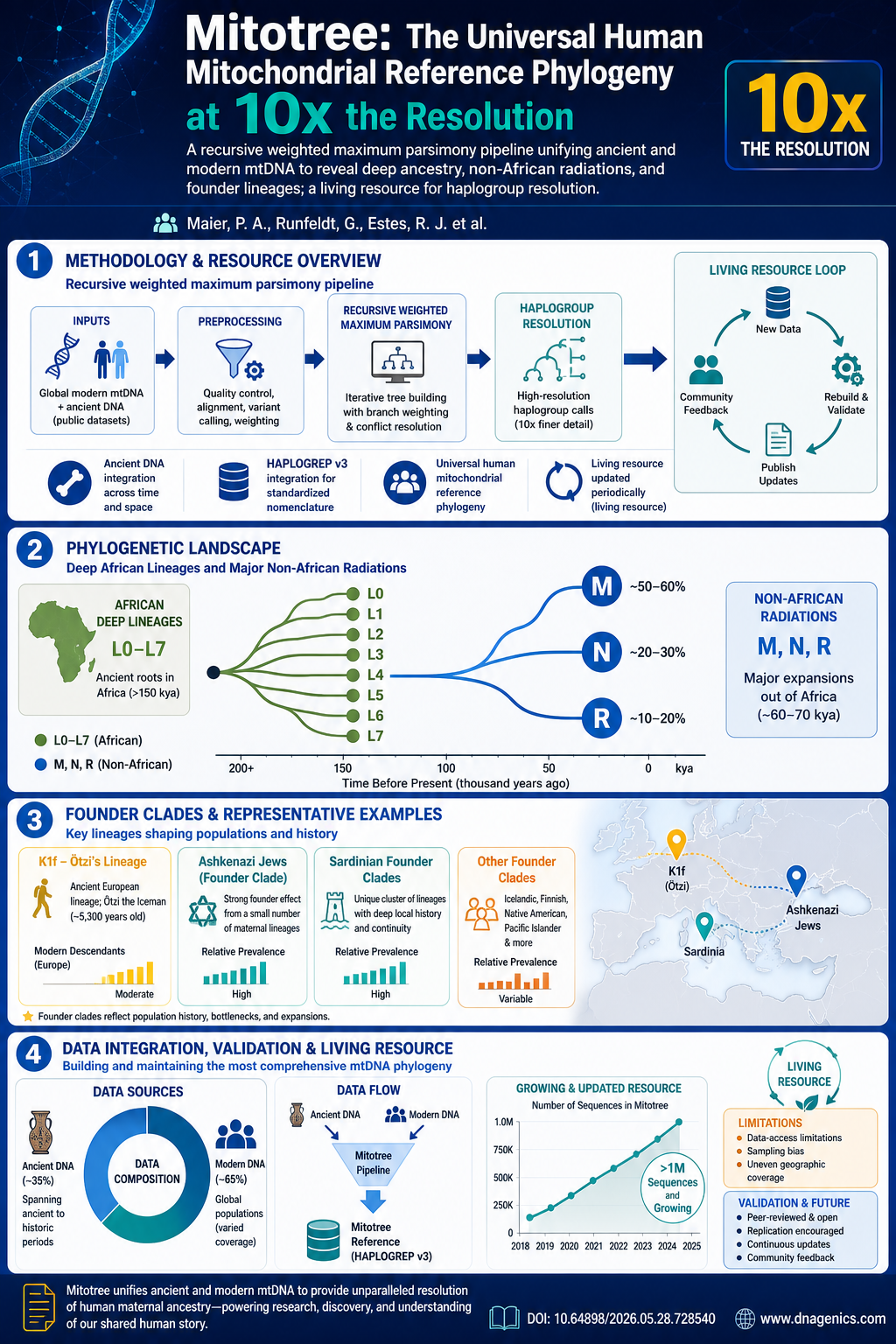
The infographic companion to Mitotree provides a visual overview of the large-scale mtDNA phylogeny, highlighting the major Africa-centered L0–L7 clades, the M, N, R radiations, and notable founder subclades such as Ashkenazi Jewish and Sardinian lineages. It also depicts the integration of ancient DNA and the living, updating nature of the reference tree.
Why It Matters
Mitotree represents a turning point in mtDNA research and genealogical genetics. By delivering the largest, continually updated mtDNA reference, it supports more accurate ancestry inferences, better understanding of founder events, and deeper insights into population history. The ongoing, annual updates ensure Mitotree remains aligned with the expanding diversity of available sequences and with advances in ancient DNA recovery and analysis. The work also highlights the value of global collaboration and data sharing in advancing population genetics and medical research related to mitochondrial function and matrilineal history.
Future work will focus on expanding sampling from underrepresented regions, refining confidence estimates for deeply ancient branches, and exploring functional interpretations of mtDNA variation in the context of population history and disease.
References
Mitotree: The Universal Human Mitochondrial Reference Phylogeny at 10x the Resolution
-DOI: 10.64898/2026.05.28.728540