Introduction
The story of African American roots often stops before the 1870 census, when enslaved people were named in official records. A groundbreaking study peers deeper into this history by analyzing 27 individuals buried at Maryland's Catoctin Furnace African American Cemetery (1774–1850) and cross referencing their genetic signals with a vast modern dataset from 23andMe. The result is a powerful demonstration of how ancient DNA, when paired with contemporary genotype data, can illuminate intimate kin networks and the broader tapestry of migration and admixture in the Mid-Atlantic.
Why this research matters goes beyond ancestry tracing. It highlights the resilience and persistence of descendant communities, the complex patterns of ancestry that shaped generations, and the importance of ethical engagement with living relatives and communities. By connecting past lives to present DNA, the study opens a window into how families migrated, intermarried, and preserved memory over centuries, while underscoring the social context of slavery and marginalization.
Key Discoveries
- Major African ancestry with variable European admixture: The Catoctin individuals show predominantly African ancestry with notable European admixture, with strongest signals linking to Senegambia and West Central Africa and connections to Great Britain and Ireland.
- Sex-biased admixture patterns: Paternal European lineages identified in several male individuals (Y haplogroups R1a, R1b), and a European-associated maternal lineage in an outlier (mt haplogroup J1b1a1a), consistent with historical patterns of coercive unions during slavery.
- Widespread modern connections via IBD: Thousands of living relatives connected through Identical-by-descent (IBD) segments — 55,342 IBD segments linking 22 historical individuals to 41,799 23andMe participants — with Maryland showing strong local clustering.
- Geographic specificity of ancestry links: African ancestry strongest in West Africa and Senegambia regions (Senegambia, West Central Africa; Angola, DRC) and European ancestry strongest in Great Britain and Ireland; US regional sharing highlights Maryland and the broader Mid-Atlantic.
- Health-related alleles discussed with caveats: The study notes the presence of rs334 (HbS) and rs1050828 (G6PD deficiency) in some individuals, but with limited data coverage, making genotype inferences tentative.
- Ethics and governance emphasized: Researchers foreground ethical considerations, community engagement, and a cautious stance against biologizing identity while honoring memory and honoring living descendants.
What This Means for Your DNA
For people curious about their own ancestry, the Catoctin Furnace study offers practical insights. First, it shows how distant connections can be inferred through modern genetic databases, even when traditional records are sparse. If your DNA shows mixed signals, especially African and European components, it might reflect historical admixture events that are common in the Mid-Atlantic and other regions shaped by the legacy of slavery and migration.
Second, the work reinforces the value of IBD analysis in uncovering living relatives who share ancient ancestors. This approach can help you map collateral relationships, cousins you may not have known about, and regional founder effects over time. While the study emphasizes caution in drawing identity from genetics alone, it demonstrates how genetics can complement archival research and family storytelling.
Historical and Archaeological Context
Catoctin Furnace operated from the late 18th century into the mid-19th century as a site of enslaved labor and later wage labor. Burial practices by Moravians reflect a long history of marginalization of enslaved people, and the study uses these grounds to honor memory and encourage community engagement. The findings connect to broader patterns of migration and labor in the Mid-Atlantic, a region where enslaved Africans, freedpeople, and European settlers interacted in complex ways.
Archaeological and historical contexts situate the Catoctin data within a network of known colonial and early American trade routes, as well as the movement of people between Maryland, Virginia, and neighboring states. The genetic signals align with historical accounts of African diaspora origins in Senegambia and West Central Africa, with later admixture from European populations tied to Great Britain and Ireland, mirroring colonial labor systems and marriage patterns. The work also touches on the cultural and ethical aspects of returning names to the memory of enslaved individuals and the ongoing role of descendant communities in interpreting findings.
The Science Behind the Study
The study combines ancient DNA data with a vast modern genotype reference to map ancestry and kinship. Genome-wide data from the ancient samples were captured at approximately 1.2 million SNPs and then imputed to increase data usability for downstream analyses. Ancestry was modeled as African, European, and Indigenous American contributions using methods like qpAdm and local ancestry inference. IBD sharing links connect historical individuals to living relatives in the modern dataset.
The researchers also examined haplogroups from mtDNA and Y-DNA to trace maternal and paternal lineages, noting markers such as rs334 (HbS) and rs1050828 (G6PD deficiency) in the context of disease susceptibility and historical selection pressures. A key methodological strength is the use of high-resolution chromosome paintings and extensive imputation via tools like GLIMPSE, which improves the reliability of ancestry inference in low-coverage ancient data.
In Simple Terms: This study uses ancient DNA from 27 people and a huge pool of modern DNA to find shared genetic blocks that indicate who might be related today, and where those ancestors came from, while keeping a careful eye on limitations and ethical considerations.
Why the Methods Matter for Advanced Readers
- The combination of qpAdm modeling with local ancestry analysis allows dissection of African, European, and Indigenous American components at both global and locus levels.
- GLIMPSE improves genotype imputation in ancient genomes, enabling better resolution of ancestry tracts and IBD detection despite uneven coverage.
- The study's emphasis on Identical-by-descent segments allows robust inferences about distant relatives in the modern population and helps map descendant networks across geography, especially single-region clustering in Maryland.
- Caution is warranted due to heavy reliance on a private modern dataset; researchers call for broader replication and careful interpretation to avoid overemphasis on biological determinism of identity.
Infographic
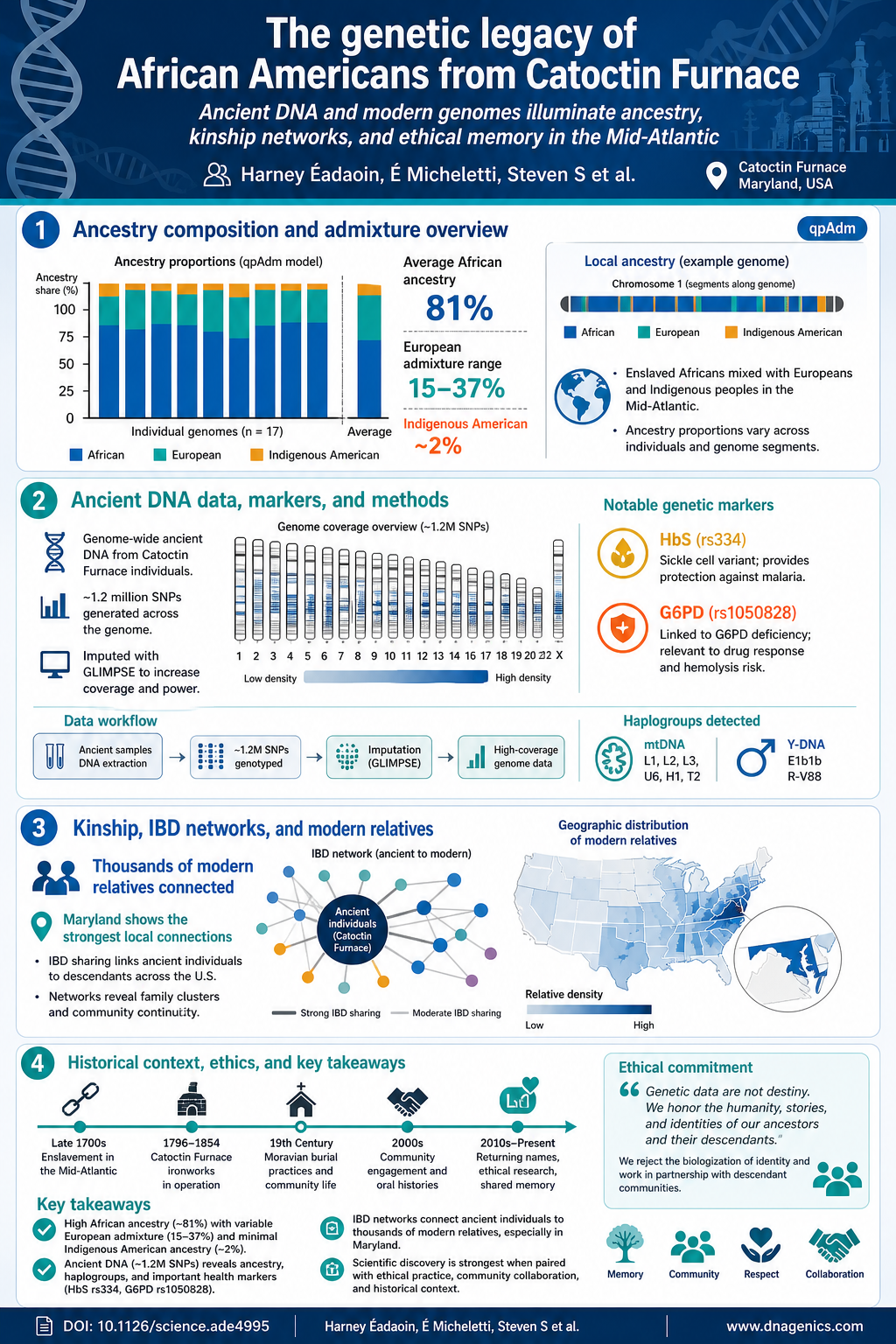
The infographic visualizes how ancient DNA from the Catoctin Furnace individuals connects to thousands of modern participants, highlighting regional ancestry signals (Senegambia, West Central Africa, Great Britain, Ireland) and the local Maryland clustering of descendants. It also depicts the IBD network showing shared segments across generations and the ethical framework guiding the study.
Why It Matters
This work demonstrates the power of integrating historical DNA with contemporary large-scale genotype data to illuminate lineage, migration, and community connectivity. It provides a template for ethically engaging with descendant communities while acknowledging the social and historical contexts that shape genetic data interpretation. Future research can expand replication with broader datasets, refine local ancestry mapping in admixed populations, and explore health-related allele frequencies with higher coverage to reduce uncertainty. The study also reinforces the value of partnerships between researchers and communities in memory work and public scholarship.