Introduction
A Bronze Age settlement sits at a crucial crossroads in northern China, where farming and herding economies converged in the agro-pastoral transition zone of the West Liao River Basin. The Erdaojingzi site, dating to ca. 3700–3330 cal BP, offers a remarkably well-preserved window into how people organized their lives when millet agriculture spread and interregional contacts intensified. By combining ancient DNA analysis with stable isotope data, archaeobotany, and zooarchaeology, researchers aimed to understand both where these communities came from and how they fed themselves.
This multidisciplinary approach matters because it links past population movements with shifts in food production and consumption. The study provides concrete evidence about diffusion patterns of farming populations from the Central Plains into the northeastern frontier, helping to clarify how genetic exchange accompanied the spread of millet agriculture and agro-pastoral economies. It also demonstrates the value—and the limits—of jointly interpreting genetic and isotopic proxies in East Asia’s Bronze Age landscape.
Key Discoveries
- Ancestry linkage to Yellow River Basin farming populations: Ancient DNA from two Erdaojingzi individuals indicates strong genetic ties to Central Plains farmers, not to earlier western Liao Neolithic groups.
- Isotopic demonstration of millet-based subsistence: Stable isotopes show millet (a C4 plant) as a dietary staple for humans and domestic animals; humans exhibit signs of high animal-protein intake, and sheep/dung hints point to foddering practices.
- Integrated subsistence and population history: The combination of ancestry signals with isotopic diet data reveals a coherent view of how population movements and economic strategies intersected in an East Asian agro-pastoral transition zone.
- Caveats and future needs: Findings are based on a small human sample (n=2); the final publication should report explicit haplogroups, coverage metrics, and more individuals to solidify the diffusion pattern.
What This Means for Your DNA
For individuals exploring ancestry, the Erdaojingzi case highlights how Bronze Age migrations contributed to the genetic mosaic of northern China. The detected connection to Yellow River Basin farming populations suggests that Central Plains-related ancestry moved into the West Liao Basin, bringing with it millet-based farming practices. When you analyze your own DNA, these kinds of findings remind us that regional farming expansions—rather than single-population replacements—often leave a detectable, layered imprint on modern genomes.
The isotopic results complement genetic signals by showing that millet-based foods and related processing shaped both human and animal diets. This kind of multi-proxy evidence helps interpret genetic admixture in practical terms: groups with Central Plains ancestry likely carried agricultural lifestyles that promoted millet cultivation and associated domesticates. However, it’s important to treat such inferences cautiously when mapping to contemporary populations, given the small sample size and the complex history of East Asia.
Historical and Archaeological Context
The Erdaojingzi findings sit within a broader Bronze Age pattern across East Asia: the diffusion of millet agriculture from the Central Plains into northeastern zones and the emergence of agro-pastoral economies in transition landscapes. In the West Liao River Basin, this period marks intensified interregional interactions between farming communities of the Yellow River Basin and local populations in the northeastern frontier. The ~3700–3330 cal BP timeframe aligns with wider networks that connected Central Plains farming lifeways with northern communities through exchange, marriage, and possibly kin-based mobility. The integration of genetic data with isotopic and archaeobotanical evidence strengthens a narrative of diffusion and adaptation, rather than simple cultural replacement, in this region.
From a methodological perspective, the study demonstrates how multiple lines of evidence—genetics, carbon and nitrogen isotopes, and material culture—can be used to reconstruct population history and subsistence in a settings where environmental conditions compelled people to adapt farming, herding, and provisioning strategies to local resources. The geographic focus on an agro-pastoral transition zone underscores the complexity of East Asian prehistory, where millet diffusion and animal management intersected with regional ecological variation.
The Science Behind the Study
The core of the research rests on a multidisciplinary toolkit: ancient DNA, stable isotope analysis, and archaeological context. DNA was recovered from two Erdaojingzi individuals, allowing researchers to assess ancestry by comparing their genetic profiles to known farming populations of the Yellow River Basin and to Neolithic groups from the western Liao region. The isotopic component included carbon and nitrogen analyses on 43 animal bones and 2 human bones, enabling reconstruction of diet and husbandry practices. By integrating these lines of evidence with zooarchaeological and archaeobotanical data, the study builds a comprehensive view of subsistence in a Bronze Age agro-pastoral setting.
Methodologically, the analysis leverages comparative population genetics to place the Erdaojingzi individuals within broader East Asian genetic structure. The isotopic data indicate that millet and its by-products formed dietary staples for both humans and domestic animals, with humans showing relatively high trophic-level signals (diet rich in animal protein) and domesticates reflecting varied plant inputs. Differences in nitrogen isotope values among sheep suggest variability in grazing and foddering, possibly tied to local soil conditions and dung enrichment that would influence nutrient cycles on ancient settlements.
In Simple Terms: Ancient DNA from two people at Erdaojingzi points to ancestry linked with Central Plains farming groups, while isotope data show millet-based diets for people and animals. Together, they reveal a Bronze Age story of population movement and millet farming spreading into a northeastern frontier, with careful caveats about sample size and future data needs.
Infographic
Infographic: Ancestry, Isotopes, and Subsistence at Erdaojingzi Bronze Age Site
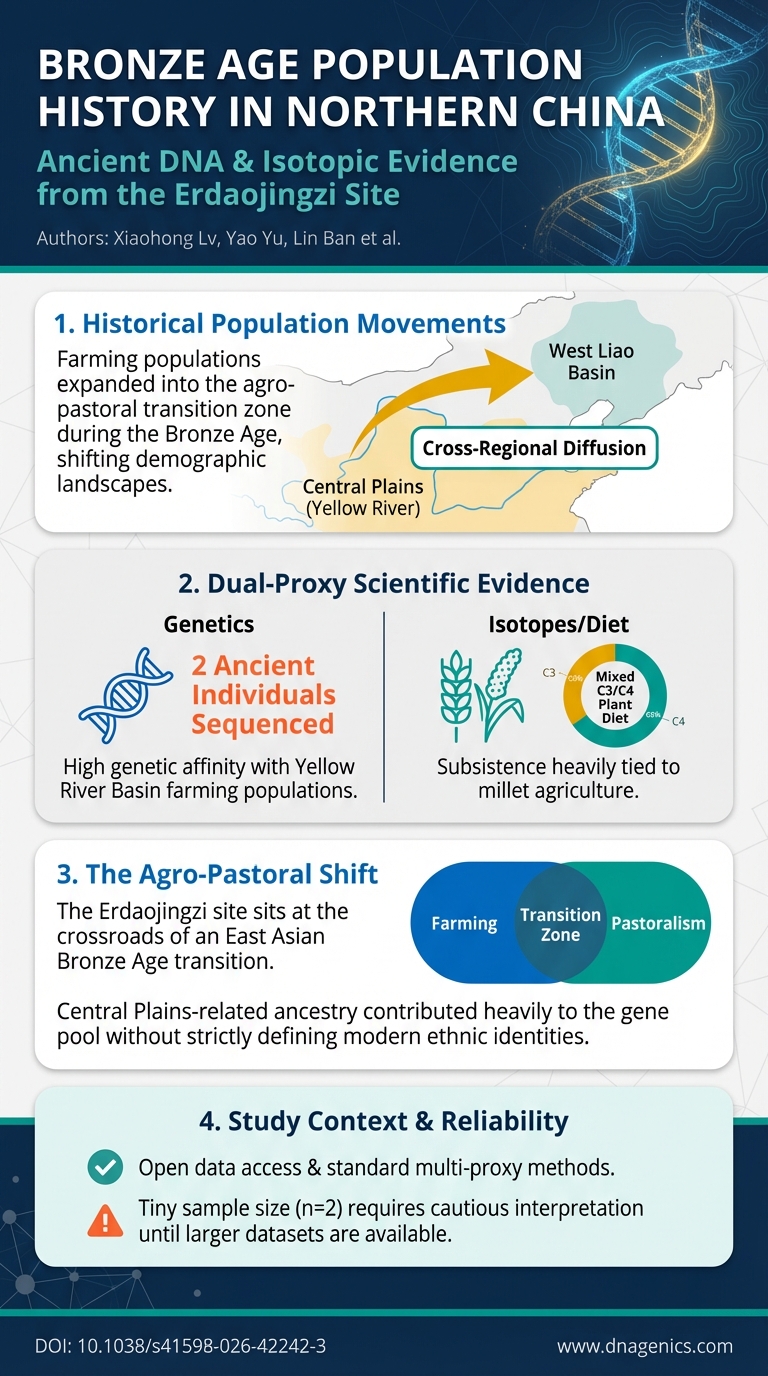 The infographic provides a visual overview of the study’s main findings: genetic affinity to Yellow River Basin farming populations, millet-based subsistence signals, and how these threads weave together into the site’s Bronze Age subsistence strategy.
Why It Matters
This study adds a key piece to the puzzle of East Asian prehistory by showing a concrete link between Central Plains farming expansions and northeastern agro-pastoral communities. It reinforces the view that Bronze Age population history in northern China involved migrations and admixture that accompanied agricultural diffusion, rather than isolated, locally developed lineages. The multi-proxy approach sets a standard for future work, emphasizing how ancient DNA, isotopes, and material culture can converge to illuminate migration patterns and subsistence strategies.
Future research should aim to increase the human sample size, report explicit haplogroups and coverage metrics, and expand to additional sites across the agro-pastoral transition zone. Such efforts will help map the geographic scale and demographic dynamics of Central Plains–related ancestry as it moved through the West Liao Basin and surrounding regions, refining our understanding of how millet agriculture reshaped population structure in prehistoric East Asia.