Introduction
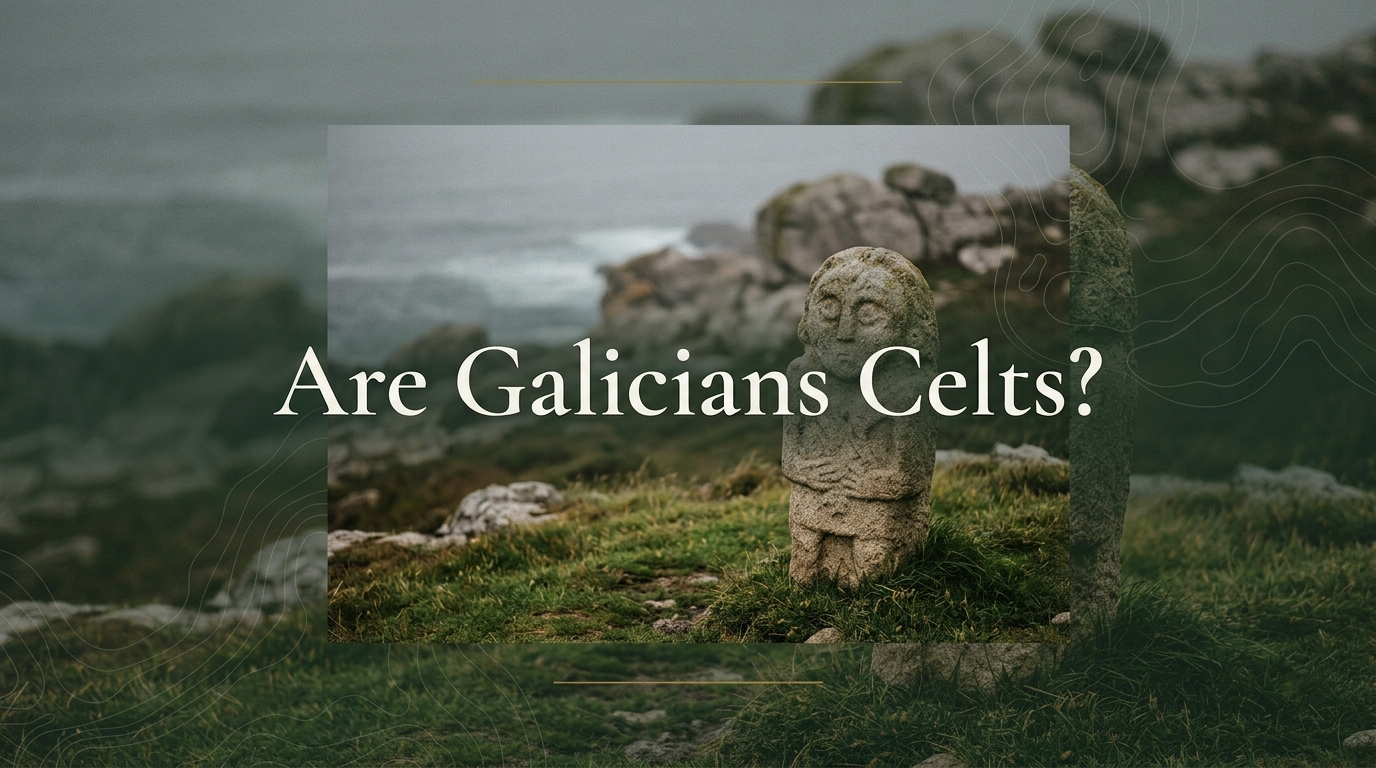
Are Galicians Celts? Galicia’s bagpipes, hillforts, coastal legends, and ties to Ireland and Brittany make this question feel intuitive. In northwestern Spain, the past is visible in the castros, or fortified Iron Age settlements, that crown many hills, while the figure of Breogán remains a powerful symbol in Galician culture. Yet cultural affinity and genetic ancestry do not always follow the same path.
Ancient DNA research now gives us a more detailed way to explore Galicia’s Atlantic roots. It shows that Galicians share deep prehistoric connections with populations around the Atlantic seaboard, especially through Bronze Age migrations associated with the Bell Beaker phenomenon. At the same time, modern Galicians cluster genetically with other Iberian populations far more closely than with the Irish, Welsh, Scots, or Bretons.
The most balanced answer is therefore nuanced: ancient Galicia included Celtic-speaking communities, and Galicia preserves real Atlantic cultural and genetic connections. But present-day Galicians are not simply an Iberian branch of the Irish or a genetically separate “Celtic” population. Their DNA reflects a long, local Iberian history shaped by several migrations, regional continuity, and contact across both the Atlantic and the wider peninsula.
Key Discoveries / Main Points
Galicians are genetically Iberian first. In Global25 comparisons described in the source data, modern Galicians are closest to Portuguese and other Spanish populations, rather than to Celtic-speaking populations of Ireland, Britain, or Brittany.
Bell Beaker migration created an Atlantic genetic link. During the third millennium BC, people carrying substantial steppe-related ancestry spread across Iberia, Britain, and Ireland. This event created an important shared layer of ancestry among Atlantic European populations.
Galicia has less steppe-related ancestry than Ireland. The source models estimate roughly 31% Yamnaya-like ancestry in modern Galicians, compared with about 50% in Irish people and around 47% in Welsh and Breton reference populations. Shared ancestry does not mean identical ancestry proportions.
Y-DNA connects Galicia to broader Atlantic Bronze Age history. Most Iberian Bell Beaker-associated paternal lines belonged to R1b-M269, especially R1b-DF27 in Iberia. A smaller proportion of Galician men carry R1b-L21, a branch especially frequent in Ireland and Brittany.
Celtic language history remains partly unresolved in northwest Iberia. A large ancient-genome study summarized in the source links the spread of Celtic languages mainly to Late Bronze Age movements from Central Europe, but it specifically highlights northeastern Iberia rather than Galicia. The route by which Celtic speech reached ancient Gallaecia remains an open question.
What This Means for Your DNA
For people exploring Galician ancestry through DNA testing, results are most likely to show a strong Iberian profile. Depending on the company and reference panels used, this may appear as Iberian, Portuguese, Spanish, or northwest Iberian similarity. These labels describe statistical resemblance to selected modern reference populations, not a precise map of every ancestor or a direct statement about cultural identity.
A Galician DNA profile can also show affinities shared across Atlantic Europe. This is unsurprising because populations in Iberia, Britain, Ireland, and western France were connected by ancient movements and repeated maritime contact. However, DNA similarity at the population level cannot prove that a particular person descends from an Iron Age Celt, a Bell Beaker migrant, or a legendary family associated with Breogán.
Paternal-line testing can add another perspective. If a man with Galician ancestry belongs to R1b-DF27, that pattern is consistent with a lineage widespread in Iberia after the Bronze Age. If he belongs to R1b-L21, it may indicate a paternal branch that is common farther north in the Atlantic world, but it does not by itself establish Irish ancestry. A haplogroup traces one direct paternal line among many thousands of genealogical ancestors, so autosomal DNA, documentary research, and cousin matching remain essential for family history.
Historical and Archaeological Context
Galicia occupies the northwestern corner of the Iberian Peninsula, facing the Atlantic through its deeply indented rías. This geography encouraged contact by sea. From the Late Bronze Age onward, objects such as metalwork, weapons, cauldrons, and gold ornaments circulated among communities in Galicia, Brittany, Britain, and Ireland. Archaeology therefore supports the idea that Galicia participated in an Atlantic cultural network long before modern national identities existed.
By about the ninth century BC, the Castro culture had spread across much of the region between the Douro River and Asturias. Its settlements often had defensive walls and round stone buildings, features that remain among the most recognizable parts of Galicia’s archaeological landscape. Roman authors referred to the region as Gallaecia and recorded groups called Celtici in parts of the northwest. Later Latin inscriptions include personal names and divine names with Celtic linguistic connections, including Lugus.
This evidence supports the view that Celtic languages were spoken across much of ancient Gallaecia during the Roman conquest. Still, archaeological culture is not a simple ethnic label. The castros of Galicia developed within an Atlantic Iberian setting and were not merely copies of the Hallstatt or La Tène societies of Central Europe. Nearby linguistic diversity also mattered: Lusitanian to the south is often treated as Indo-European but not clearly Celtic, while Basque survived to the east. Ancient northwest Iberia was culturally interconnected, but it was never genetically or linguistically uniform.
The medieval Irish text known as the Lebor Gabála Érenn later connected Ireland to Galicia through Breogán and a tower at Brigantia, usually associated with A Coruña. This tradition is historically important as a medieval origin story, but modern genetic models described in the source do not detect a meaningful Galician or Iberian contribution to modern Irish ancestry. The legend reflects Atlantic imagination and cultural memory more than a demonstrated migration of Gaelic founders from Galicia.
The Science Behind It
The deepest shared genetic layer between Galicia and Atlantic Celtic-speaking regions appears to date largely to the Bell Beaker phenomenon, around 2500 to 2000 BC. Ancient DNA from Iberia indicates that populations with steppe-related ancestry entered the peninsula during this period. Their arrival was associated with a major change in paternal ancestry: the source study reports that nearly all earlier Y chromosomes were replaced, while roughly 40% of overall Iberian ancestry was replaced or introduced through this transformation.
Researchers use autosomal DNA to examine ancestry across all lines of descent, and Y-DNA to follow the direct paternal line. In population genetics, models can estimate the relative fit of ancient source groups to later populations. The source data used a distal model including western hunter-gatherer, Anatolian farmer, Yamnaya-like steppe, Iranian farmer, and North African-related components. Such models are useful for comparing broad trends, especially steppe-related ancestry, but they are not exact reconstructions of individual ancestors.
The Global25 analysis in the source compared average coordinates for 19 modern Galicians with other modern European reference groups. Lower distances indicate greater statistical similarity in this framework. Portuguese, Andalusian, Castilian, Cantabrian, and Asturian references were all closer to Galicians than Breton, Cornish, Welsh, Scottish, or Irish references. This is an important reminder that shared ancient DNA can coexist with substantial later divergence caused by local population history, geography, and additional admixture.
In Simple Terms: Galicians, Irish people, and other Atlantic populations inherited some DNA from related Bronze Age populations. But each region mixed with different neighbors over thousands of years. That is why Galicians can share ancient Atlantic roots with Ireland while still being genetically much closer to other people in Iberia today.
A further question concerns Central European Late Bronze Age populations associated with the Urnfield horizon. The study summarized in the source describes westward movement from groups related to the Knoviz culture in Bohemia into France, the British Isles, northeastern Iberia, and Italy between roughly 3200 and 2800 years ago. It proposes this movement as a major explanation for Celtic language dispersal. Yet Galicia is not identified as a principal sampled destination, and cremation practices leave fewer skeletal remains available for ancient DNA. More samples from northwest Iberia are needed before genetics can resolve this question fully.
Why It Matters
Galicia shows why ancestry is more interesting than a simple yes-or-no identity label. Its population history combines local Iberian continuity, Bronze Age migration, Atlantic exchange, Iron Age cultural development, Roman incorporation, and later historical admixture. Ancient DNA can clarify some parts of that story, but it cannot reduce language, culture, or modern identity to a percentage or a single haplogroup.
Future ancient DNA sampling from Galicia, particularly from Bronze Age and Iron Age contexts, may reveal whether later Central European-related ancestry reached the region directly and how it interacted with the Castro culture. For DNA ancestry research, the larger lesson is clear: the strongest conclusions come from combining genetics with archaeology, linguistics, historical sources, and carefully chosen reference populations.
References / Further Reading
- Olalde, I. et al. (2019). Ancient genome-wide analyses of Iberian population history, including Bronze Age Bell Beaker-associated change.
- Ancient DNA research on Rathlin Island Bronze Age individuals and R1b-L21 in Ireland.
- Nature study summarized in the source material, based on 4,587 ancient genomes, on Late Bronze Age population movements and Celtic language dispersal.
- Classical references to Gallaecia and Celtici, including Strabo, Pomponius Mela, and Pliny the Elder.
- Lebor Gabála Érenn, the medieval Irish pseudo-historical tradition involving Breogán and Brigantia.