Introduction
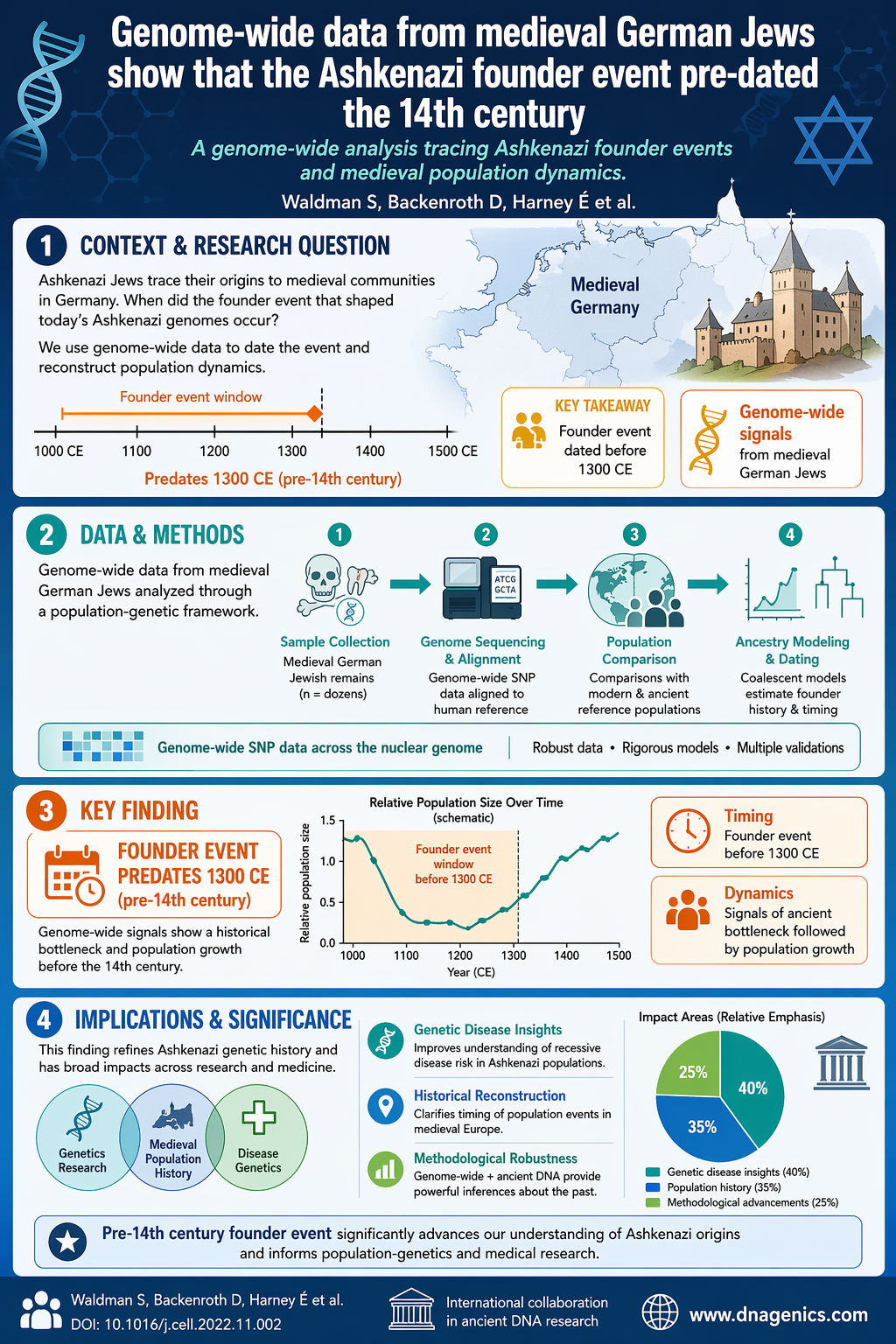
The story of the Ashkenazi Jewish population is written in DNA as clearly as in history books, but with the ink of genomes rather than parchments. A salvage excavation of a medieval Jewish cemetery in Erfurt, Germany, yielded genome-wide data from 33 individuals dated to the 14th century. Despite the era, these genomes show striking connections to modern Ashkenazi Jews (AJ) while also revealing greater variability in Eastern European-related ancestry than we see today.
This research matters because it refines our understanding of when the AJ founder event occurred and how early population dynamics set the stage for later genetic disease patterns. By anchoring the founder event to a time before the 14th century, the study illuminates how an early bottleneck and subsequent migrations shaped the genetic landscape that today influences ancestry interpretations and medical genetics within AJ communities. The Erfurt data also suggest medieval substructure that has since eroded in the modern AJ gene pool, highlighting the dynamic nature of population history.
Key Discoveries
- Ashkenazi Jews founder event occurred before the 14th century, indicating an early establishment and separation from other Jewish populations.
- The founder event significantly shaped the genetic diversity of Ashkenazi Jews, contributing to their distinctive population genetics today.
- The Erfurt samples show more variability in Eastern European-related ancestry than modern AJ, revealing medieval substructure within AJ ancestry components.
- A third of the Erfurt individuals carried a mitochondrial lineage common in modern AJ, and eight carried pathogenic variants known to affect AJ today, underscoring continuity of disease-related alleles.
- Elevated runs of homozygosity (ROH) in Erfurt individuals signal a severe bottleneck, suggesting substructure and strong recent size reductions within medieval AJ.
What This Means for Your DNA
For people exploring their ancestry through DNA testing, these findings sharpen the timeline of AJ history. The pre-14th-century founder event means that much of the modern AJ genetic framework—haplotype blocks, shared segments, and disease-associated variants—was already in place well before late medieval events. The observed medieval heterogeneity also cautions against assuming a uniform ancestral signal across all AJ lineages; some individuals or families may harbor ancestry components that were later diluted or reorganized in the modern population.
Practically, this study reinforces the value of genome-wide data when tracing deep ancestry. While present-day AJ DNA reflects centuries of demographic turning points, ancient genomes reveal the variability and structure that helped sculpt those modern patterns, informing personalized ancestry assessments and the interpretation of disease risk alleles.
Historical and Archaeological Context
Erfurt, a bustling center in medieval central Europe, hosted a sizeable Jewish community with long-standing ties to broader Jewish diasporas. The 14th-century Erfurt cemetery provides a rare window into population dynamics immediately prior to major historical upheavals that would later scatter communities across Europe. The ancient samples connect to modern AJ in their general genetic makeup but differ in the breadth of Eastern European ancestry signals, implying that the medieval AJ population possessed more substructure than is evident in contemporary AJ, reflecting localized endogamy and demographic fluctuations.
These findings dovetail with known migration and admixture patterns in European Jewish history. The data support a scenario in which a founder group formed the backbone of AJ ancestry before the 14th century, followed by subsequent migrations and demographic changes that diversified modern AJ genetic components. Chronologically, the Erfurt genomes sit at a pivotal point between early medieval population formation and later dispersion across European regions, helping map a more nuanced timeline for AJ population genetics.
The Science Behind the Study
The Erfurt samples underwent rigorous ancient DNA analysis, with genome-wide data generated from 33 individuals dated to the 14th century. Researchers compared these ancient genomes to modern Ashkenazi Jewish genomes to assess relatedness, ancestry components, and population structure. Analyses included assessments of genetic similarity (e.g., PCA and admixture-like frameworks), evaluations of heterogeneity in Eastern European ancestry, and calculation of runs of homozygosity to infer past bottlenecks. The pattern of mitochondrial lineages and identification of pathogenic variants provided a link between ancient and modern disease-associated genetic architecture. Overall, the study employed robust genome-wide techniques to reconstruct demographic history, showing a founder event predating the 14th century and signaling substantial medieval substructure within AJ.
- Sample size and preservation: 33 ancient individuals from a salvage excavation, enabling genome-wide analyses despite degradation typical of ancient DNA.
- Analytic approach: comparative genome-wide analyses against modern AJ, focusing on ancestry components, population structure, and homozygosity patterns; integration of mitochondrial haplogroups and known pathogenic variants to trace continuity of disease alleles.
In Simple Terms: Ancient DNA from these 14th-century individuals helps us see not just where modern AJ came from, but how their ancestors lived and mixed before the 1300s. A founder event means a small group set the genetic course, and ROH are long stretches of identical DNA that appear when a population passes through a bottleneck—like a genetic squeeze that leaves lasting marks.
Why It Matters
This work clarifies the timing of the Ashkenazi founder event, demonstrating that central elements of AJ ancestry and disease-associated variants were already present before the 14th century. The discovery of medieval genetic heterogeneity adds nuance to our understanding of AJ population history, emphasizing that modern AJ are the product of longer and more complex demographic processes than a single, uniform founder event. These insights can inform future population-genetics research, improve interpretations of ancestral DNA tests, and guide studies of genetic disease prevalence in AJ communities.
Future research that broadens ancient DNA sampling across Europe and the medieval period will refine the portrait of AJ substructure and migration, helping to bridge archaeological findings with genetic signatures. Such work will deepen our understanding of how historical events shaped present-day genetic diversity and disease risk profiles within AJ populations.
References
- View publication on DnaGenics
- Genome-wide data from medieval German Jews show that the Ashkenazi founder event pre-dated the 14th century
- DOI: 10.1016/j.cell.2022.11.002