Introduction
Local ancestry inference helps scientists map which parts of your genome come from which ancestral populations. This is powerful for understanding population history, migration, and how genetic variation influences traits. Traditional methods rely on quite closely matched reference panels for each ancestry, which is not always feasible for every population.
FLARE2 extends the original method by introducing a haplotype clustering step that enables accurate local ancestry inference even when one or more ancestries lack a close reference. This keeps the speed and scalability of FLARE while broadening its applicability to underrepresented populations and proxy references. In this study, the method is applied to North African Mozabite individuals from the Human Genome Diversity Project (HGDP), illustrating how a mixed ancestry background can be resolved even with imperfect references.
Key Discoveries
- Mozabite autosomal ancestry: about 67% from a Middle Eastern/European-like population and 33% from a West African-like population, highlighting substantial admixture.
- X-chromosome ancestry: about 76% of Ancestry 1 on the X chromosome, suggesting sex-biased admixture with different lineage contributions compared to autosomes.
- Admixture timing: autosomal data estimate roughly 44 generations since admixture; X-chromosome signals show different timing patterns, reflecting complex history and sex-specific migration events; STEAM estimates support recent admixture in autosomes but reveal additional structure on the X chromosome.
- Outliers: two Mozabite individuals show markedly divergent ancestry proportions, underscoring sampling effects and the importance of multi-method validation.
- Methodological contribution: FLARE2’s clustering enables robust local ancestry inference with more reference panels and proxy references, delivering speed advantages over MOSAIC and RFMix while maintaining accuracy.
What This Means for Your DNA
For individuals exploring mixed or underrepresented ancestries, FLARE2 offers a practical path to more reliable local ancestry inferences when perfect reference data are not available. The Mozabite example illustrates how autosomal and X-chromosome patterns can tell different stories, pointing to sex-biased migration and historical population dynamics. When you analyze your own DNA, these methods can help disentangle complex ancestry mosaics across the genome, especially if your lineage involves populations that lack close, well-characterized reference samples.
If you plan to use FLARE2 or similar approaches, remember that results depend on the composition and quality of reference panels, and on the presence of proxy references. The interpretation should consider potential label-switching and the possibility of subtle biases introduced by limited sample sizes.
Historical and Archaeological Context
North Africa has long been a crossroads of migrations and cultural exchange. The Mozabite samples studied here sit within a broader Maghrebi and North African genetic landscape shaped by medieval and earlier movements across the Mediterranean and along trans-Saharan routes. The autosomal results showing a strong Middle Eastern/European-like component alongside a West African-like component align with known historical contact zones and trade networks that connected Europe, the Middle East, and West Africa with North Africa.
The differing X-chromosome signal points to sex-biased admixture, a pattern observed in various global populations where male- or female-mediated gene flow leaves distinct imprints on the sex chromosomes. Taken together, the findings fit a narrative of repeated influxes of people and cultures into North Africa, with complex, multilayered ancestry across generations.
The Science Behind the Study
FLARE2 builds on the original FLARE framework by adding a haplotype clustering step that allows accurate local ancestry inference even when one or more ancestries do not have a closely matched reference panel. This preserves FLARE’s computational efficiency while broadening applicability to proxy references and more diverse populations. In this study, Mozabite individuals from the HGDP served as a test case to demonstrate the method’s robustness when reference panels are imperfect.
Compared with established methods like MOSAIC and RFMix, FLARE2 offers a favorable balance of speed and accuracy, driven by its clustering approach and efficient haplotype processing. The analysis also introduces an ancestry autocorrelation statistic to help detect spurious signals that can arise when reference panels are sparse or poorly matched. The authors note limitations including small sample size and reliance on proxy references, but emphasize the method’s potential to expand local ancestry research to underrepresented populations.
In Simple Terms: FLARE2 groups similar haplotypes into ancestry-like clusters, so it can assign ancestry to genome segments even when the reference data for some ancestries are imperfect or missing. This makes it faster and more flexible while still being accurate.
This section highlights a visual summary of the Mozabite FLARE2 results, including autosomal ancestry proportions and X-chromosome patterns that suggest sex-biased admixture.
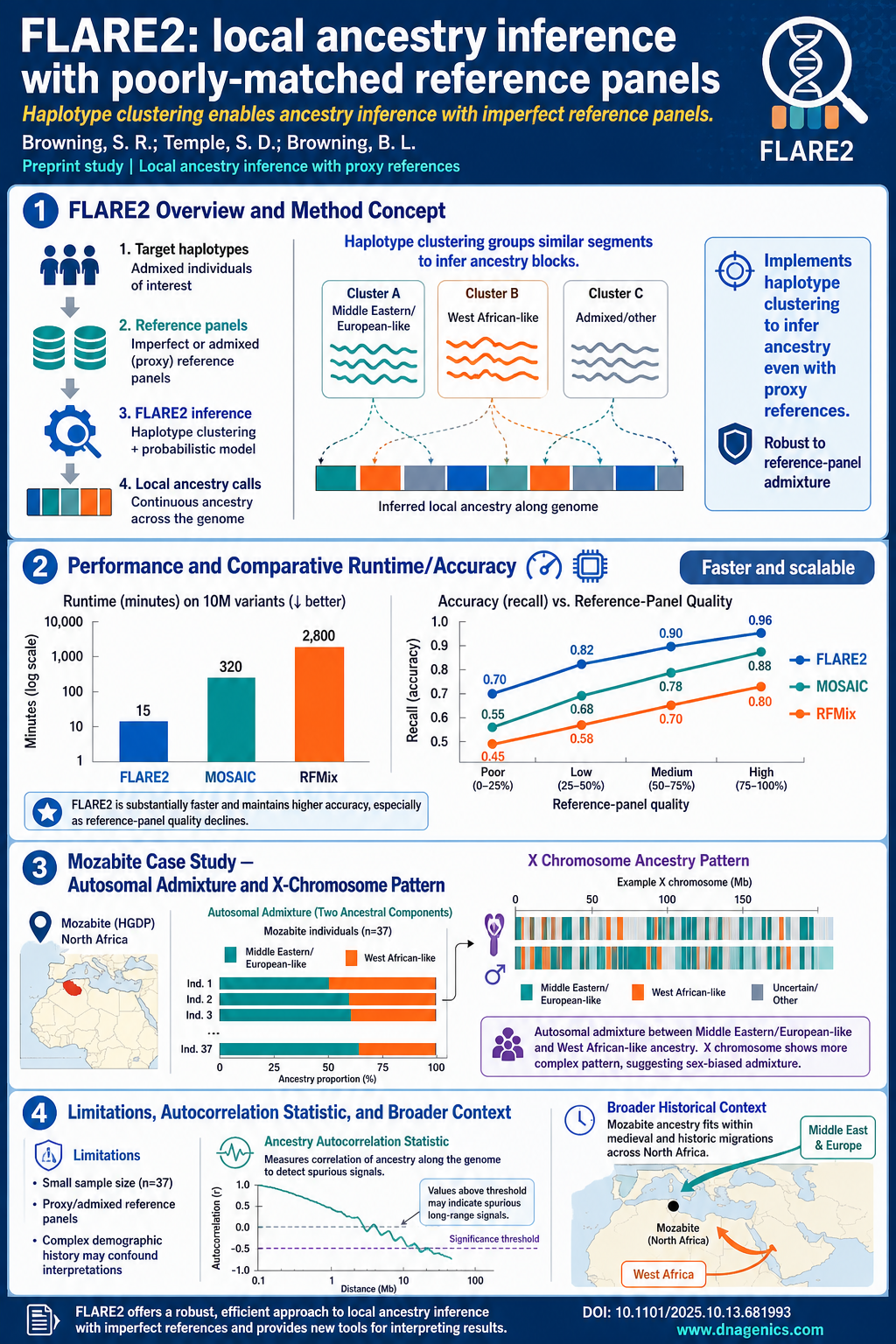
The infographic shows autosomal ancestry proportions (approximately 67% Middle Eastern/European-like and 33% West African-like) and contrasts them with the X-chromosome pattern (about 76% Middle Eastern/European-like for Ancestry 1), illustrating how different parts of the genome can reflect different migration histories. It also notes a pair of Mozabite outliers with unusual ancestry profiles and highlights the reference panel considerations that underpin FLARE2 analyses.
Why It Matters
Expanding local ancestry inference to work with imperfect references broadens the reach of population genetics research to include underrepresented groups. This capability improves our understanding of historical population movements, migration routes, and sex-biased admixture patterns that shaped the genomes of modern populations. In the future, FLARE2-style methods can be applied to larger, more diverse data sets, refining our reconstructions of population history and informing studies on how ancestry influences trait variation and disease risk across populations.
References
FLARE2: local ancestry inference with poorly-matched reference panels
- DOI: https://doi.org/10.1101/2025.10.13.681993