Introduction
The story of medieval Jews in Iberia is often told through manuscripts and archaeology, but a genomic lens can reveal how communities formed, moved, and interacted. In the Roquetes necropolis at Tàrrega (Catalonia, Spain), researchers uncovered six communal graves dated to the mid-14th century, with signs of violence that align with the era’s pogroms. By analyzing DNA from sixteen individuals using Twist ancient DNA enrichment, the study provides a genomic snapshot of a Jewish community in Iberia during a period of upheaval amid the Black Death and rising antisemitism.
Why this matters: genome-scale data from medieval Iberian Jews have been largely unknown until now. This work connects Roquetes to broader Jewish diaspora populations—both ancient and modern—while also illustrating how local Iberian admixture shaped these communities. The findings offer a tangible bridge between historical narratives and genetic evidence, deepening our understanding of migration, identity, and resilience in medieval Europe.
Key Discoveries
- Levantine core with Iberian admixture: Roquetes modeled as ~0.69 Levantine/Canaan MLBA plus ~0.31 Iberian medieval non-Jewish Iberian ancestry, consistent with a Jewish diaspora population that carried a Levantine core while interacting with Iberian neighbors.
- Affinity to Jewish populations: PCA and ADMIXTURE analyses show Roquetes clustering with ancient and present-day Jewish groups (Ashkenazi and Sephardic) and with Erfurt/Norwich Jewry across multiple analyses.
- Diverse uniparental lineages: mtDNA haplogroups span multiple maternal lineages; Y-chromosome haplogroups include J2a2a, E1b1b1a1a1c1b1a1a, G1a1a, and E2a, reflecting varied maternal and paternal inputs typical of Mediterranean Jewish populations.
- Endogamy signal in one individual: ROQ2 displays longer runs of homozygosity (ROH), suggesting background endogamy, while overall kinship among sampled individuals shows no close ties.
- Historical concordance and cautious interpretation: genetic patterns support attribution of the Roquetes burials to the 1348 Tàrrega pogrom; the authors emphasize cautious interpretation due to small ancient DNA sample size and model dependencies.
What This Means for Your DNA
For people exploring ancestry, this study highlights several practical takeaways:
- Ancient DNA teaches us that populations are mixtures. Roquetes’ genome reflects a Levantine core blended with Iberian medieval Iberian ancestry, a pattern that can appear in other Jewish diasporic populations as well.
- Uniparental markers (mtDNA and Y-DNA) reveal maternal diversity and varied paternal inputs, reminding us that surnames or language alone don’t capture personal ancestry. In modern DNA tests, haplogroups offer clues about deep maternal/paternal lineages rather than a complete family tree.
- Acknowledge limitations: small sample sizes, potential reference bias, and admixture models influence inferred ancestry proportions. As in Roquetes, your own DNA results benefit from broader reference panels and integrating archaeology, history, and genetics.
In practice, if you’re tracing Sephardic or other Jewish ancestry, you might encounter deep Levantine signals interwoven with Iberian, North African, or Mediterranean inputs. This study underscores the value of combining autosomal DNA with uniparental markers and historical context to build a nuanced ancestry narrative.
In Simple Terms: This research looks at tiny, ancient fragments of DNA from 16 individuals to estimate where their ancestors came from. By comparing those fragments to modern and ancient reference populations, scientists can infer mixed origins and family patterns even when the DNA is highly degraded.
Historical and Archaeological Context
The mid-14th century in Iberia was a volatile time for Jewish communities. The Black Death and a hostile antisemitic climate fueled pogroms across Europe, including the 1348 attack in Tàrrega. The Roquetes necropolis, with at least sixty-nine individuals in six communal graves showing signs of violence, provides a somber, tangible link to those events. This study is the first to present genomic data for medieval Iberian Jews, offering a genetic perspective to accompany historical records of persecution and diaspora.
Historically, Iberian Jewry formed a vibrant, interconnected network across the Mediterranean, interacting with local Iberian populations and other Jewish diasporas. The Roquetes genomes reflect this interconnectedness: a Levantine-derived core combined with Iberian admixture mirrors patterns seen in both ancient and modern Jewish populations, suggesting sustained contact and gene flow within a broader Mediterranean context. The findings align with historical narratives that identify Iberian Jews as a key node in medieval Jewish migration and exchange.
The Science Behind the Study
The research relies on paleogenomic methods designed to recover and interpret DNA from degraded ancient remains. DNA was enriched using Twist ancient DNA capture to maximize recovery from challenging samples. Researchers then performed a suite of analyses on nuclear DNA and uniparental markers to determine population origin and relatedness:
- Principal Component Analysis (PCA) and ADMIXTURE to visualize ancestry components and affinities with ancient and modern Jewish groups.
- qpAdm modeling to estimate ancestry proportions from proposed source populations (Levantine/Canaan MLBA and Iberian medieval non-Jewish Iberian ancestry).
- Uniparental markers (mtDNA and Y-DNA) to assess maternal and paternal lineages and diversity.
- Runs of Homozygosity (ROH) and kinship analyses to infer endogamy signals and family relationships within the burial.
Sample size and limitations are important: sixteen individuals were analyzed from the Roquetes necropolis, a fraction of the total buried there. While the data reveal clear affinities to Jewish populations and a two-source ancestry model, the authors caution that conclusions depend on model choices and reference panels. Replication with larger ancient DNA datasets would strengthen the portrait of medieval Iberian Jewry.
In Simple Terms: Think of the DNA as a small puzzle made of tiny shards. Scientists use modern and ancient reference puzzles to fit the shards together, estimating where people’s ancestors came from and how they were related, even when most of the puzzle is missing or noisy.
Infographic Section
The study provides a dedicated infographic that summarizes ancestry proportions, population affinities, and the archaeological context of Roquetes. It visually ties the Levantine core and Iberian admixture to the observed uniparental diversity and the historical setting of 14th-century Catalonia, offering a quick, at-a-glance understanding of how genetics and history converge in this case.
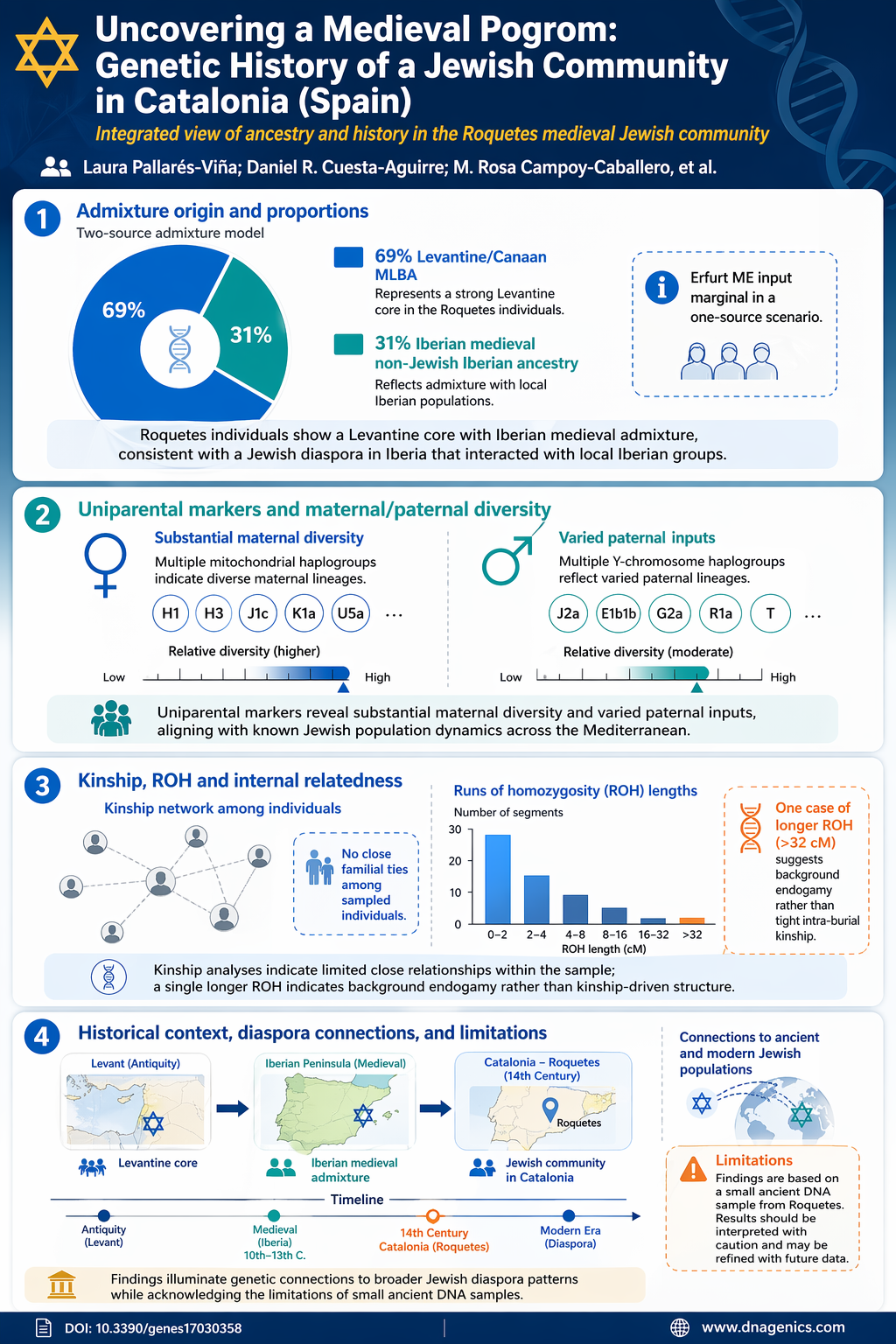
What the infographic shows:
- The dominant Levantine/Canaan signal paired with Iberian Medieval Iberian ancestry
- Clustering with both ancient and modern Jewish populations in PCA/ADMIXTURE analyses
- The diversity of maternal and paternal lineages across individuals
- The absence of close kinship overall, with one individual showing signs of endogamy
Why It Matters
This study marks a milestone by providing genomic data for medieval Iberian Jews, connecting a specific Catalan community to broader Jewish diasporic patterns. It strengthens the narrative that medieval Iberian Jewry was a dynamic, migratory population with deep connections across the Mediterranean. The work also highlights the importance of cautious interpretation in ancient DNA, given small sample sizes and reference-panel limitations. Going forward, expanding Iberian medieval DNA datasets will sharpen our understanding of population movements, admixture, and the social history of Jewish communities in Europe.
Future directions include expanding geographic coverage within Iberia, integrating archaeological context with more refined dating, and refining models with broader reference panels to improve resolution of ancestry components and kinship patterns.
References
Uncovering a Medieval Pogrom: Genetic History of a Jewish Community in Catalonia (Spain)