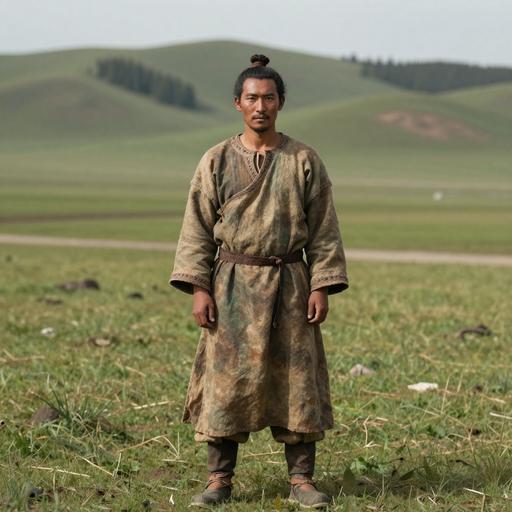
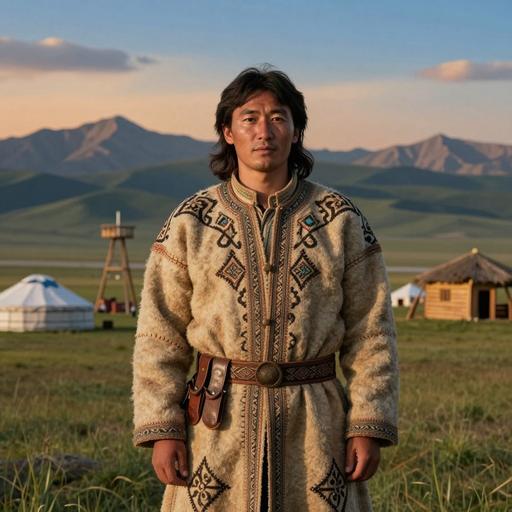
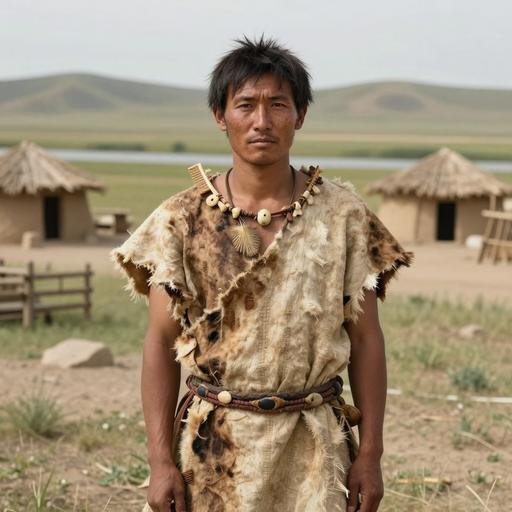
The Story
The journey of mtDNA haplogroup A14
Origins and Evolution
mtDNA haplogroup A14 sits as a subclade beneath the parent lineage AA1A and therefore belongs to the broader mitochondrial A clade, a major East Asian/Siberian maternal lineage. Based on its phylogenetic position under AA1A and comparisons with time estimates for nearby A subclades, a reasonable estimate places the divergence of A14 in the early Holocene (roughly 10–15 kya), a period of post-glacial population reorganization in northern Eurasia. The lineage likely represents a local differentiation event in Northeast Asia or adjacent Siberia following the Last Glacial Maximum.
Because A14 is presently rare in published modern datasets and only tentatively observed in a small number of ancient samples, the internal branching (downstream subclades) of A14 is not yet well characterized in public phylogenies; continued sequencing of complete mitogenomes from the region is needed to resolve its internal structure and age more precisely.
Subclades
At present, A14 is best treated as an intermediate clade with limited publicly reported downstream diversity. No well-supported, extensively sampled sublineages of A14 have been described in the broader literature, which suggests either (a) A14 diversified only modestly and remains rare, or (b) deeper sampling (especially of complete mtDNA genomes from Northeast Asia and Siberia) will reveal additional subclades. As more mitogenomes from the Amur, Okhotsk, and adjacent Siberian regions are reported, the topology beneath A14 may become clearer.
Geographical Distribution
Published and unpublished data that include candidate A14 mitotypes point to a northeast Asian / southern Siberian distribution, often at low frequency. Putative occurrences appear in:
- Indigenous groups of the Amur River basin and adjacent coastal regions
- Some northern Japanese (Jomon-derived) or Hokkaido-related populations in small numbers
- Scattered records in north-central Siberian groups and in Holocene ancient remains from northeastern Eurasia
The pattern is consistent with a lineage that evolved in situ in northern East Asia and was maintained by local hunter-gatherer and early fishing/foraging communities, sometimes surviving into modern populations at low frequency.
Historical and Cultural Significance
Because A14 is rare and under-sampled, its direct association with specific archaeological cultures remains tentative. Reasonable inferences based on geography and time depth suggest links to post-glacial Neolithic hunter-gatherer populations of the Amur/Okhotsk region and possibly to Jomon-related groups in northern Japan. If confirmed in additional ancient samples, A14 could help document regional continuity across the Holocene and the maternal ancestry of coastal and riverine forager communities. The lineage does not currently appear to be a major maternal founder in large-scale migrations (for example, it is not a principal Amerindian founder haplogroup), but it contributes to the mosaic of maternal diversity that informs studies of northern Eurasian population structure.
Conclusion
mtDNA haplogroup A14 is an informative but under-characterized maternal clade within the AA1A branch. Its early Holocene origin in Northeast Asia / Siberia and its occurrence at low frequencies in modern and ancient northern populations make it valuable for fine-scale phylogeographic studies of post-glacial recolonization and regional continuity. Increased mitogenome sampling from the Amur basin, Sakhalin, Hokkaido and neighboring Siberian regions is the most direct path to refining age estimates, resolving subclades, and clarifying archaeological associations.
Key Points
- Origins and Evolution
- Subclades
- Geographical Distribution
- Historical and Cultural Significance
- Conclusion