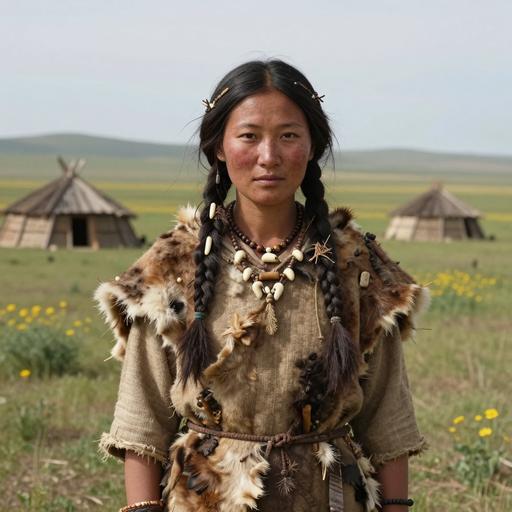
The Story
The journey of mtDNA haplogroup C5D
Origins and Evolution
mtDNA haplogroup C5D is a subclade of haplogroup C5, itself a branch of the broader haplogroup C that diversified in northern and eastern Eurasia after the Last Glacial Maximum. Given the parent clade C5 is estimated to have arisen around the end of the Pleistocene (circa 18 kya), C5D likely differentiated later in the early Holocene (we estimate ~12 kya) within populations occupying central-east Siberia and adjacent Mongolia. Its emergence fits a pattern of post‑LGM population reorganization and local continuity among northern Eurasian hunter‑gatherer groups, followed by later Holocene demographic movements.
Subclades
C5D is a terminal or low‑resolution subclade within the C5 phylogeny in current public databases; further sequencing (complete mitogenomes) may resolve additional branches within C5D. As with many regionally restricted mtDNA clades, improved sampling across Siberia, Mongolia, and adjacent regions often reveals previously unrecognized substructure, so C5D may include geographically localized lineages associated with particular ethnic groups (e.g., Buryat, Evenk, Yakut) once deeper sampling is available.
Geographical Distribution
C5D has its highest frequencies in northern Eurasia, particularly among Siberian and Mongolic/Tungusic populations. Modern reports and population surveys indicate presence in: Yakuts, Buryats, Mongolians, Evenks, Tuvans and other Tungusic groups. There are also scattered occurrences among Tibetan and Himalayan populations (interpreted as either ancient gene flow into the Plateau or Holocene dispersals of northern lineages), as well as low‑frequency detections in some Central Asian groups (e.g., Kazakh, Altaians) and isolated reports farther east (Korea/Japan) or west (northern/eastern Europe) tied to historical gene flow and more recent admixture. C5D has been identified in at least two archaeogenetic samples, indicating its presence in past northern Eurasian contexts.
Historical and Cultural Significance
The geographic and temporal profile of C5D suggests it is associated with long‑term northern Eurasian population continuity and the mosaic of Holocene movements across Siberia and the steppe. It likely persisted in hunter‑gatherer and early pastoralist communities and later moved with or was assimilated into groups involved in Bronze and Iron Age steppe interactions (e.g., cultures of south Siberia and the Eurasian forest‑steppe). In more recent history, expansions and movements associated with Turkic and Mongolic-speaking peoples, as well as localized Tibeto‑Burman migrations into Himalayan foothills, provide plausible routes for the observed scattered distribution of C5D beyond core Siberia.
Conclusion
C5D is a regionally informative northern Eurasian mtDNA lineage that illustrates post‑LGM diversification and Holocene continuity in Siberia and adjacent Mongolia, with downstream traces in the Tibetan Plateau and Central Asia. Its limited but geographically coherent distribution makes it valuable for studies of population continuity, migration routes linking Siberia and the Plateau, and the demographic history of Mongolic/Tungusic and neighboring groups. Continued mitogenome sequencing and targeted ancient DNA sampling in northern Eurasia will clarify its internal structure and historical dynamics.
Key Points
- Origins and Evolution
- Subclades
- Geographical Distribution
- Historical and Cultural Significance
- Conclusion