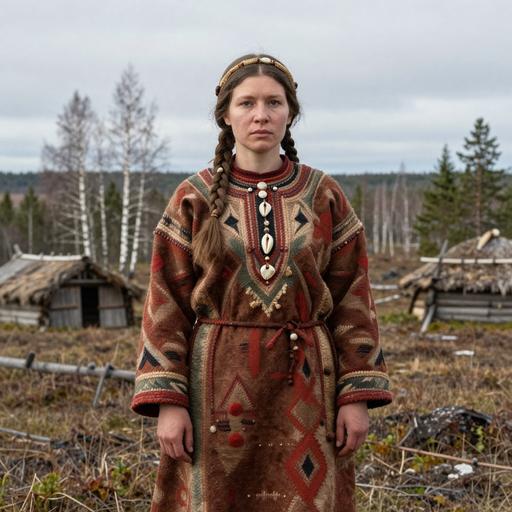
The Story
The journey of mtDNA haplogroup Z1A1
Origins and Evolution
mtDNA haplogroup Z1A1 is a downstream branch of Z1A, itself derived from haplogroup Z1. The parent clade Z1A likely formed in northeastern Eurasia after the Last Glacial Maximum (LGM), and Z1A1 appears to have diversified during the early Holocene as populations that had weathered the LGM in Siberia and adjacent regions expanded and restructured. Based on its phylogenetic position and the time depth of its parent clade, a reasonable estimate places the origin of Z1A1 in the early to mid-Holocene (~9 kya), consistent with postglacial recolonization and demographic processes in northeast Asia.
Subclades (if applicable)
Z1A1 is a named subclade within Z1A; if further internal divisions exist (for example Z1A1a, Z1A1b in some phylogenies), they are typically rare and geographically localized. Ancient DNA records for Z1A1 remain sparse (only a few archaeological occurrences have been reported in available datasets), so the internal branching structure is less well resolved than for some more common haplogroups. Continued mitogenome sequencing of modern and ancient samples from Siberia and adjacent regions will refine subclade topology and dating.
Geographical Distribution
Z1A1 shows a strongly northeastern Eurasian distribution with focal concentrations among indigenous Siberian groups and peripheral presence in neighboring regions:
- Core area: Indigenous Siberian populations (e.g., Evenk, Yakut, Nganasan and related groups) show the highest incidence of Z1A lineages, including Z1A1. These occurrences reflect long-term regional continuity of maternal lineages in Siberia.
- Inner Asia and Mongolia: Z1A1 occurs among Mongolian and Inner Mongolian populations at low but detectable frequencies, consistent with prehistoric and historic gene flow across the Mongolian steppe and forest-steppe margins.
- Northeast China: Low-frequency occurrences are recorded in northern Chinese provinces such as Heilongjiang and Liaoning, reflecting geographic proximity and historical contacts between Northeast China and Siberia.
- Central Asia: Scattered, low-frequency occurrences are found in parts of the Altai, western Mongolia and among some Kazakh groups, probably reflecting westward migrations and admixture events in the Holocene.
- Northern Europe: Very low-frequency appearances of Z1A1 in northern Europe (including Sámi and Scandinavian contexts) have been reported; these are best interpreted as isolated maternal gene flow events from eastern Eurasia into Fennoscandia, potentially mediated by later contacts (Bronze Age and onwards) or more recent historical movements.
Overall, Z1A1 is not a high-frequency continental haplogroup but a lineage with clear ties to the northeastern Eurasian mtDNA pool.
Historical and Cultural Significance
Because Z1A1 is concentrated in Siberia and adjacent regions, it is informative for reconstructing postglacial demographic dynamics in northeast Eurasia. Its presence among indigenous Siberian groups ties it to long-term forager and pastoralist histories in the taiga and steppe zones. The low-level presence of Z1A1 in Central Asia and northern Europe provides evidence for episodic east–west gene flow during the Holocene, which may be associated with broad-scale processes such as:
- postglacial re-expansion and local Neolithic forager continuities in Siberia,
- Bronze Age movements across the Eurasian interior that redistributed some eastern maternal lineages toward Central Asia,
- later historical and medieval contacts (including movements associated with steppe pastoralist groups and Uralic expansions) that could carry rare eastern lineages into northern Europe.
Caution is warranted in tying Z1A1 to any single archaeological culture because its frequency is low and its occurrences are scattered; however, the haplogroup contributes to the genetic signature of northeastern Eurasian populations that appear in ancient DNA records from Neolithic and later contexts.
Conclusion
mtDNA Z1A1 is a geographically informative, low-frequency maternal lineage characteristic of northeastern Eurasia. Its early Holocene origin and distribution among indigenous Siberian, Mongolian, northeastern Chinese and some Central Asian and northern European groups make it a useful marker for studying postglacial population continuity in Siberia and episodic east–west gene flow in the Holocene. Continued targeted mitogenome sequencing of both modern and ancient remains will sharpen our understanding of its internal structure, timing, and routes of dispersal.
Key Points
- Origins and Evolution
- Subclades (if applicable)
- Geographical Distribution
- Historical and Cultural Significance
- Conclusion