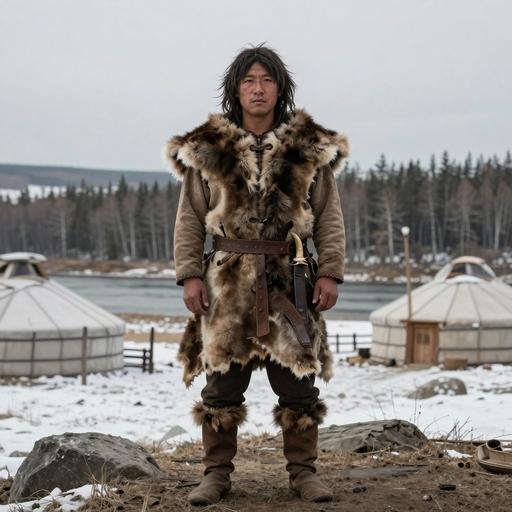
The Story
The journey of mtDNA haplogroup C4B3
Origins and Evolution
mtDNA haplogroup C4B3 is a subclade of the C4B (C4b) lineage, itself a descendant of the broader haplogroup C4. The parent C4B expanded in northern Asia after the Last Glacial Maximum (~16 kya). Based on its position within the C4B phylogeny and the distribution of related subclades, C4B3 most likely differentiated during the early- to mid-Holocene (several thousand years after the main post-LGM expansion), reflecting localized maternal diversification among populations in Siberia and adjacent regions.
The emergence of C4B3 can be interpreted as part of the broader pattern of postglacial population re-expansion and regionalization in northeastern Asia, where environmental amelioration and the development of localized foraging, and later pastoralist and agro-pastoralist lifeways, promoted the formation of regionally distinctive maternal lineages.
Subclades (if applicable)
C4B3 is a terminal or near-terminal branch in many published phylogenies and ancient-DNA reports, so detailed internal substructure is limited compared with older, deeper clades. Where further subdivisions exist, they are generally rare and geographically localized, often identified only when high-resolution complete mtDNA genomes are available from targeted Siberian or Central Asian sampling. Continued sequencing of modern and ancient mitogenomes in northeastern Asia may reveal additional minor subclades derived from C4B3.
Geographical Distribution
C4B3 is primarily a northeastern Asian (Siberian) lineage with a distribution pattern characterized by:
- Moderate to low frequencies among Indigenous Siberian groups (for example in Yakut, Evenk, Nenets and related Tungusic and Uralic-speaking peoples).
- Presence in Mongolic- and Tungusic-speaking populations (Buryats, Evens, some Mongolian samples) and in several Central Asian groups (Tuvans, Altaians, Kazakhs) reflecting historical regional contact and movement.
- Sporadic low-frequency occurrences in populations nearer Beringia and occasional detection in ancient or admixed contexts in northern Eurasia; downstream presence in the Americas is rare and typically associated with other C4 subclades rather than C4B3 specifically.
- Isolated occurrences in Himalayan or highland populations have been reported in a few studies, suggesting episodic long-distance gene flow or ancient connectivity across southern Siberia and the high plateaus.
Historical and Cultural Significance
C4B3 should be viewed as part of the matrilineal substrate of northeastern Eurasia. Its presence in both hunter-gatherer and later pastoralist contexts indicates continuity and gene flow through major cultural transitions: from postglacial foragers to Neolithic and Bronze Age communities and into historic-era pastoralist societies. Ancient DNA records linking C4 and C4B derivatives to Mesolithic/Neolithic Siberian foragers and to Bronze Age groups in southern Siberia emphasize the clade's role in the peopling and demographic history of north-central Eurasia.
Although C4B3 is not associated with any single pan-regional archaeological culture at high frequency, it contributes to the genetic signature of regional groups involved in trading, mobility, and admixture across Siberia, Central Asia and adjacent regions during the Holocene.
Conclusion
mtDNA haplogroup C4B3 is a geographically informative maternal lineage that reflects postglacial diversification in northeastern Asia. Its moderate but localized frequency across Siberian and Central Asian populations, and occasional detection in archaeogenetic datasets, make it a useful marker for studying female-mediated continuity and regional population structure in northern Eurasia. Continued mitogenome sequencing in under-sampled regions and time periods will refine its internal structure and chronology.
Key Points
- Origins and Evolution
- Subclades (if applicable)
- Geographical Distribution
- Historical and Cultural Significance
- Conclusion