The Story
The journey of mtDNA haplogroup G
Origins and Evolution
mtDNA haplogroup G is a descendant of the M12'G node within macro-haplogroup M, placing its origin within the broad East Eurasian/ northern Asian maternal radiation of the Upper Paleolithic. Coalescence age estimates for the G clade and its main sublineages typically fall in the late Upper Paleolithic to early post-glacial period (roughly ~30–45 kya, with commonly used working estimates near ~35 kya), consistent with an origin in northeastern Asia or adjacent Siberian regions. From that ancestral population, G diversified into a set of subclades that show regional structure reflecting later population isolation, local expansions and Holocene demographic events.
Ancient DNA studies and modern population surveys indicate that G emerged after the initial M-bearing migrations across Asia and reflects later, regionally focused differentiation in northern Eurasia. Its phylogenetic position as a daughter of M12'G means G and the sibling clade M12 share a recent common maternal ancestor before differentiating into distinct geographic and genetic lineages.
Subclades
Haplogroup G is divided into several recognized subclades (commonly labeled G1, G2, G3, G4, G5, and their downstream branches). Each subclade shows typical geographic tendencies:
- G1 —often observed in Japan (including Jomon-associated remains), parts of Korea and northeastern China.
- G2 —frequent among Siberian and Tungusic-speaking groups, and found across eastern Central Asia.
- G3–G5 —lower-frequency branches distributed sporadically across East Asia and Central Asia, with some localized clusters in Mongolia, the Russian Far East and adjacent areas.
These subclades provide the finer phylogeographic signal used to infer local histories: for example, certain G1 lineages are enriched in ancient Jomon samples and modern Ainu/Japanese populations, while G2 and other sublineages are more typical of continental Siberian and Mongolic/Tungusic groups.
Geographical Distribution
G is principally a Northeast Asian / Siberian maternal lineage. High or moderate frequencies appear in:
- Northern Japan (including Jomon-descended groups), parts of the Japanese archipelago and the Ainu.
- Korean and northeastern Chinese populations at low-to-moderate frequencies.
- Indigenous Siberian groups (e.g., Buryat, Evenk, some Yakut and other North Asian groups) and parts of Mongolia and eastern Central Asia.
Outside of its core range, G occurs at low frequencies in neighboring regions due to historical gene flow (for example, scattered occurrences in Central Asia and in eastern parts of Russia and Europe where Siberian admixture has occurred). Unlike the principal Native American founding haplogroups (A, B, C, D, X), G does not represent a major founding lineage of the Americas and is only rarely observed there.
Historical and Cultural Significance
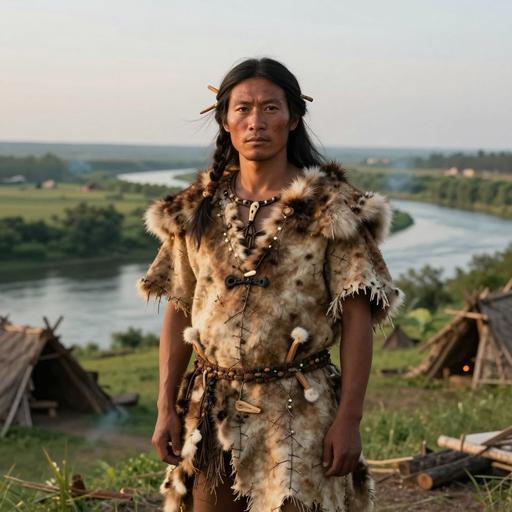
Genetic evidence links haplogroup G to several prehistoric and historic northeastern Asian populations. Notably, Jomon-era remains from Japan include G lineages, supporting a role for G-bearing maternal lines in the pre-Neolithic populations of the Japanese archipelago. In Siberia and Mongolia, G subclades appear in modern groups associated with Tungusic- and Mongolic-speaking peoples and are consistent with continuity from Holocene hunter-gatherer and early pastoralist communities.
During the Neolithic and later Bronze/Iron Age periods, demographic processes (local expansions, cultural diffusion and steppe-associated movements) redistributed maternal lineages across northern Eurasia. Haplogroup G's persistence in regional populations reflects both long-term continuity in some areas and later admixture in others; therefore G can act as a marker for northern East Asian ancestry in both modern and ancient genomic contexts.
Conclusion
mtDNA haplogroup G is a regionally important East Eurasian maternal lineage that arose from the M12'G node in the Upper Paleolithic and diversified into several subclades with distinct geographic patterns in Northeast Asia and Siberia. It is particularly informative in studies of Jomon-period populations, Holocene Siberian hunter-gatherers, and the population history of northern East Asia, where it complements the broader set of northern maternal haplogroups (such as C and D) to reconstruct migration and admixture events over the last tens of thousands of years.
Key Points
- Origins and Evolution
- Subclades
- Geographical Distribution
- Historical and Cultural Significance
- Conclusion