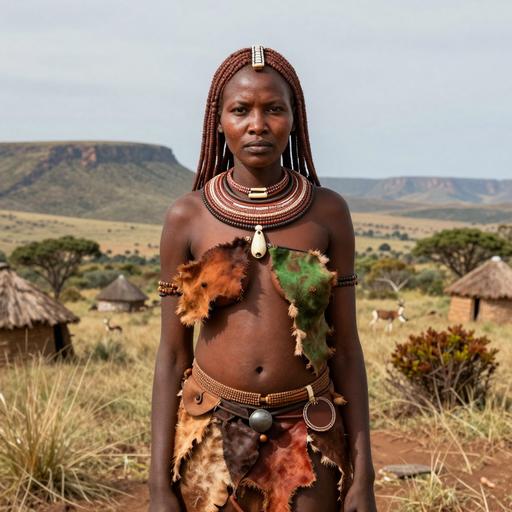
mtDNA · Maternal lineage

L0D1A1

mtDNA Haplogroup L0D1A1

A reference profile for one lineage branch. Shared haplogroups do not establish a family relationship or cultural identity.

Reference profile

Branch background

Historical context for mtDNA lineage branch L0D1A1

Origins and Evolution

mtDNA haplogroup L0d1A1 is a subclade of L0d1A, itself part of the deep-rooting L0d branch that is characteristic of southern African maternal diversity. The parent clade L0d1A has been estimated to date to the Late Pleistocene (~35 kya), and L0d1A1 represents a later, more derived lineage that likely coalesced in the terminal Pleistocene to early Holocene (roughly ~12 kya, though point estimates vary by study and molecular clock calibration). Like other L0d branches, L0d1A1 reflects long-term continuity of maternal lineages in southern Africa and a deep divergence from non‑African and many other African haplogroups.

Ancient DNA studies and population surveys indicate that L0d lineages were present among local forager populations for many millennia. The emergence of L0d1A1 is best interpreted in the context of local population structure among Khoe‑San ancestors and subsequent demographic events (climate-driven population changes at the Pleistocene–Holocene transition and later contact with expanding Bantu-speaking populations).

Subclades (if applicable)

L0d1A1 is a terminal/derived branch beneath L0d1A. Depending on the resolution of sampling and sequencing, researchers may recognize further nested subclades within L0d1A1 in highly sampled Khoe‑San groups; however, many published datasets treat L0d1A1 as a relatively fine-scale lineage defined by a small set of diagnostic mutations. Continued dense sequencing of southern African populations and ancient genomes is likely to resolve additional internal structure and local microphylogeography.

Geographical Distribution

L0d1A1 is concentrated in southern Africa, particularly among Khoe‑San forager groups (e.g., Ju|'hoan, !Kung, Nama and related populations). It also appears at lower frequencies in nearby Bantu-speaking populations and other groups in the region as a result of historic and prehistoric admixture. Occasional low-frequency occurrences have been reported farther afield (e.g., parts of eastern and central Africa and, rarely, among African-descended populations in the Americas) but these are best explained by recent movement or sparse historical gene flow rather than broad prehistoric expansions.

Historical and Cultural Significance

Because L0d1A1 is embedded in the broader L0d diversity that is tightly associated with Khoe‑San groups, it carries significance for studies of southern African population history, including continuity of Late Pleistocene forager lineages through the Holocene. The persistence of L0d1A1 in present-day Khoe‑San and its occasional presence in neighboring Bantu populations illustrate long-term local continuity combined with episodic admixture during events such as the Bantu expansions and more recent historical contacts. Archaeogenetic data from southern Africa support the interpretation that many L0d lineages reflect very ancient local ancestry, making L0d1A1 informative for reconstructing maternal population structure in the region.

Conclusion

L0d1A1 is a regionally focused maternal lineage that exemplifies the deep-time genetic heritage of southern African forager populations. It is best understood as a derived branch of an ancient southern African mtDNA radiation, retained at high frequency in some Khoe‑San groups and found at lower frequency in admixed and neighboring populations. As sampling and ancient DNA coverage improve, the internal structure and finer-scale geographic history of L0d1A1 will be clarified, but current evidence underscores its role as a marker of long-term maternal continuity in southern Africa.

Notes on dating and distribution: coalescence age estimates vary with mutation-rate assumptions and sample coverage; statements above reflect conservative synthesis of population-genetic and ancient-DNA literature concerning L0d lineages and their subclades.

Key Points

  • Origins and Evolution
  • Subclades (if applicable)
  • Geographical Distribution
  • Historical and Cultural Significance
  • Conclusion
Reference profile

Tree & Relationships

Phylogenetic context and subclades

Evolution Path

Follow the recorded parent branches toward L0D1A1. Dates are estimates and can change as reference data is revised.

Steps Haplogroup Age Estimate Archaeology Era Time Passed Immediate Descendants Tested Modern Descendants Ancient Connections
1 L0D1A1 Current ~12,000 years ago Neolithic 12,000 years 1 2 0
2 L0D1A ~20,000 years ago Mesolithic 20,000 years 1 2 0
3 L0D1A'D - - - 1 2 0
4 L0D1A'C'D - - - 2 3 0
5 L0D1 ~60,000 years ago Paleolithic 60,000 years 2 8 0
6 L0D1'2 - - - 2 14 0
7 L0d ~120,000 years ago Paleolithic 120,000 years 2 24 4
8 L0 ~170,000 years ago Paleolithic 170,000 years 3 384 6
9 L ~160,000 years ago Paleolithic 160,000 years 2 32,236 5
Reference profile

Where in the World

Geographic distribution and modern presence

Recorded origin

Southern Africa

Modern Distribution

The populations where mtDNA haplogroup L0d1A1 is found include:

  1. Khoe-San groups of southern Africa (e.g., Ju|'hoan, !Kung, Nama)
  2. Various southern African Bantu-speaking populations (low-to-moderate frequency due to admixture)
  3. Some East African populations at low frequency (reflecting ancient and historic contacts)
  4. Central African forager groups at low frequency
  5. African-descended populations in the Americas (rare, due to the transatlantic slave trade)
  6. Occasional low-frequency occurrences in North Africa and the Near East (historical admixture)
Historical context

A branch through time

Estimated formation in a broad historical timeline. Period markers provide context and do not imply a connection with particular cultures.

  1. ~12k years ago

    Haplogroup L0D1A1

    Estimated formation of this mtDNA branch; dates and locations are reference estimates.

    This branch
  2. ~10k years ago

    Neolithic Revolution

    Agriculture begins, settled communities form

  3. ~5k years ago

    Bronze Age

    Metalworking, writing, and early civilizations

  4. ~3k years ago

    Iron Age

    Iron tools, expanded trade networks

  5. ~2.5k years ago

    Classical Antiquity

    Greek and Roman civilizations flourish

  6. Present

    Present Day

    Modern era

Reference profile

Archaeological context

Recorded archaeological associations for mtDNA branch L0D1A1

Recorded associations

These labels describe archaeological contexts recorded for reference samples linked to L0D1A1. An association does not establish that all carriers belonged to a culture or followed a particular migration route.

Fingira Culture Late Iron Age Makwasinyi Malawian LSA Mtwapa Pemba Phase I Tanzanian Prehistoric Terminal Stone Age Zambian LSA
Culture assignments are based on archaeological context of ancient DNA samples and may represent regional associations during specific time periods.
Reference profile

Sample Catalog

2 subclade carriers of haplogroup L0D1A1 (no direct carriers in the current reference selection)

2 shown · 2 matching samples

Portraits are AI-generated illustrations. Sample labels and accession IDs identify the reference records.

Portrait Sample Country Era Date Culture mtDNA Match
AI-generated illustrative portrait of Bantu individual, Kasteelberg, South Africa (665-884 CE)
Sample ID: UCT473
South Africa SouthAfrica 1200BP 665 CE - 884 CE Late Iron Age L0d1a1a Subclade
AI-generated illustrative portrait of Africa South Ancient individual, Kasteelberg, South Africa (884-665 BCE)
Sample ID: UCT473
South Africa Ancient South Africa 665 BCE - 884 BCE L0d1a1a Subclade
MATERNAL LINEAGE · ANCIENT DNA

Ancient lineage evidence map

Follow parent clades toward this branch and explore where ancient carriers were found.

Loading ancient observations…

Markers are archaeological find locations. A dashed connector is an uncertain, proposed geographic transition between consecutive branches supported by multiple dated observations; it is not an exact travel route, birthplace or proof of direct descent. Parent-clade samples may belong to other descendant branches. Gaps remain where evidence is insufficient. Sample dates differ from haplogroup formation dates.

Reference profile

Carrier Distribution Map

Geographic distribution of 2 ancient DNA samples (direct and subclade carriers of L0D1A1)

Subclade carrier
Time Period Filter
All Time Periods
Showing all samples
Reference profile

Temporal Distribution

Distribution of carriers across archaeological periods

Reference profile

Geographic Distribution

Counts by recorded sample country. These reflect the available reference selection, not population frequencies.

Reference profile

Country × Era Distribution

Compare recorded sample counts across countries and archaeological periods. Select a populated cell to inspect a sample.

Data

Data & Provenance

Source information and data quality

Last Updated 2026-02-16
Confidence Score 50/100
Coverage Low

Data Source

Classification, estimated dates and geographic context reflect the recorded reference data and may change as evidence is revised. Sample coverage is uneven; recorded locations and archaeological associations do not establish personal origin or cultural identity.

A haplogroup follows one maternal or paternal line. The branch prediction depends on which markers the DNA file contains. How our analysis works