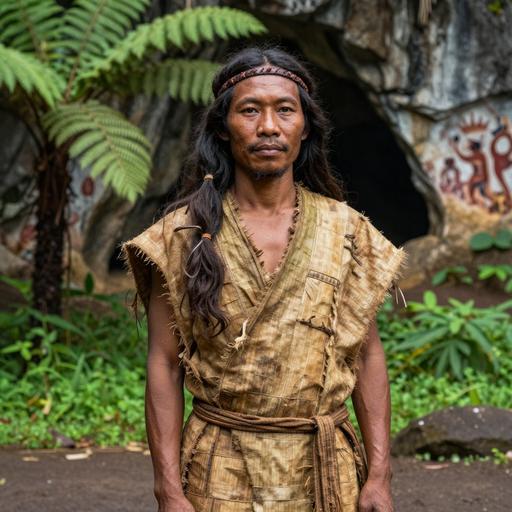
The Story
The journey of mtDNA haplogroup M21B1
Origins and Evolution
mtDNA haplogroup M21B1 is an internal subclade of the broader M21 lineage (through intermediary nodes such as M21B / M21BB). As a sub-branch of macro-haplogroup M, it is part of the deep Asian maternal radiation that followed the initial Out-of-Africa dispersals. Based on the phylogenetic position within M21 and comparisons with coalescence estimates for neighboring M subclades, M21B1 most plausibly arose in Mainland or Island Southeast Asia during the Late Pleistocene to early Holocene (order of ~15–25 kya), although precise molecular dating requires targeted full mitogenome sampling and calibrated analyses.
Subclades
M21B1 is described as an intermediate / terminal clade within M21B-derived diversity. At present it is thought to have limited internal branching (few well-documented downstream subclades), which is consistent with either a relatively recent origin for the subclade or low sampling coverage. Because M21B1 sits between higher-level M21 nodes and later, locally diversified lineages, it is useful for reconstructing maternal genealogies that connect ancient hunter-gatherer groups of mainland and island Southeast Asia with later population events.
Geographical Distribution
The available phylogeographic signal for M21 and its derivatives indicates a Southeast Asian focus. M21B1 is best considered a regionally restricted lineage likely found at low-to-moderate frequencies in indigenous groups of the Malay Peninsula, Borneo, Sumatra, and parts of the Philippines, and as a rare lineage in neighboring mainland populations. Its distribution pattern is consistent with persistence in refuge populations (for example, rainforest hunter-gatherers and Negrito groups) and partial continuity through later demographic events (e.g., Neolithic farmer expansions and Austronesian movements), leading to low-frequency survival in some modern populations.
Historical and Cultural Significance
Because of its putative antiquity and confined geographic distribution, M21B1 is most relevant for studies of Southeast Asian prehistory. It likely reflects components of the maternal gene pool associated with Late Pleistocene and early Holocene hunter-gatherer communities (often connected in archaeological literature to the Hoabinhian and later rainforest forager traditions). During the Holocene and Neolithic, incoming agriculturalists (including Austroasiatic and later Austronesian-speaking groups) reshaped regional genetic landscapes; M21B1's persistence at low frequencies in some present-day groups indicates episodes of assimilation and continuity rather than wholesale replacement.
Conclusion
M21B1 is a useful marker for fine-scale reconstruction of maternal ancestry in Southeast Asia. Although currently undersampled and requiring more full mitogenome data for confident dating and distributional mapping, available evidence supports an origin in Southeast Asia during the Late Pleistocene to early Holocene and an association with indigenous hunter-gatherer populations that have been partially integrated into later populations. Targeted sequencing of indigenous and ancient remains across the Malay Peninsula, Borneo, Sumatra, and the Philippines will clarify its phylogeography and demographic history.
Key Points
- Origins and Evolution
- Subclades
- Geographical Distribution
- Historical and Cultural Significance
- Conclusion