The Story
The journey of Y-DNA haplogroup D
Origins and Evolution
Haplogroup D is one of the deep non-African Y-chromosome lineages that branches from the DE clade (the other major branch being haplogroup E, mainly African). Current population-genetic evidence indicates that D split from the DE ancestor soon after the out-of-Africa expansions and established a long-lasting presence in Asia. Dating analyses place the origin of D roughly in the Upper Paleolithic (on the order of ~50–70 kya), followed by isolation and regional differentiation into multiple geographically distinct subclades.
The phylogeographic pattern of D—high frequency in small, often isolated populations and low, scattered presence across many mainland groups—suggests an early migration into Asia with subsequent population bottlenecks, founder effects, and local drift shaping its distribution.
Subclades
The best-known marker for the clade is D-M174 (commonly used in many studies), and downstream sublineages show strong regional structure rather than broad, continuous dispersal. Major geographic clusters include:
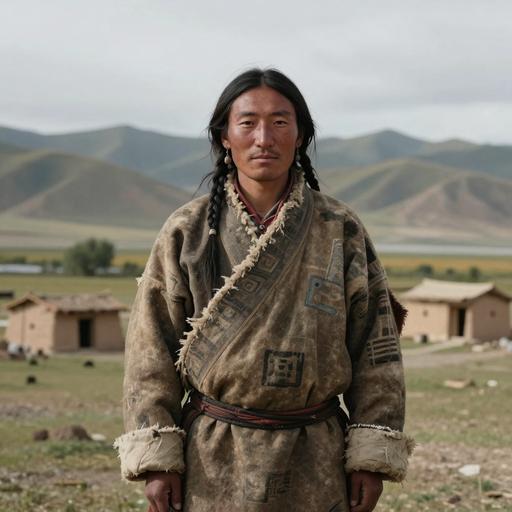
- a Himalayan/Tibetan cluster largely found among Tibeto-Burman and high-altitude groups;
- a Japanese cluster (including Ainu and some Ryukyuan/Japanese lineages) that reflects an ancient Jomon-related component in the archipelago;
- Andaman Islands lineages present at very high frequency in small island populations (Onge, Jarawa).
Different research groups use varying SNP labels for subclades; the general pattern is that D has a few deep splits that became regionally restricted and genetically distinctive, rather than a wide pan-continental expansion.
Geographical Distribution
Haplogroup D shows a patchy but strongly regionalized distribution. It reaches high local frequencies in specific, often isolated populations (e.g., Andaman Islanders, some Tibetan groups, Ainu), while appearing at low frequencies across parts of mainland East, Central, and Southeast Asia. The modern distribution likely reflects ancient peopling routes into East and South Asia, combined with millennia of drift and demographic change.
Importantly, while D is prominent in some highland and island groups, major later expansions in East Asia (for example, those carrying Y-haplogroup O) have largely replaced or diluted D in many areas of the continental mainland.
Historical and Cultural Significance
Because haplogroup D traces to deep Paleolithic roots in Asia, it is often associated in the literature with early hunter-gatherer populations of the region rather than with later farming or steppe-metalworking migrations. Specific cultural associations include:
- Jomon-era Japan: the presence of D lineages in Ainu and some Japanese groups aligns with an ancestral Jomon affiliation in the archipelago.
- Andaman hunter-gatherers: very high local frequencies of D in the Onge and Jarawa indicate extreme isolation and continuity on the Andaman Islands.
- Tibetan Plateau populations: D is one of several Y-lineages present among Tibeto-Burman speakers and high-altitude communities; however, physiological high-altitude adaptations are driven mainly by autosomal genes, not Y-chromosome markers.
Because D is not a marker of major later continental demographic events (e.g., Neolithic farmer expansions from the Yellow River or Bronze Age steppe migrations), its chief significance is as a tracer of early, regionally persistent paternal ancestry.
Conclusion
Haplogroup D is a geographically focused, deep Eurasian paternal lineage that illuminates aspects of early human settlement and regional continuity in parts of East and South Asia. Its pattern—localized high frequencies within otherwise low-frequency broader distributions—reflects ancient splits, drift, and long-term isolation rather than the large-scale demographic turnovers that characterize other, later Y-haplogroups in Asia.
Key Points
- Origins and Evolution
- Subclades
- Geographical Distribution
- Historical and Cultural Significance
- Conclusion