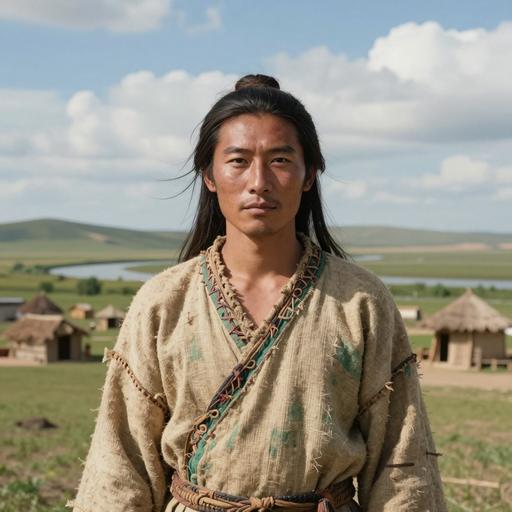
The Story
The journey of Y-DNA haplogroup O2A1
Origins and Evolution
Y-DNA haplogroup O2A1 is an intermediate subclade within O2A, one of the most important paternal lineages in East and Southeast Asia. Because it sits downstream of the broader O2A expansion, O2A1 likely emerged during the late Pleistocene to early Holocene transition, when expanding human populations in East Asia began to diversify into multiple regional branches. A reasonable estimate for its origin is around 15 thousand years ago, though the exact age depends on how the lineage is defined in different phylogenetic frameworks.
This lineage belongs to the larger O-M122/O2 radiation, which is strongly associated with population expansions in East Asia, especially during the Neolithic. As farming societies, intensified food production, and regional interactions increased, descendant haplogroups spread widely across China and into neighboring areas. O2A1 should therefore be understood not as a single archaeological marker, but as part of a complex paternal network that reflects repeated demographic growth and migration.
Subclades
O2A1 is an intermediate clade, meaning it connects broader ancestral and more derived lineages rather than representing a terminal branch by itself. Its specific downstream substructure varies by classification system, and some datasets may resolve O2A1 into additional regional or population-specific branches. In general, subclades within O2A1 are expected to show a mixture of northern East Asian, southern Chinese, and mainland Southeast Asian connections, reflecting the wide geographic reach of its parent haplogroup.
Geographical Distribution
O2A1 is found primarily in East Asia, with strong representation in Han Chinese and other Chinese populations, especially in southern and central regions, but also in northern populations due to broad Han demographic expansion. It also appears in Southeast Asia, including Thai, Vietnamese, and Austroasiatic-speaking populations, where its presence often reflects long-term contact, migration, and assimilation processes.
The lineage is also observed in Korean and Japanese populations, though usually at lower or regionally variable frequencies compared with major East Asian clades. In addition, O2A1-related paternal ancestry can occur in Tibeto-Burman-speaking groups across southwestern China and the Himalayas, as well as among Austronesian-speaking populations in Taiwan and Island Southeast Asia, where it may reflect prehistorical and historical demographic exchange.
Historical and Cultural Significance
The broader O2A radiation is closely tied to some of the most consequential population expansions in East Asian prehistory, particularly those associated with the Neolithic transition and the subsequent rise of complex societies in China and surrounding regions. O2A1 likely participated in these processes as populations expanded, fragmented, and mixed across river basins, coastal zones, and upland corridors.
While no single archaeological culture can be uniquely assigned to O2A1, the lineage is broadly compatible with demographic processes seen in Neolithic and Bronze Age East Asia, including the spread of farming communities, local fusion events, and later state-level population movements. Its wide modern distribution also reflects historical-era population growth, especially the expansion of Chinese-speaking populations into new territories.
Conclusion
Y-DNA haplogroup O2A1 is an East Asian paternal lineage nested within the major O2A expansion. Its significance lies in its connection to ancient demographic growth in East Asia and its persistence across many present-day populations in China, Southeast Asia, and adjacent regions.
Key Points
- Origins and Evolution
- Subclades
- Geographical Distribution
- Historical and Cultural Significance
- Conclusion