


ancIBD - Screening for identity by descent segments in human ancient DNA
Ringbauer, H., Huang, Y., Akbari, A. et al.
Visual Summary
A visual snapshot of this publication's key findings at a glance
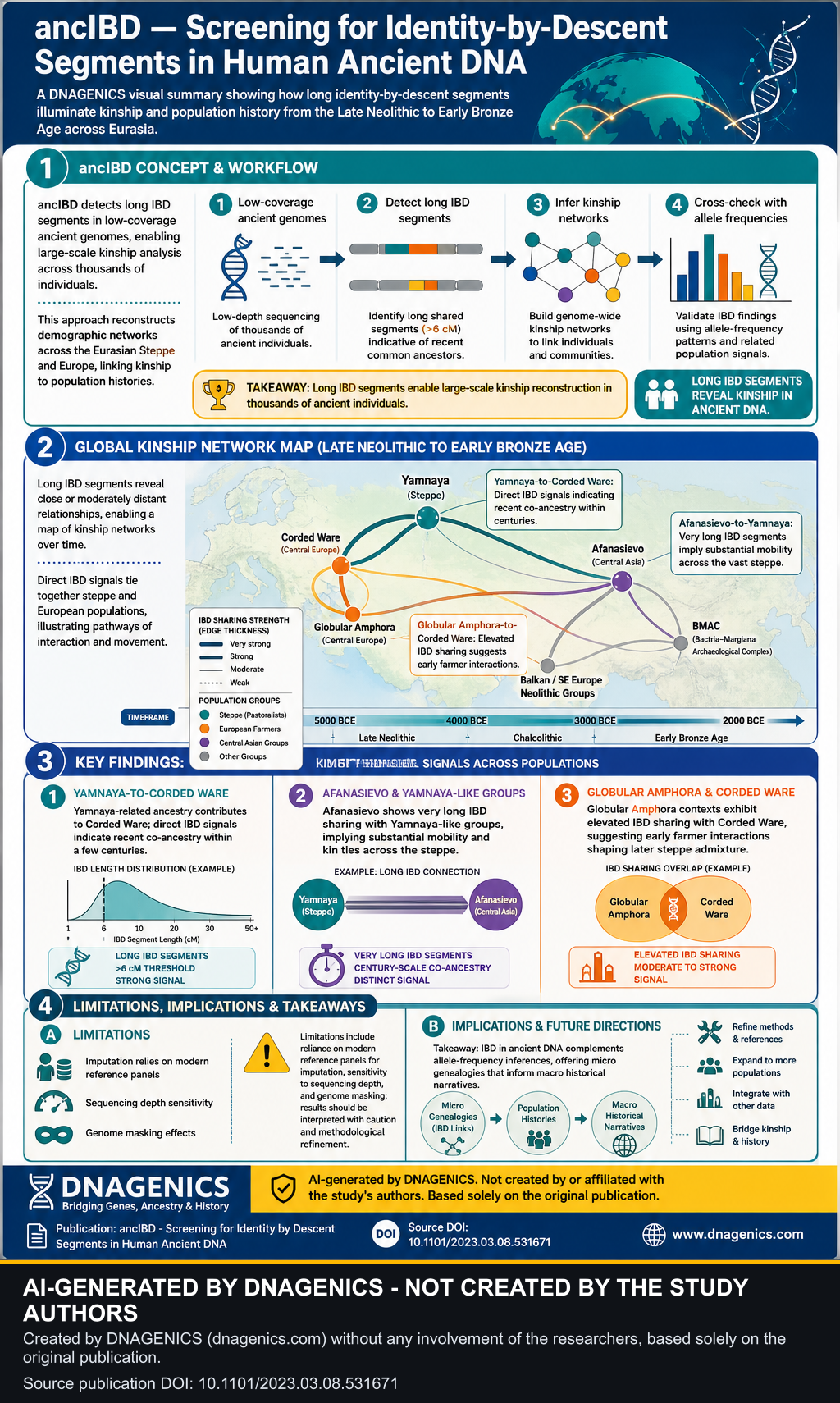
- This infographic was AI-generated.
- It was created by DNAGENICS, without any involvement of the researchers, based solely on the original publication.
- The researchers involved in the study have nothing to do with the creation of this infographic and are not associated with, and do not endorse, it.
Publication Details
Comprehensive information about this research publication
Abstract
Summary of the research findings
Long DNA sequences shared between two individuals, known as Identical by descent (IBD) segments, are a powerful signal for identifying close and distant biological relatives because they only arise when the pair shares a recent common ancestor. Existing methods to call IBD segments between present-day genomes cannot be straightforwardly applied to ancient DNA data (aDNA) due to typically low coverage and high genotyping error rates. We present ancIBD, a method to identify IBD segments for human aDNA data implemented as a Python package. Our approach is based on a Hidden Markov Model, using as input genotype probabilities imputed based on a modern reference panel of genomic variation. Through simulation and downsampling experiments, we demonstrate that ancIBD robustly identifies IBD segments longer than 8 centimorgan for aDNA data with at least either 0.25x average whole-genome sequencing (WGS) coverage depth or at least 1x average depth for in-solution enrichment experiments targeting a widely used aDNA SNP set ( 1240k). This application range allows us to screen a substantial fraction of the aDNA record for IBD segments and we showcase two downstream applications. First, leveraging the fact that biological relatives up to the sixth degree are expected to share multiple long IBD segments, we identify relatives between 10,156 ancient Eurasian individuals and document evidence of long-distance migration, for example by identifying a pair of two approximately fifth-degree relatives who were buried 1410km apart in Central Asia 5000 years ago. Second, by applying ancIBD, we reveal new details regarding the spread of ancestry related to Steppe pastoralists into Europe starting 5000 years ago. We find that the first individuals in Central and Northern Europe carrying high amounts of Steppe-ancestry, associated with the Corded Ware culture, share high rates of long IBD (12-25 cM) with Yamnaya herders of the Pontic-Caspian steppe, signaling a strong bottleneck and a recent biological connection on the order of only few hundred years, providing evidence that the Yamnaya themselves are a main source of Steppe ancestry in Corded Ware people. We also detect elevated sharing of long IBD segments between Corded Ware individuals and people associated with the Globular Amphora culture (GAC) from Poland and Ukraine, who were Copper Age farmers not yet carrying Steppe-like ancestry. These IBD links appear for all Corded Ware groups in our analysis, indicating that individuals related to GAC contexts must have had a major demographic impact early on in the genetic admixtures giving rise to various Corded Ware groups across Europe. These results show that detecting IBD segments in aDNA can generate new insights both on a small scale, relevant to understanding the life stories of people, and on the macroscale, relevant to large-scale cultural-historical events.
AI-Generated Summary
AI-generated by DNAGENICSIndependent AI summary of ancestry and genetic findings from the published study
Important: This summary is AI-generated by DNAGENICS for informational purposes only. It was not created by, affiliated with, or endorsed by the researchers behind the original publication, and is based solely on that published research. It may contain errors or omissions. DNAGENICS disclaims all liability for any inaccuracies or consequences arising from use of this information. Verify all information against the original publication. This is not professional scientific review or medical advice.