Introduction
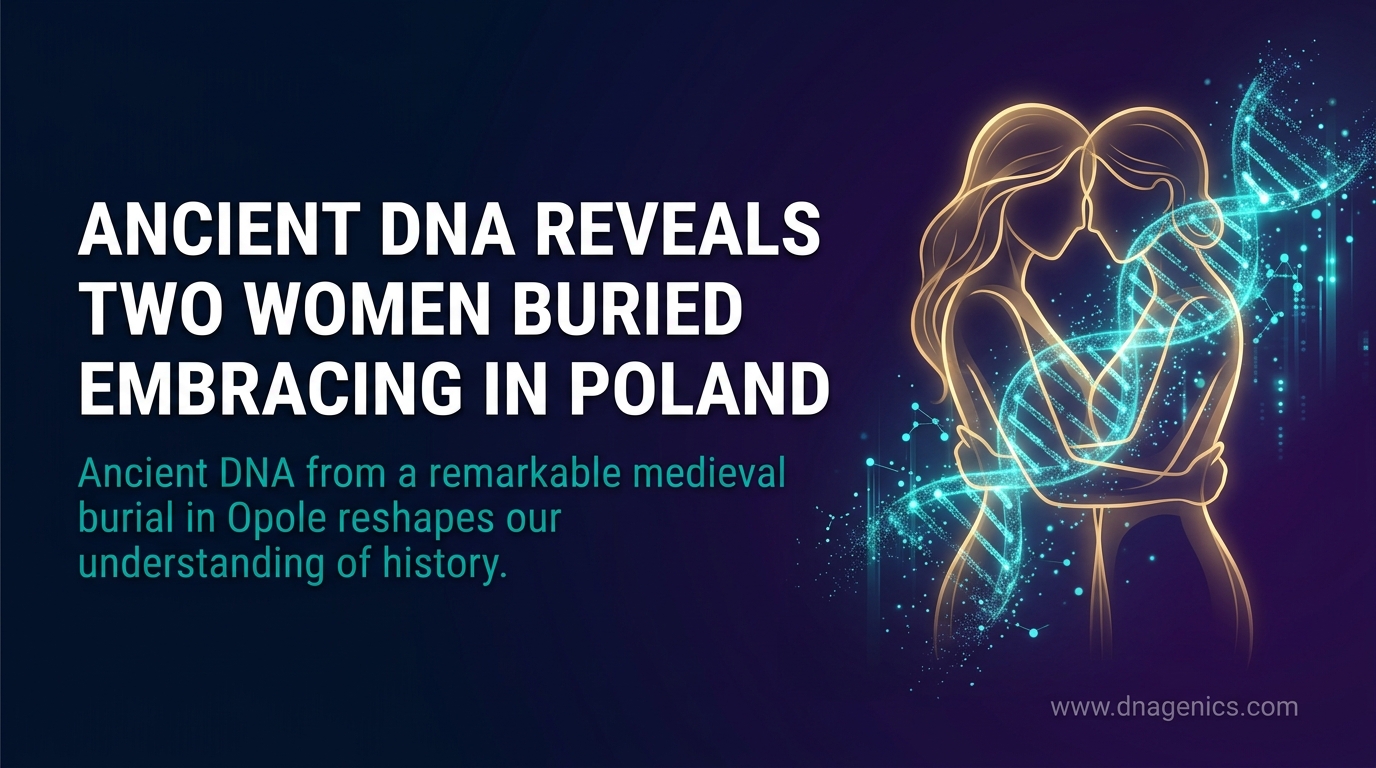
A burial can tell a story, but sometimes the story is not the one people first assume. In medieval cemeteries, two people laid to rest together are often interpreted as relatives, spouses, or close companions. This new ancient DNA study from Opole, Poland, shows why those assumptions need careful testing. A double burial found beside the Cathedral of the Exaltation of the Holy Cross turned out to be far more complex than the grave position alone suggested.
This research matters because it shows how ancient DNA, osteology, and archaeology can work together to correct long-standing ideas about burial practice, social bonds, and identity in the past. For anyone interested in DNA ancestry, genetics, haplogroups, and population genetics, the study is a reminder that burial context does not always equal biological relationship. It also adds important evidence from medieval Central Europe, a region shaped by migration, changing power structures, and church-centered communities.
This article is an AI-generated summary by DNAGENICS. It was not written, reviewed, or endorsed by the researchers behind the study and is based on the published research.
Key Discoveries
- Genetic sex determination showed that both individuals in the Opole double burial were biologically female, making this the first genetically confirmed same-sex burial reported from medieval Poland.
- Kinship testing did not find close genetic relatedness between the two individuals, which argues against a simple parent-child, sibling, or other close family explanation.
- The burial context, including the tightly arranged position of the bodies, suggests that social, institutional, or ritual factors may have shaped the interment more than biological kinship alone.
- The study highlights how ancient DNA analysis can challenge traditional interpretations of so-called “lovers” or “couples” in archaeology when those interpretations are based only on skeletal position.
- The dataset was deposited for independent reuse, supporting transparency and reproducibility in population genetics and biomolecular archaeology.
What This Means for Your DNA
For people exploring family history through DNA, this study is a useful example of how genetics can confirm, refine, or overturn assumptions. A burial that looks like a couple’s grave may actually represent two women who shared a social bond, a religious setting, a household connection, or another relationship that did not depend on biological kinship. That distinction matters in ancestry research because DNA is powerful, but it does not always map neatly onto identity, social roles, or affection.
This also shows why haplogroups and kinship testing need careful interpretation. In ancestry testing, mitochondrial DNA and Y chromosome markers can reveal deep maternal or paternal lineages, while autosomal DNA can identify close relatives. In ancient burials, however, the absence of close kinship does not make a relationship less meaningful. Instead, it broadens the possibilities, showing that communities in the past organized burial and memory in ways that reflect culture as much as family.
For beginners, the main takeaway is simple: DNA can tell us who was biologically related, but it cannot fully explain why two people were buried together. For advanced users, this study reinforces the need to integrate genetic evidence with archaeological context, isotope data, and osteological analysis before drawing conclusions about social structure or ancestry.
Historical and Archaeological Context
The burial comes from medieval Opole in Poland, within the landscape of a church-centered urban community. In Christian burial settings, location, orientation, and grave arrangement often carried strong symbolic meaning. A double burial near a cathedral suggests that the deceased were placed in a context shaped by religion, status, and local funerary custom, not simply by biological family ties.
Across medieval Europe, double and multiple burials have often been read as evidence of tragedy, marriage, or kinship. Yet archaeology increasingly shows that these interpretations are not always reliable. The Opole case fits into a broader pattern seen in other parts of Europe, where biomolecular studies have revised famous “lover” burials and revealed same-sex or non-kin pairings. This pushes historical interpretation toward a more nuanced view of social relationships, institutional care, and burial ideology.
From a migration and population history perspective, medieval Central Europe was a region of movement and interaction, with shifting political borders, trade routes, and cultural influences. Even when a study does not report detailed ancestry proportions, it still contributes to the larger map of how ancient populations lived, moved, and organized their dead. That makes this find relevant to both local history and broader population genetics research.
The Science Behind the Study
This study combined archaeology, osteology, and ancient DNA analysis to reassess the burial. The researchers used genetic sex determination and kinship assessment to test whether the individuals were biologically related and to verify their sex assignments. According to the available summary, the data were deposited as mapped BAM files in ENA, which allows other scientists to inspect and potentially reanalyze the sequence data. That is an important feature of modern archaeogenetics, because reproducibility strengthens confidence in conclusions.
In practical terms, ancient DNA studies often compare patterns across many genome positions to estimate relatedness, while also checking for contamination and DNA damage typical of old material. The excerpt provided does not include detailed coverage, contamination rates, or exact statistical thresholds, so interpretation should remain cautious. Even so, the combination of burial context and genetic data is enough to show that visual or positional clues alone can be misleading.
In Simple Terms: DNA from old bones can tell scientists whether two buried people were biologically related and sometimes whether they were male or female. If the DNA says two people were not close relatives, then the reason they were buried together is probably social, cultural, or ritual, not just family connection.
Why It Matters
This study matters because it demonstrates how ancient DNA changes the way we read graves, cemeteries, and medieval society. It reminds researchers and the public that burial practice reflects many kinds of relationships, including care, status, religion, and community membership. That is especially important in ancestry research, where people often want direct answers about family ties, migration, and identity.
Looking ahead, more studies like this will help refine how archaeologists interpret double burials across Europe and beyond. As more genomes are recovered from medieval cemeteries, researchers will be better able to connect genetics, mobility, and cultural practice. The result will be a fuller picture of the past, one that is less dependent on assumptions and more grounded in evidence.
References
DOI: 10.1016/j.jasrep.2026.105792