Introduction
The Iron Age in the Iberian Peninsula was a dynamic crossroads where local communities interacted with Mediterranean traders and expanding empires. Genetic perspectives on this era are beginning to catch up with the rich archaeological record, revealing a nuanced portrait of continuity and change. Paleogenomic analyses of newborns from three northeastern Iberian sites offer a rare window into population dynamics during 800–50 BCE, a period that includes early Iberian culture along the coast, inland Celtic influences, and the coming of Phoenician, Greek, Punic, and Roman contact.
Why this research matters goes beyond who lived where. By linking genetic patterns to archaeological contexts and historical events, the study helps explain how culture and genetics evolved together in a region famous for its mosaics of language, craft, and commerce. The northeastern Iberian focus highlights how coastal and inland interactions produced distinct admixture signals while preserving a durable Iberian genetic signature eventually shaped by Roman expansion and broader Mediterranean connections.
Key Discoveries
- Genetic continuity from Bronze Age locals with a gradual shift in ancestry through the Iron Age, rather than abrupt replacement.
- Steppe-related ancestry increases from Bronze Age to Iron Age in the region, aligning with broader European patterns of late Bronze Age to Iron Age admixture.
- Mediterranean gene flow is detectable before Roman conquest, especially at coastal sites, reflecting Phoenician and Greek influence and intercultural exchange.
- Roman period diversity rises, including North African-related ancestry in some individuals, while local Iberian signatures persist in others.
- mtDNA diversity remains high (notably haplogroups such as H, K, U) and Y-chromosome lineages are predominantly R1b with occasional lineages like H2a1, signaling both continuity and admixture.
This article is an AI-generated summary by DNAGENICS. It was not written, reviewed, or endorsed by the researchers behind the study and is based on the published research.
What This Means for Your DNA
For people tracing Iberian ancestry, the findings illustrate how modern DNA reflects a layered past. The Iron Age northeastern Iberian genomes show a strong local Bronze Age backbone with gradual admixture from steppe-related sources and Mediterranean contacts that intensify over time. In practical terms, this means your Iberian DNA could carry a mix of ancient lineages that reflect long-standing continuity with local populations alongside late antique inputs from Mediterranean networks and, later, Roman-era movements.
If you are exploring haplogroups, expect a mixture that aligns with these patterns: persistent Iberian Y-chromosome signatures in some lineages (like R1b) and diverse maternal lineages (such as H and K), offering clues about population interactions across time. Interpreting modern results benefits from understanding that ancient admixture is often gradual and regionally structured, not a single ancestral event.
Historical and Archaeological Context
Archaeological evidence has long shown that Iberia was a meeting ground for Iberian, Celtic, Phoenician, Greek, Punic, and later Roman societies. This study’s timeframe (early to late Iron Age) captures the rise of Iberian coastal culture around the 6th century BCE and the sustained contact with Mediterranean civilizations. The coastal zones, where Mediterranean contact is archaeologically supported, likely experienced earlier and stronger gene flow compared with interior regions.
The genetic data dovetail with historical narratives of increasing intercultural exchange and political complexity. The arrival of Rome in the region brought new population dynamics, reflected in greater genetic diversity during the later Iron Age and into the Roman era. The findings help anchor a timeline in which local Iberian communities persisted, yet gradually integrated broader Mediterranean and North African influences as power structures shifted and trade networks expanded.
The Science Behind the Study
The study analyzes 54 newborns from three northeastern Iberian sites dated roughly between 775 BCE and 50 CE. Genome-wide data (more than 20,000 SNPs from the 1240k panel) were obtained for 22 individuals, with mitochondrial data available for nine others and limited Y-chromosome information for some individuals. This combination enables both broad population structure analyses and targeted lineage inferences.
Analytical approaches include principal component analysis (PCA), admixture modeling, and qpAdm-based admixture tests to explore plausible ancestral mixtures. The researchers acknowledge that admixture models are not always unique, especially given variable data quality and coverage, and emphasize cautious interpretation of results within those limits. These methods collectively illuminate patterns of continuity and admixture across time, linking genetic signals to archaeological expectations of coastal Mediterranean contact and inland diversification.
In Simple Terms: qpAdm is a statistical tool used to test whether a target population could be explained as a mix of reference populations. When data are sparse or uneven, several models can fit the data, so results should be interpreted with care and in context of other evidence.
Infographic Section
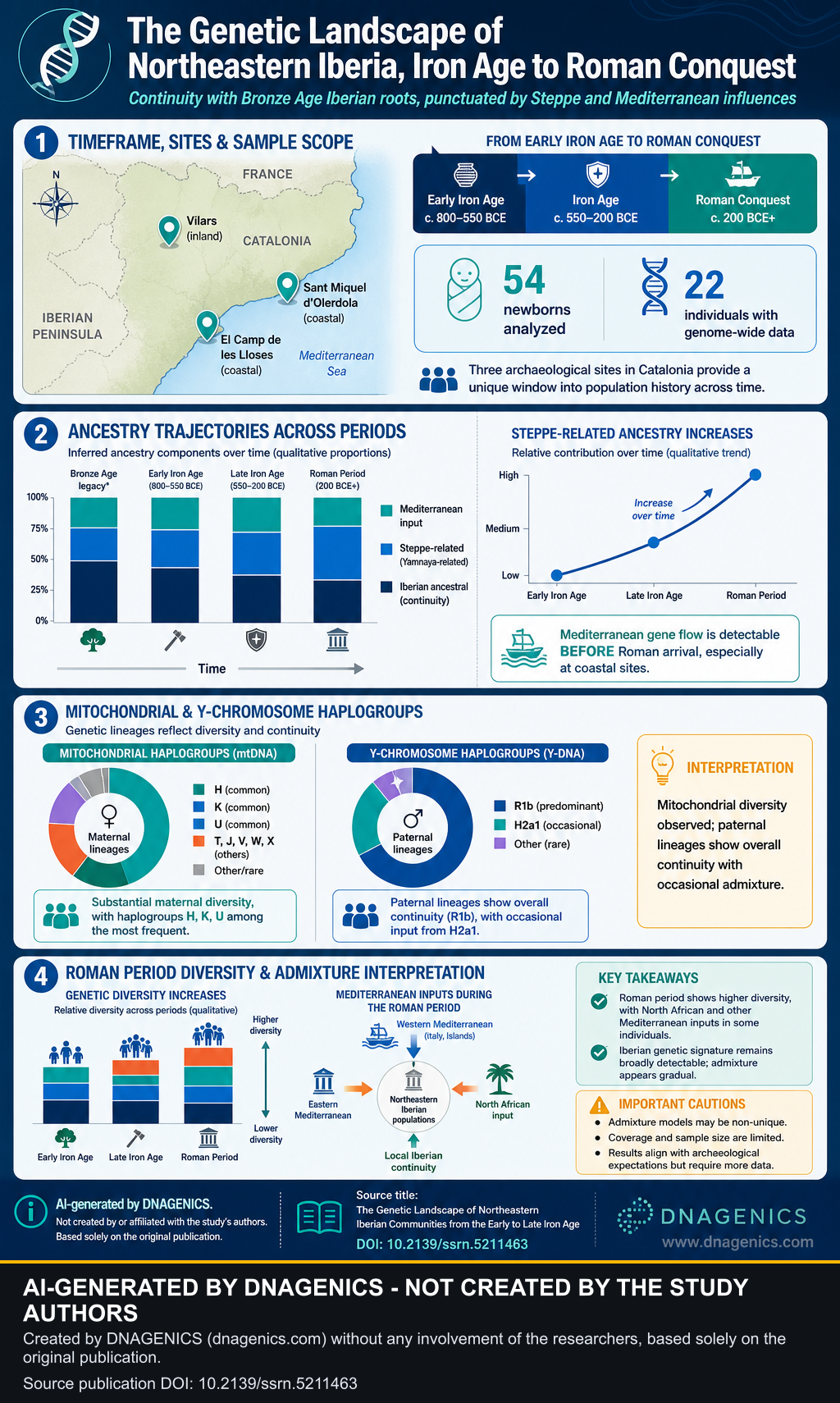
This infographic summarizes the major genetic patterns across the Iron Age northeastern Iberia sites, showing how continuity and Mediterranean contact shaped ancestry over time. It highlights the three sites, timelines, and the shifting proportions of steppe-related, Mediterranean, and local Bronze Age ancestry inferred from the genomic data.
Why It Matters
These findings contribute to a more nuanced view of population dynamics in Iberia during a pivotal transitional era. They support a model of long-standing local continuity with incremental admixture from Mediterranean networks and later Roman inputs, rather than a wholesale replacement. This has broad implications for how researchers interpret genetic signals in modern Iberians and for understanding how culture, trade, and empire influence genetic diversity over centuries. Future work with larger samples and more sites will help refine the timing and sources of Mediterranean and North African genetic influences and clarify regional variation within the peninsula.
References
The Genetic Landscape of Northeastern Iberian Communities from the Early to Late Iron Age