Introduction
Northern Finland’s Kitka site, Kuusamo, preserves a rare glimpse into the life of a Sámi individual from the turn of the 16th to 17th centuries. This single burial, set against the backdrop of a broader shift from semi-nomadic Sámi livelihoods to Finnish agricultural settlement, offers a multi-faceted portrait built from ancient DNA, stable isotopes, and archaeological context. The findings illuminate how people navigated changing landscapes, economies, and identities in a region experiencing profound demographic and cultural transformation.
Why this research matters goes beyond a single grave. It demonstrates the power of a multi-proxy approach to reconstruct mobility, diet, and ancestry in historical contexts where written records are sparse. By identifying genetic ties to contemporary Sámi populations, tracing Siberian admixture, and revealing long-distance movements, the Kitka study contributes to a nuanced understanding of Sámi histories and the long reach of population dynamics across northern Europe. It also highlights the social nature of ethnicity, reminding us that genetics is one lens among many for interpreting identity.
The study sits at the intersection of genetics, archaeology, and anthropology, and benefits from AI-assisted analysis to integrate diverse data streams. Together, these lines of evidence sketch a life history that challenges simple labels and underscores the richness of Sámi experiences during a pivotal era of Northern Finno-Ugric history.
Key Discoveries
- Kitka is genetically Sámi-related: mtDNA haplogroup V, Y‑haplogroup N1a1a1a1a2a1a1a1; close affinity to present-day Sámi and ancient Sámi groups.
- Siberian ancestry signal is stronger in Kitka than in some modern Sámi from Finland, consistent with Siberian-related ancestry in Sámi populations historically.
- IBD connectivity within Finland shows Sámi–Finn admixture patterns; the highest sharing is with northern Lapland, Sodankylä, and eastern Lapland, indicating substructure and gene flow within Finland.
- Long-range mobility is indicated by isotopes: childhood signals point to residence far north or northeast of Kitka; a third molar Sr value as low as 0.7081 raises the possibility of Icelandic or other northern Atlantic connections, though baselines remain uncertain.
- Diet was mixed but terrestrial-biased with marine input: stable isotope modelling suggests a diet dominated by land resources with notable marine contribution and minimal freshwater input in adolescence and adulthood; freshwater signals appear in childhood.
What This Means for Your DNA
For DNA enthusiasts and genealogists, the Kitka case illustrates how ancestry signals can reflect both deep connections and dynamic life histories. The strong Sámi genetic signature confirms a deep-rooted regional identity, while Siberian admixture underscores the complex, layered ancestry characteristic of northern populations. The high identity-by-descent (IBD) sharing with modern northern Finnish groups demonstrates how historical gene flow can leave lasting imprints in present-day communities.
The isotopic data add a practical reminder: your genetic story is only part of the picture. Isotope analyses reveal where a person spent childhood and adulthood, revealing mobility that genetics alone cannot show. Taken together, these data suggest that ancestry testing should be interpreted alongside archaeological and historical context to avoid oversimplified conclusions about ethnicity or origin.
Historical and Archaeological Context
The Kitka discovery sits within a larger narrative of Sámi history during a period of major transition. From the 16th to 19th centuries CE, northern Finland saw a move away from semi-nomadic Sámi lifeways toward agriculture brought by Finnish settlers. This shift contributed to language loss, the assimilation of speaker communities, and changes in burial practices. Although inhumation burials predating Finnish settlement are rare, Kitka’s 16th–17th century grave provides a rare link to pre-settlement Sámi lifeways in the region.
Archaeologically, the Kitka grave goods reflect shared northern Sámi cultural networks spanning multiple siidas and regions, supporting a picture of interconnected communities rather than isolated groups. The genetic and isotopic profile aligns with Sámi heritage while also revealing interactions with neighboring Finnish populations, consistent with known migration and contact patterns in the broader circumpolar north. The dating places this individual at a crossroads in which traditional Sámi subsistence and new Finnish influences intersected, shaping later population dynamics in Lapland and beyond.
The Science Behind the Study
This study employs a robust multi-proxy framework to reconstruct ancestry, mobility, and diet for a single Kitka burial. Genome-wide ancient DNA was analyzed to determine haplogroups, genetic affinities, and IBD sharing with present-day populations. Stable isotope analyses (including strontium and carbon/nitrogen isotopes) were used to infer childhood and adult geographic residence and dietary transitions. Archaeological context anchored the findings within Sámi material culture and regional settlement patterns. The integration of these data streams allows a nuanced reconstruction of life history while acknowledging limitations inherent in single-individual studies.
Key methodological points include: a genome-wide SNP panel targeting known informative markers, Y‑chromosome and mtDNA haplogroup assignment, isotope baselines for northern environments, and statistical tests for population structure and kinship. Small sample size (one individual) is balanced by multi-proxy corroboration, cross-checks against regional baselines, and careful interpretation of IBD sharing within the context of Finland’s demographic history.
In Simple Terms: This study combines a person’s ancient DNA, their chemical fingerprints from bones and teeth, and the archaeology of their grave to tell a story about where they came from, how they moved, and what they ate, rather than relying on genetics alone.
Infographic Section
The study features an infographic that visualizes the Kitka genome, isotope signals across life stages, and regional ancestry connections. See the infographic below for a concise, visual summary of the genetic ties, mobility patterns, and dietary shifts discussed in the text.
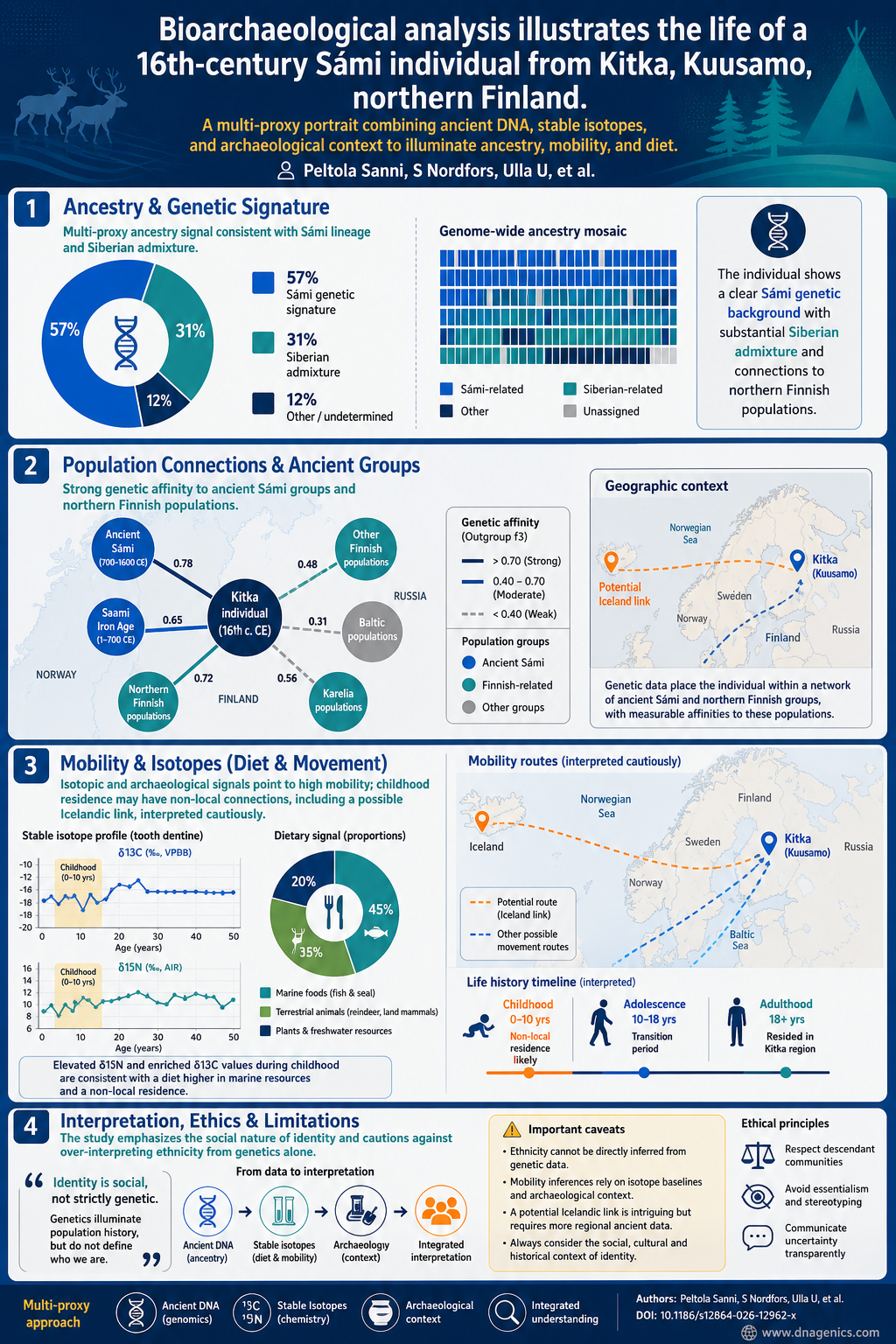
The infographic synthesizes how Kitka individuals relate to modern Sámi groups, where mobility signals point to during childhood, and how diet shifts align with life history events. It serves as a quick-reference companion to the detailed narrative in the sections above.
Why It Matters
This work enhances our understanding of Sámi histories by revealing a complex portrait of ancestry, mobility, and diet that challenges simplistic narratives about ethnicity in ancient contexts. The demonstration that Kitka shares Sámi-related genetic signatures with Siberian admixture echoes broader population-genetics themes in Arctic and subarctic Europe, where movement and interaction shaped genetic landscapes over centuries. The finding that a portion of modern Finns carry Kitka- or Sámi-related IBD segments highlights the enduring imprint of Sámi–Finn admixture on the contemporary gene pool.
Future research will benefit from additional ancient Sámi and northern Finnish samples to refine substructure, track migration routes, and corroborate dietary interpretations across regions. As more data accumulate, researchers can better distinguish individual mobility from broader population-level patterns and further explore how social identities intersect with genetics and archaeology in shaping history.
References
DOI: 10.1186/s12864-026-12962-x