Introduction
Latin America has been historically underrepresented in genomics, leaving many fine-scale population histories and trait architectures hidden. The Mexican Biobank (MXB) project advances this field by genotyping 6,057 individuals from 898 rural and urban localities across all 32 Mexican states at 1.8 million genome-wide markers, with linked trait and disease information. This nationwide genotype-phenotype resource enables detailed ancestry deconvolution and identity-by-descent analyses, unlocking a clearer view of Mexico's complex genetic landscape.
Why this research matters goes beyond cataloging variation. By capturing Indigenous, colonial, and postcolonial demographic dynamics, MXB provides a foundation for understanding how ancestry interacts with environment to shape health and traits. The study demonstrates that population-specific genomic resources can improve trait prediction and disease risk assessment, which is essential for advancing precision and preventive medicine in Latin America and worldwide.
Key Discoveries
- Indigenous American ancestry: MXB uncovers substantial fine-scale Indigenous American ancestry within Mexico and pronounced regional substructure linked to historical demography across states and cultural regions.
- Ancestry-specific Ne trajectories: Ancestry-specific Ne trajectories reveal regionally distinct demographic histories, including founder effects and population size changes associated with colonial and postcolonial events.
- East Asia and South Asia ancestry signals: East Asia and South Asia ancestry signals reflect historical trade routes (for example the Manila galleon) and later migrations, contributing to low but detectable regional variation.
- ROH burden and ancestry proportions: ROH burden and ancestry proportions are linked to trait variation, with Indigenous Americas ancestry associated with more ROH and certain allelic patterns, and regional ROH patterns correlating with birth cohort and geography.
- Lipid genetics and ABCA1 findings: MXB GWAS identifies lipid-related loci and confirms the ABCA1 C230 allele association with HDL, enriched in Indigenous American ancestry, with replication in Indigenous samples; MXB-derived polygenic scores outperform UKB-based scores for several traits in MXB, especially with TOPMed-imputed data.
What This Means for Your DNA
For individuals exploring their ancestry, MXB highlights how a person may carry substantial Indigenous American segments alongside European, African, Asian, and other ancestries. Population-specific reference panels and finer-scale local ancestry calls can improve the accuracy of ancestry composition estimates and trait interpretations. The study also shows that certain health-related traits may be better predicted using data derived from MXB participants, underscoring the value of building regional genomic resources.
Practically, this means personal DNA reports that rely on generic reference panels may miss important regional signals. In MXB, ancestry deconvolution and GWAS tailored to Mexican populations enhance the relevance of polygenic risk predictions and trait associations for individuals with Mexican or mixed Mexican ancestry. As always, environment and sociocultural factors remain essential components of trait variation.
At DnaGenics, we integrate these insights to refine ancestry deconvolution, trait interpretation, and risk assessment, while upholding strict ethical standards and data-sharing principles that respect participants and communities.
In Simple Terms: Ancestry deconvolution breaks your genome into pieces from different ancestral roots, like a map of your family origins. IBD segments are stretches of DNA shared because of common ancestors. Runs of Homozygosity are long, identical DNA stretches that reveal past isolation or inbreeding. GWAS look for DNA variants linked to traits, and polygenic scores combine many small effects to predict traits.
Historical and Archaeological Context
The MXB results reflect a deep history of population formation in Mesoamerica. The substantial Indigenous American ancestry and pronounced regional substructure align with known pre-Columbian diversity and later demographic shifts, including colonial-era population movements and postcolonial demographic changes. The geographic gradient of Indigenous ancestry from north to south and east to west mirrors historical settlement patterns and regional cultural landscapes, offering a genomic mirror to archaeological and linguistic findings.
Colonial contact brought European and African influences, shaping admixture patterns across modern Mexico. The appearance of East Asian and South Asian ancestry signals in some regions corresponds to historical trade and migration routes, such as trans-Pacific exchanges that reached coastal Mexico and inland communities over centuries. The MXB data place these events on a geographic and temporal map, enhancing our understanding of how migration and sociocultural dynamics sculpt present-day genetic diversity.
Together, these findings provide a timeline that spans precolonial life, the colonial period, and contemporary Mexico, connecting genetic variation to archaeological sites, historical records, and regional cultures. The regional sharpness in ancestry and the spatial distribution of demographic signals reinforce the importance of integrating genetics with archaeology and history to interpret population dynamics accurately.
The Science Behind the Study
The MXB study leverages a comprehensive, nationwide dataset. It genotyped 6,057 individuals from 898 localities across all Mexican states at 1.8 million genome-wide markers and linked it to rich trait and disease information, enabling a broad spectrum of analyses in population genetics and complex trait genetics.
To dissect population structure and history, the researchers used a combination of global and local ancestry approaches. Global ancestry was inferred with standard methods such as ADMIXTURE, while local ancestry used methods like RFmix and GNOMIX to assign ancestry at specific genome segments. They also applied MAAS-MDS for fine-scale structure visualization, and IBD-based Ne trajectories to reconstruct historical population sizes. Admixture graphs (e.g., AdmixtureBayes) helped model demographic events across time. These methods together reveal ancestry-specific population histories and the distribution of runs of homozygosity and rare deleterious variants across regions.
The MXB GWAS analyzed 22 complex traits and found that several traits are better predicted with MXB-derived data than with UK Biobank data. Importantly, imputation with reference panels such as TOPMed enhanced discovery and replication in Indigenous-dominated samples. The study also emphasizes that ancestry labels are imperfect and must be used cautiously, advocating ethical engagement and responsible data sharing.
In Simple Terms: Scientists map genetic ancestry across the genome and look for regions that tell us where people’s ancestors came from. They also examine stretches of DNA that two people share because of the same ancestor, and long identical regions that indicate historical isolation. Then they scan millions of variants to find those linked to traits, and combine many small effects to predict traits for an individual.
The MXB infographic provides a visual synthesis of the study. It shows the fine-scale Indigenous American contribution across Mexico, regional substructure linked to historical demography, and the interplay between ancestry, runs of homozygosity, and trait variation. It also highlights the lipid trait loci and the ABCA1 signal, as well as how MXB-based polygenic scores improve trait prediction relative to UKB-derived scores in MXB populations.
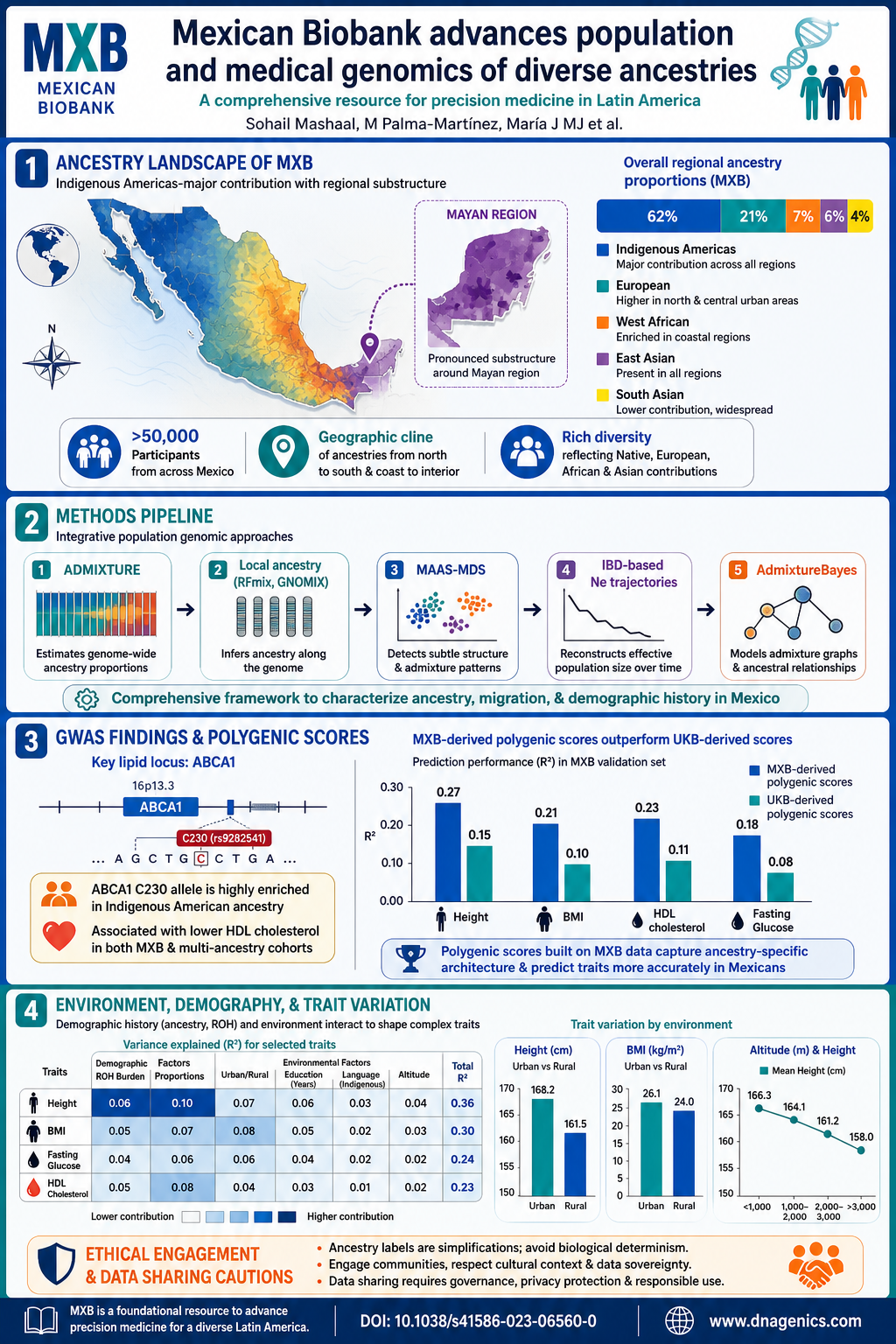
The infographic serves as a compact reference for readers to grasp the geographic distribution of ancestry, key demographic events, and trait associations across the MXB dataset.
Why It Matters
This work represents a major step toward inclusive genomics in Latin America. By delivering a dense, nationwide genotype-phenotype resource, MXB enables culturally and biologically informed precision medicine strategies tailored to Mexican populations. The findings also underscore the value of population-specific GWAS and reference panels for improving predictive accuracy, health risk assessment, and the equitable translation of genomics into clinical practice. Future research can expand to additional traits, integrate environmental and sociocultural data, and broaden participation to further diversify global genomic resources.
References
Mexican Biobank advances population and medical genomics of diverse ancestries