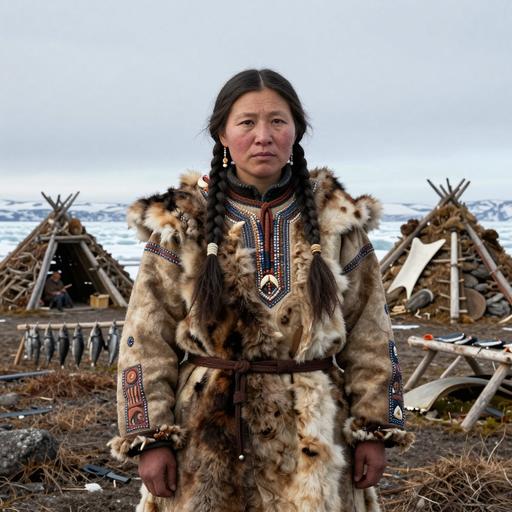
The Story
The journey of mtDNA haplogroup A2A2
Origins and Evolution
mtDNA haplogroup A2A2 is a downstream branch of A2A, itself a subclade of the broader Indigenous American founding lineage A2. Given its phylogenetic position and the known chronology for A2 and A2A, A2A2 most likely arose in the early Holocene (roughly 9 kya, within the range of uncertainty) on the Beringian–Arctic margin or immediately after entry into northern North America. The lineage represents a localized diversification of one of the founding maternal groups that accompanied early post‑glacial expansions into the sub‑Arctic and Arctic environments.
Population genetic patterns (reduced haplotype diversity, regional concentration, and presence in ancient Arctic samples) are consistent with a scenario of founder effect and serial drift as human groups moved into high‑latitude niches after the Last Glacial Maximum. Ancient DNA recoveries (several reported instances in regional archaeological contexts) support continuity of A2A‑derived lineages in circumpolar archaeological populations.
Subclades
A2A2 is a subclade beneath A2A; depending on sequencing resolution, researchers may identify internal branches within A2A2 defined by private mutations seen in particular regional or community samples (for example, Arctic‑specific variants). Because mtDNA phylogenies are refined as more full mitogenomes are sequenced, the known internal structure of A2A2 can expand; currently it is treated as a regional derivative of A2A with limited deep substructure in published datasets.
Geographical Distribution
A2A2 is primarily associated with northern North America and the circumpolar Americas. It shows the highest frequencies and diversity in Arctic and sub‑Arctic Indigenous groups (Inuit, Yup'ik, some Northern First Nations), with lower frequencies across other Native American populations through northern and central North America and sporadic detection in Central and South America due to later migration, drift, or admixture. A2A2 or closely related variants have been detected at low frequencies in some northeastern Siberian and Chukotkan groups, reflecting ancient Beringian connections and occasional backflow or shared ancestry across the Bering Strait.
Geographic patterns indicate a history of early northward expansion, regional diversification, and strong effects of genetic drift in small, mobile Arctic populations.
Historical and Cultural Significance
A2A2 is informative for studies of Arctic prehistory. Its association with early Holocene and later circumpolar populations links it to archaeological traditions adapted to high latitudes (for example, Paleo‑Eskimo groups and later Thule expansions). The lineage contributes to reconstructing maternal continuity and population turnovers in the North American Arctic: when A2A2 appears in ancient contexts, it helps trace the maternal ancestry of archaeological finds and test models of population movement, replacement, or continuity (for instance, distinguishing Paleoeskimo persistence from Thule arrival).
Because mtDNA is maternally inherited and subject to strong drift in small populations, A2A2 can reach relatively high local frequencies and be useful as a marker of maternal ancestry in modern Indigenous communities and in admixed populations carrying Indigenous maternal lineages.
Conclusion
mtDNA A2A2 is a regional derivative of the A2A lineage that marks early Holocene maternal diversification associated with Arctic and sub‑Arctic settlement. Its distribution and genetic signature reflect founder events, post‑glacial expansion into high latitudes, and subsequent drift and local persistence in northern Indigenous populations. Continued mitogenome sequencing of modern and ancient samples will refine A2A2's internal structure and clarify its precise timing and migratory links across Beringia and the North American Arctic.
Key Points
- Origins and Evolution
- Subclades
- Geographical Distribution
- Historical and Cultural Significance
- Conclusion