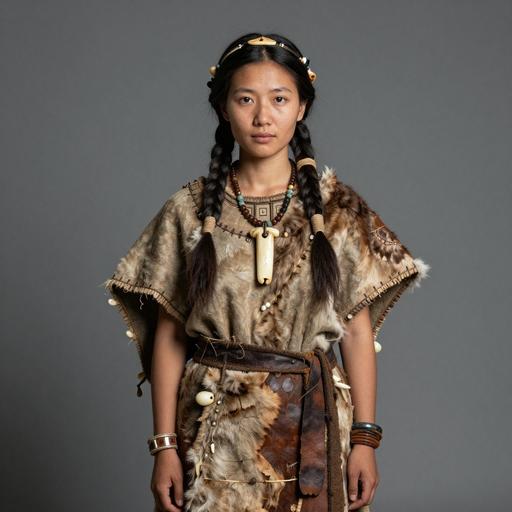
The Story
The journey of mtDNA haplogroup B4'5
Origins and Evolution
Haplogroup B4'5 represents the internal node that unites the B4 and B5 lineages within mtDNA haplogroup B, itself a descendant of macro-haplogroup R. Based on phylogenetic relationships and molecular-clock estimates for adjacent branches of B, B4'5 most likely arose in mainland Southeast Asia or nearby island regions during the Late Upper Paleolithic, broadly estimated around ~40 kya (± several thousand years). The lineage provided the ancestral variation from which the geographically and culturally important descendant clades B4 and B5 later emerged.
Subclades
The principal descendant clades downstream of B4'5 are B4 and B5. B4 contains multiple sub-branches including the well-known B4a1a (the 'Polynesian motif') that is strongly associated with Austronesian dispersals into Island Southeast Asia and the Pacific. B5 comprises several lineages that are mainly reported in East and Mainland Southeast Asian populations and show more localized structure. Because B4'5 is an intermediate internal node, its primary relevance in genetics is as the shared ancestor of these descendant clades rather than as a frequently observed terminal haplogroup in modern samples.
Geographical Distribution
Descendant lineages of B4'5 are concentrated across East Asia, Mainland and Island Southeast Asia, and Oceania. B4 subclades are particularly frequent among Austronesian-speaking groups (Taiwan indigenous groups, Philippines, Indonesia) and in Pacific islanders where the Polynesian motif is common. B5 sublineages have been observed in Han Chinese and multiple Southeast Asian populations but at lower, more patchily distributed frequencies. The highest diversity for the broader B clade (and thus informative region for the origin of B4'5) is found in mainland and island Southeast Asia, consistent with an origin in that general area.
Historical and Cultural Significance
Although B4'5 itself is a deeper phylogenetic node, its descendant B4 lineages played an important role in demographic events of the Holocene. The Austronesian expansion (Neolithic to Bronze Age movements of maritime farming peoples from Taiwan into Island Southeast Asia and across Remote Oceania) carried B4-derived lineages—most notably the Polynesian motif—far into the Pacific. B5-lineages, by contrast, are more often associated with mainland East and Southeast Asian populations and reflect long-term regional continuity and local demographic processes. Thus, B4'5 is indirectly tied to both Upper Paleolithic coastal/eastern Asian population structure and later Neolithic/Austronesian dispersals.
Conclusion
B4'5 functions as an important internal node connecting the Paleolithic-era diversification of haplogroup B with the later, historically significant expansions of its descendants. While B4'5 is not usually cited as a high-frequency terminal haplogroup in modern populations, understanding this node helps clarify the origins and spread of B4 and B5 lineages across East and Southeast Asia and into Oceania. Ongoing ancient DNA sampling and higher-resolution mitogenome studies will refine the age estimates, geographic origin, and finer substructure of B4'5 and its descendant clades.
Key Points
- Origins and Evolution
- Subclades
- Geographical Distribution
- Historical and Cultural Significance
- Conclusion