mtDNA · Maternal lineage

V14

mtDNA Haplogroup V14

A reference profile for one lineage branch. Shared haplogroups do not establish a family relationship or cultural identity.

Reference profile

Branch background

Historical context for mtDNA lineage branch V14

Origins and Evolution

mtDNA haplogroup V14 is a downstream lineage within the broader haplogroup V, specifically nested under V1. Given the established position of V1 as a post‑Last Glacial Maximum (LGM) lineage that expanded from refugia in the Franco‑Cantabrian/Iberian zone, V14 is best interpreted as a regional derivative that arose during the early Holocene (post‑glacial Mesolithic period). Its estimated time to most recent common ancestor (TMRCA) on the order of ~9 kya places its origin after the main recolonization pulses that followed the LGM but early enough to have been present during Mesolithic and subsequent cultural phases in Western Europe.

Genetically, V14 carries the defining control‑region and coding‑region mutations that distinguish it from other V1 subclades; as with other rare mtDNA sublineages, these mutations allow researchers to identify localized maternal continuity and micro‑demographic events (founder effects, isolation, or limited gene flow) that are not apparent from higher‑level haplogroups alone.

Subclades

At present V14 is a low‑diversity, low‑frequency branch with few recognized downstream subclades described in the literature or public databases. Where deeper branching is observed, it typically reflects very recent, often population‑specific diversification (for example, private or family‑level sublineages). Continued sampling and ancient DNA recovery could reveal further structure within V14, particularly from Mesolithic and Neolithic contexts in Iberia and adjacent regions.

Geographical Distribution

The distribution of V14 is geographically focal rather than broad. Based on its phylogenetic position under V1 and available population data for related lineages, V14 is most plausibly concentrated in:

  • The Iberian Peninsula (including Basque and other Atlantic‑facing populations)
  • Atlantic France and nearby Western European coastal groups
  • Sporadic occurrences in northern European populations (including isolated findings among Scandinavian and Saami groups) reflecting later mobility
  • Coastal North Africa (Berber and Maghrebi groups) where V lineages are known to occur at low frequency due to prehistoric and historic cross‑Mediterranean contacts

Overall, V14 is expected to be rare in continental Central and Eastern Europe but detectable at low levels where gene flow or historical migrations introduced western maternal lineages.

Historical and Cultural Significance

Because V14 derives from a lineage associated with post‑glacial reoccupation of Western Europe, it is most informative for understanding Mesolithic population structure, regional continuity, and micro‑demographic processes (local founder events, isolation). The presence of V subclades in later cultural horizons indicates that some maternal lineages from early postglacial hunter‑gatherer groups persisted through the Neolithic and into Bronze Age contexts, sometimes becoming integrated into expanding farmer and metal‑age societies.

Archaeologically, V14 may be encountered in contexts tied to:

  • Mesolithic coastal and riverine hunter‑gatherer sites in Iberia and Atlantic France (primary association)
  • Later prehistoric cultural assemblages where regional maternal continuity persisted (secondary associations), including some Bell Beaker and Neolithic contexts in western Europe where continuity or admixture occurred

While V14 itself is not tied to major continent‑wide population replacements, its detection helps map local survival and transmission of maternal lineages across cultural transitions.

Conclusion

mtDNA haplogroup V14 is a localized, low‑frequency descendant of V1 that most likely originated in the early Holocene in the Franco‑Cantabrian/Iberian region. Its value to genetic and archaeological research lies in its ability to signal regional maternal continuity from post‑glacial hunter‑gatherers into later prehistoric populations; however, current data are limited and additional modern and ancient sampling could clarify its finer phylogeography and demographic history.

Key Points

  • Origins and Evolution
  • Subclades
  • Geographical Distribution
  • Historical and Cultural Significance
  • Conclusion
Reference profile

Tree & Relationships

Phylogenetic context and subclades

Evolution Path

Follow the recorded parent branches toward V14. Dates are estimates and can change as reference data is revised.

Steps Haplogroup Age Estimate Archaeology Era Time Passed Immediate Descendants Tested Modern Descendants Ancient Connections
1 V14 Current ~9,000 years ago Neolithic 9,000 years 0 0 0
2 V1 ~12,000 years ago Neolithic 12,000 years 10 97 0
3 V ~14,000 years ago Mesolithic 14,000 years 10 572 118
4 HV ~30,000 years ago Paleolithic 30,000 years 14 11,092 228
5 R0 ~15,000 years ago Mesolithic 15,000 years 2 11,230 4
6 R ~55,000 years ago Paleolithic 55,000 years 17 22,830 57
7 NA - - - 1 22,830 0
8 N ~60,000 years ago Paleolithic 60,000 years 16 26,150 13
9 L3 ~70,000 years ago Paleolithic 70,000 years 7 30,162 6
10 L3'4 - - - 2 30,212 0
11 L3'4'6 - - - 2 30,216 0
12 L2'3'4'6 - - - 2 31,333 0
13 L2'3'4'5'6'7 - - - 2 31,349 0
14 L1'2'3'4'5'6'7 - - - 2 31,852 0
15 L ~160,000 years ago Paleolithic 160,000 years 2 32,236 5

Subclades (0)

Terminal branch - no recorded subclades

Siblings (9)

Other branches from the same parent haplogroup

Reference profile

Where in the World

Geographic distribution and modern presence

Recorded origin

Western Europe (Iberian / Franco-Cantabrian region)

Modern Distribution

The populations where mtDNA haplogroup V14 is found include:

  1. Iberian populations (Spain, Portugal; including Basque populations)
  2. Atlantic France and other Western European coastal groups
  3. Northern European populations (sporadic occurrences in Scandinavian and Saami groups)
  4. Berber and other North African coastal populations (low frequency)
  5. Ancient European hunter‑gatherer remains from Mesolithic contexts in Western Europe
  6. Modern populations showing localized persistence or recent admixture in Western and Southwestern Europe
Historical context

A branch through time

Estimated formation in a broad historical timeline. Period markers provide context and do not imply a connection with particular cultures.

  1. ~10k years ago

    Neolithic Revolution

    Agriculture begins, settled communities form

  2. ~9k years ago

    Haplogroup V14

    Estimated formation of this mtDNA branch; dates and locations are reference estimates.

    This branch
  3. ~5k years ago

    Bronze Age

    Metalworking, writing, and early civilizations

  4. ~3k years ago

    Iron Age

    Iron tools, expanded trade networks

  5. ~2.5k years ago

    Classical Antiquity

    Greek and Roman civilizations flourish

  6. Present

    Present Day

    Modern era

Reference profile

Archaeological context

Recorded archaeological associations for mtDNA branch V14

Recorded associations

These labels describe archaeological contexts recorded for reference samples linked to V14. An association does not establish that all carriers belonged to a culture or followed a particular migration route.

Alföld Linear Pottery Brześć Kujawski Culture Körös Culture Linear Pottery Culture Sopot Culture
Culture assignments are based on archaeological context of ancient DNA samples and may represent regional associations during specific time periods.
Reference profile

Sample Catalog

2 direct carriers of haplogroup V14

2 shown · 2 matching samples

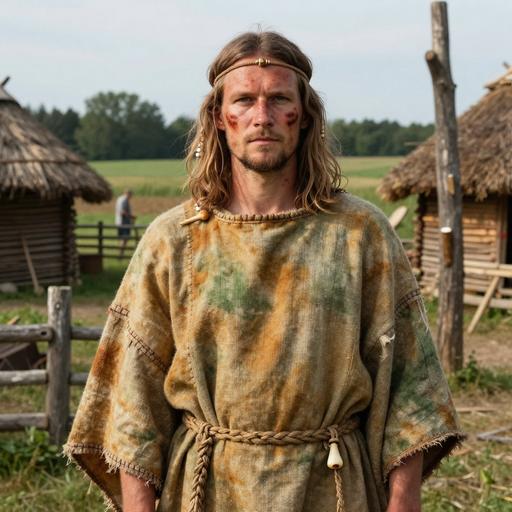
Portraits are AI-generated illustrations. Sample labels and accession IDs identify the reference records.

Portrait Sample Country Era Date Culture mtDNA Match
AI-generated illustrative portrait of European Neolithic individual, Oslonki, Poland (4,600-4,000 BCE)
Sample ID: N27
Poland Poland BKG 4600 BCE - 4000 BCE Brześć Kujawski Culture V14 Direct
AI-generated illustrative portrait of Poland N individual, Oslonki, Poland (4,600-4,000 BCE)
Sample ID: N27
Poland Neolithic Poland 4600 BCE - 4000 BCE V14 Direct
MATERNAL LINEAGE · ANCIENT DNA

Ancient lineage evidence map

Follow parent clades toward this branch and explore where ancient carriers were found.

Loading ancient observations…

Markers are archaeological find locations. A dashed connector is an uncertain, proposed geographic transition between consecutive branches supported by multiple dated observations; it is not an exact travel route, birthplace or proof of direct descent. Parent-clade samples may belong to other descendant branches. Gaps remain where evidence is insufficient. Sample dates differ from haplogroup formation dates.

Reference profile

Carrier Distribution Map

Geographic distribution of 2 ancient DNA samples (direct and subclade carriers of V14)

Direct carrier
Time Period Filter
All Time Periods
Showing all samples
Reference profile

Temporal Distribution

Distribution of carriers across archaeological periods

Reference profile

Geographic Distribution

Counts by recorded sample country. These reflect the available reference selection, not population frequencies.

Reference profile

Country × Era Distribution

Compare recorded sample counts across countries and archaeological periods. Select a populated cell to inspect a sample.

Data

Data & Provenance

Source information and data quality

Last Updated 2026-02-16
Confidence Score 50/100
Coverage Low

Data Source

Classification, estimated dates and geographic context reflect the recorded reference data and may change as evidence is revised. Sample coverage is uneven; recorded locations and archaeological associations do not establish personal origin or cultural identity.