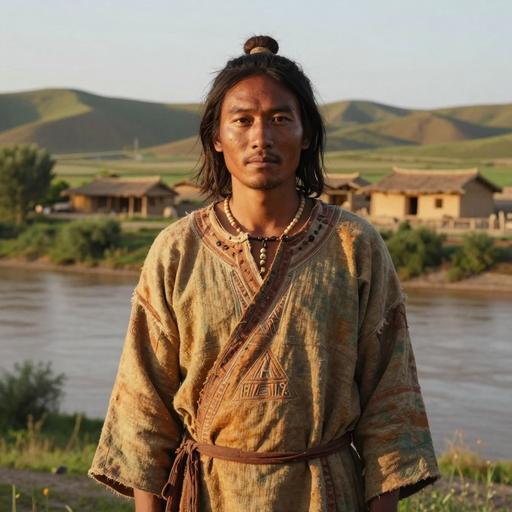
The Story
The journey of Y-DNA haplogroup O2A2B1A2A1A
Origins and Evolution
Y-DNA haplogroup O2A2B1A2A1A is a downstream subclade of O2A2B1A2A1, itself part of the broader O-M117 paternal lineage within haplogroup O. This places it within a major East Asian Y-chromosome radiation that expanded extensively during the Holocene, especially in regions linked to the rise of farming societies, population growth, and later demographic dispersals in southern China and nearby mainland Southeast Asia.
Because this clade is quite downstream, its age is expected to be relatively recent compared with the broader O-M117 trunk. A reasonable estimate places its origin in the late Neolithic to Bronze Age horizon, roughly around 3 thousand years ago, though the exact age depends on future phylogenetic resolution and sampling. Its formation likely reflects local lineage diversification within expanding East Asian populations rather than an ancient deep-rooted population split.
Subclades
As an intermediate subclade, O2A2B1A2A1A serves as a bridge between its parent lineage and any more recently derived branches. Public phylogenetic resolution may still be incomplete for some downstream nodes, so the internal structure of this clade may continue to be refined as more high-coverage Y-chromosome sequencing becomes available.
In practical population-genetic terms, this means the haplogroup should be viewed as part of a cluster of closely related East Asian paternal lineages that may show strong geographic patchiness, founder effects, and expansion patterns tied to specific historical populations.
Geographical Distribution
This haplogroup is expected to occur primarily in East Asia, with its strongest presence in southern Chinese populations and related groups in nearby mainland and insular Southeast Asia. The distribution pattern is consistent with a lineage that diversified in a regional East Asian context and then spread through later movements of people.
Reported or expected carrier populations include:
- Han Chinese, especially in southern China
- Southern Chinese regional populations
- Vietnamese populations
- Tai-Kadai-speaking populations
- Tibeto-Burman-speaking populations
- Korean populations
- Japanese populations
- Austronesian-speaking populations in Taiwan and Island Southeast Asia
Its frequency is likely moderate to low overall at broad continental scales, but can be locally enriched in specific regional or ethnolinguistic groups due to ancestry concentration and founder effects.
Historical and Cultural Significance
Lineages within O-M117 are often associated with the demographic history of southern East Asia, including the expansion of farming populations, regional state formation, and the spread of Sinitic and neighboring ethnolinguistic groups. While no single archaeological culture can be assigned uniquely to this downstream clade, its ancestry is broadly compatible with the population dynamics of the late Neolithic and Bronze Age in China and adjacent regions.
For modern populations, the significance of O2A2B1A2A1A lies in illustrating how paternal lineages can become regionally structured over time. Its presence in multiple East and Southeast Asian populations reflects a mixture of ancient regional continuity and more recent historical dispersal, including migrations, assimilation, and the expansion of large ethnolinguistic communities such as Han Chinese.
Conclusion
Y-DNA haplogroup O2A2B1A2A1A is a recent East Asian paternal subclade within the O-M117 network, most likely formed in southern China or nearby mainland Southeast Asia about 3 kya. It is most relevant for studies of regional population history, fine-scale paternal structure, and the spread of East Asian lineages across China, Southeast Asia, and parts of Northeast Asia.
Key Points
- Origins and Evolution
- Subclades
- Geographical Distribution
- Historical and Cultural Significance
- Conclusion