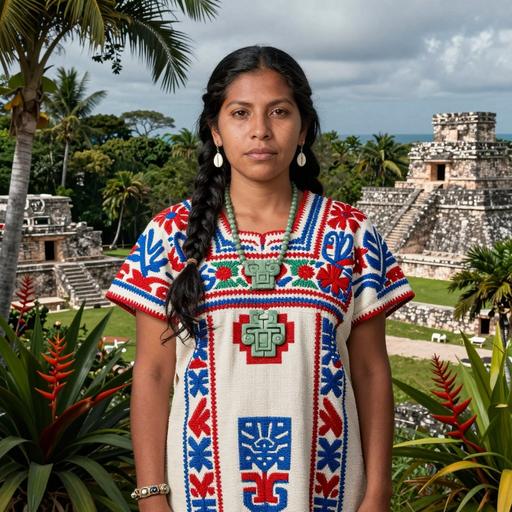
The Story
The journey of mtDNA haplogroup A2M
Origins and Evolution
mtDNA haplogroup A2M is a downstream branch of the Native American macro-lineage A2, specifically nested beneath the intermediate clade A2A48. Haplogroup A2 is one of the founding maternal lineages associated with the initial peopling of the Americas from Beringia during the Late Pleistocene. As an internal subclade, A2M most likely formed after the initial dispersal into the Americas, during the early to mid-Holocene, when regional diversification of maternal lineages increased as populations became more sedentary and regionally differentiated.
Because A2M is a derived branch of A2A48, its time depth is expected to be substantially younger than the basal A2 root (commonly estimated ~15–20 kya) and instead fits into a mid-Holocene timeframe. Exact dating requires targeted complete mitogenome sequencing of confirmed A2M samples and coalescent analysis; current placement is an informed estimate based on phylogenetic position and comparative divergence of similar A2 subclades.
Subclades
At present, A2M is characterized as an intermediate/terminal clade beneath A2A48 in available phylogenies. The internal structure (further named subclades under A2M) is either poorly sampled or not yet fully resolved in public databases. Additional full mitochondrial genome sequencing from diverse indigenous populations across the Americas is necessary to identify and validate any downstream sublineages and to refine the internal branching order and age estimates.
Geographical Distribution
Direct observations of A2M in published literature are limited, but reasonable population-genetic inference places this haplogroup primarily in indigenous North American and nearby Central American populations, with possible occurrences in parts of South America depending on historical migration and gene flow. The ancestral A2 lineage shows a trans-American distribution, and many A2 subclades have localized high frequencies (for example, some A2 branches are concentrated in the Pacific Northwest, the Andes, or Mesoamerica). A2M is therefore best understood as a regionally derived clade whose present-day distribution likely reflects Holocene demographic processes: founder effects, localized expansions, and drift in relatively small, often isolated populations.
Historical and Cultural Significance
Haplogroup A2 and its subclades are strongly associated with the founding populations of the Americas. While A2M itself does not currently have a specific, well-documented archaeological culture uniquely tied to it, as a Holocene-derived A2 branch it plausibly contributed maternally to communities involved in postglacial recolonization and later regional cultural developments. Potential cultural contexts where A2-derived maternal lineages were important include:
- Early Paleoindian groups that established initial settlements in North America (context for the deeper A2 lineage).
- Holocene Archaic and regionalized hunter-gatherer groups where local maternal lineages diversified.
- Later coastal and inland Native American societies (including those of the Northwest Coast, Great Plains, and Mesoamerica), depending on the specific local frequency of A2M.
Because A2M is likely low-to-moderate frequency and under-sampled, attributing it to a single archaeological culture (e.g., Thule, Mississippian, or other named cultures) would be premature without more targeted ancient DNA or broad population sampling.
Conclusion
mtDNA haplogroup A2M represents a regional, derived maternal lineage within the Native American A2 clade, nested under A2A48. It most likely arose in the Holocene (several thousand years after the initial Late Pleistocene entry into the Americas) and is found among indigenous populations of North and Central (and possibly parts of South) America. The limited public data on A2M means its precise age, substructure, and fine-scale distribution remain to be clarified; full mitogenome sequencing from diverse populations and ancient remains will be essential to refine its phylogeny and historical inference. Researchers and community scientists are encouraged to report complete mtDNA sequences and associated metadata (with appropriate permissions) to improve the resolution of A2M's history.
Key Points
- Origins and Evolution
- Subclades
- Geographical Distribution
- Historical and Cultural Significance
- Conclusion