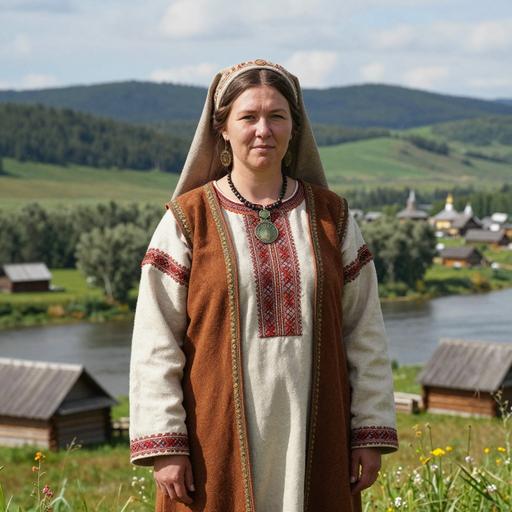
The Story
The journey of mtDNA haplogroup D4J6
Origins and Evolution
mtDNA haplogroup D4J6 is a downstream lineage nested within D4JB and the broader D4 haplogroup. Haplogroup D4 is one of the major East Asian maternal lineages that expanded after the Last Glacial Maximum; its many subclades have diverse regional histories across East Asia, Siberia and into the Americas. Given its position under D4JB, D4J6 most plausibly arose in the Holocene (several thousand years ago) as a local diversification in Northeast Asia or adjacent Siberian regions. The estimated origin time given here (≈7 kya) is a cautious, literature-based inference reflecting typical time depths observed for comparable D4 subclades, but this estimate should be treated as provisional until dated ancient or high-coverage modern sequences confirm it.
Subclades
As an intermediate terminal clade identified in Phylotree-style trees, D4J6 may have further downstream branches or remain a narrow lineage depending on sampling. At present it is best described as a localized subclade of D4JB; comprehensive high-resolution sequencing across Northeast Asia and Siberia will be required to resolve any internal substructure (e.g., D4J6a, D4J6b) and to calibrate coalescence times precisely.
Geographical Distribution
Available population-genetic patterns for the parent clade (D4J / D4JB) and for D4 generally indicate a concentration in Northeast Asia and adjacent Siberia, with lower-frequency occurrences across East Asia and in diasporic or admixed groups. Therefore, the most reasonable inference is that D4J6 is primarily found among Northeast Asian and some Siberian indigenous groups, with occasional detection in neighboring East Asian populations (for example, northern Han, Korean, Japanese) due to historical gene flow and recent migrations. Current evidence is limited and geographic assignments remain provisional pending broader sampling.
Historical and Cultural Significance
Because D4 lineages have been recorded in both prehistoric hunter-gatherer and early farming contexts in East Asia, D4J6 may reflect maternal continuity among local Holocene populations (for example, Amur-region hunter-gatherers/Jomon-related groups) or regional Neolithic-to-Bronze Age demographic processes. However, there is no direct strong association in the literature tying D4J6 specifically to a single archaeological culture; instead it likely represents the fine-scale maternal structure that accompanies broader regional cultural sequences in Northeast Asia.
Conclusion
D4J6 is best regarded as a geographically focused, low-to-moderate frequency mtDNA subclade within the D4 family, probably originating in Northeast Asia during the Holocene. It serves as an informative marker for population history at subregional scales, but its full distribution, internal diversity and precise chronology require additional high-coverage sequencing, wider modern population surveys, and ancient DNA data to move from inference to firm conclusion.
Key Points
- Origins and Evolution
- Subclades
- Geographical Distribution
- Historical and Cultural Significance
- Conclusion