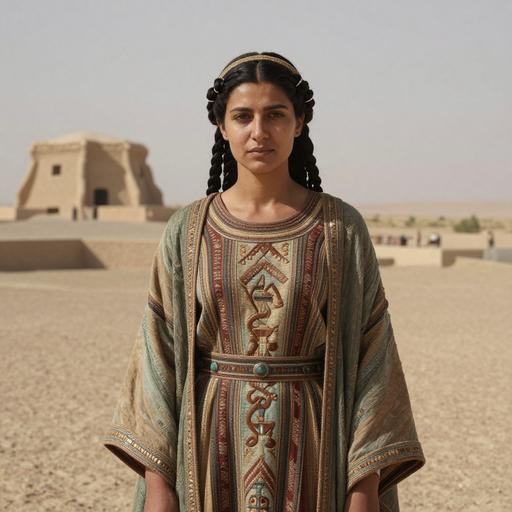
The Story
The journey of mtDNA haplogroup U2D
Origins and Evolution
mtDNA haplogroup U2D sits beneath the U2C'D node in the mitochondrial phylogeny and represents one of the regional branches of the broader U2 family. Haplogroup U2 as a whole is an ancient Eurasian lineage that diversified during the Upper Paleolithic; U2D is best interpreted as a derived branch that likely formed in South–Central Asia after the initial radiation of U2. The exact coalescence time for U2D is uncertain because of limited sampling, but phylogenetic placement and comparative branch lengths indicate a Late Upper Paleolithic to early postglacial origin (tens of thousands to a few tens of thousands of years ago).
Because U2D is an intermediate clade in the U2C'D subtree, it acts as a connector between the parental diversity (U2C'D) and its downstream daughter lineages. Continued resequencing and ancient DNA sampling are required to refine its internal structure and precise chronology.
Subclades (if applicable)
At present U2D is recognized as a defined sub-branch of U2C'D; further subdivision within U2D has been reported in some high-resolution mtDNA surveys but remains incompletely characterized. As more complete mitochondrial genomes from South Asia, Central Asia, and adjacent regions become available, additional subclades (private mutations and geographically localized branches) are likely to be identified. Researchers often treat U2D as an intermediate node linking the parent U2C'D and more localized descendant lineages found in regional populations.
Geographical Distribution
Primary concentrations of U2D are inferred in South Asia, where the broader U2 complex shows a strong presence. Detectable but lower-frequency occurrences have been reported in Central Asia and the Iranian plateau, and sporadic occurrences are found further west or north as a result of historical migrations and recent admixture. The pattern is consistent with an origin in South–Central Asia followed by limited dispersal along trade routes, pastoralist movements, and later demographic events.
Observed geographic associations are commonly: tribal and caste populations within the Indian subcontinent, select Central Asian groups (e.g., populations in Tajikistan and Uzbekistan), and rare occurrences in western and northern Southwest Asia.
Historical and Cultural Significance
Because U2D likely arose in the Upper Paleolithic and persisted through the Mesolithic and Neolithic, it represents a maternal lineage that contributed to the genetic substrate of later South Asian populations. It is therefore potentially detectable among ancient remains associated with regional Mesolithic hunter-gatherers and later Neolithic/Chalcolithic communities. In later periods (Bronze Age and historic times) low-frequency movement of people (trade, migration, and pastoral expansions) may explain the scattered detections of U2D outside South Asia.
At present there is no strong, exclusive association between U2D and any single well-known archaeological 'Pan-European' culture (e.g., Bell Beaker or Corded Ware). Instead, its significance is primarily regional: it informs reconstructions of maternal lineages in prehistoric South and Central Asia and helps to contrast local maternal continuity versus incoming maternal lineages associated with Steppe or West Asian migrations.
Conclusion
U2D is an informative but under-sampled mtDNA subclade within the U2 family. It most likely originated in South–Central Asia in the Late Upper Paleolithic and survives today at low-to-moderate frequencies in South Asian populations with occasional occurrences in Central and West Asia. Improved geographic sampling, full mitochondrial genome sequencing, and ancient DNA studies will clarify its internal substructure, exact age, and the routes by which it dispersed beyond its core range.
Key Points
- Origins and Evolution
- Subclades (if applicable)
- Geographical Distribution
- Historical and Cultural Significance
- Conclusion