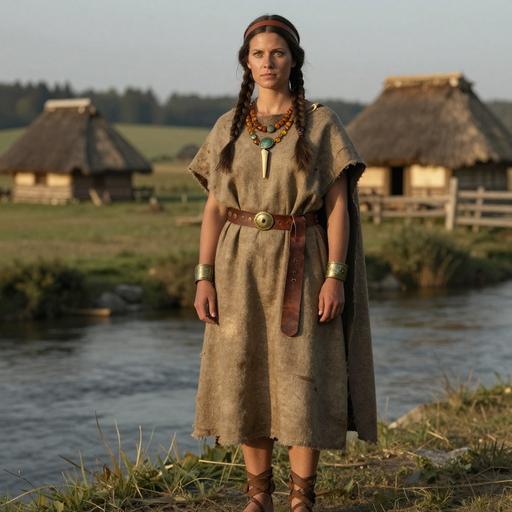
The Story
The journey of mtDNA haplogroup U5B2C4
Origins and Evolution
mtDNA haplogroup U5B2C4 is a terminal subclade of U5B2C, itself part of the broader U5b/U5 lineage that is one of the oldest and most characteristic maternal markers of European hunter-gatherer populations. The wider U5 clade arose in Europe during or shortly after the Last Glacial Maximum, and U5B2C4 is inferred to have diverged from its parent U5B2C in Western/Northern Europe during the early Holocene (~9 kya). Its phylogenetic position as a low-frequency, derived branch indicates a localized origin followed by long-term persistence rather than a large demographic expansion.
Subclades (if applicable)
As a named terminal clade (U5B2C4), no well-documented downstream subclades are widely reported in public databases; the lineage is currently represented by a very small number of modern and ancient mitogenomes. Because the clade is rare, additional sequencing of full mitogenomes from understudied populations could reveal further subdivisions, but at present U5B2C4 should be treated as a low-diversity terminal branch of U5B2C.
Geographical Distribution
Modern distribution: U5B2C4 occurs at low frequencies across Northern and Western Europe, including among some Saami and other northern indigenous groups, with sporadic detections in Central and Eastern Europe. Occasional low-frequency occurrences have been reported in the Caucasus/Anatolia and North Africa, likely reflecting complex, low-level gene flow events or later mobility.
Ancient DNA: The haplogroup is identified in a small number of ancient samples (the current database mentions one aDNA occurrence), consistent with a Mesolithic or early Holocene presence in Europe and subsequent survival at low levels in descendant populations.
Historical and Cultural Significance
U5 lineages are strongly associated with European Mesolithic hunter-gatherers (often described in population-genetic literature as Western Hunter-Gatherers, WHG). U5B2C4, as a derived branch, likely reflects this Mesolithic heritage and the continuity of maternal lineages in northern European refugia and postglacial recolonization routes. Its persistence into the historic period—albeit at low frequency—indicates maternal continuity through the Neolithic and later cultural transitions, sometimes appearing in contexts linked with later archaeological cultures at low incidence (for example, samples from Neolithic or post-Neolithic contexts may occasionally carry derived U5 lineages).
Because U5B2C4 is rare, it is not strongly tied to any single later archaeological culture such as Bell Beaker or Corded Ware; rather, its significance is as a genetic relic of pre-Neolithic European maternal ancestry that survived demographic turnovers and admixture events across millennia.
Conclusion
U5B2C4 represents a small, regionally rooted branch of the ancient European maternal tree. It is most informative for studies of Mesolithic continuity and localized maternal lineage persistence in northern and western Europe. Continued ancient and modern mitogenome sequencing—especially in under-sampled northern populations and archaeological contexts—will clarify its exact distribution, internal diversity, and any finer-scale substructure.
Key Points
- Origins and Evolution
- Subclades (if applicable)
- Geographical Distribution
- Historical and Cultural Significance
- Conclusion